

Reviewed · CITY TOURS
Barcelona: City Sightseeing Hop-On Hop-Off Bus Tour
Barcelona reveals itself in wide, satisfying layers from the top deck of this bus: Gaudi’s fanciful buildings, the Gothic Quarter, Montjuïc, the beaches, Sagrada Familia, and the far reaches of the city all fit into one useful sightseeing plan. I like the two-route coverage and the freedom to get off whenever a stop catches your eye. I also like the multilingual audio guide, which gives just enough context to make the city’s odd corners meaningful.
The catch is timing. The buses stop running from Stop 1 at 7pm, and a complete route takes about 120 minutes, so this works better as a flexible sightseeing tool than as a precise way to reach a dinner reservation. Park Güell also involves a steep walk from the bus stop.
In This Review
- Key points at a glance
- Why this bus makes sense in a spread-out city
- Red Route: Montjuïc, the waterfront, and Gaudi’s great church
- Red Route: beaches, Poblenou, and Sagrada Familia
- Blue Route: Gaudi, Tibidabo, and the western city
- How to plan one day without racing the clock
- Audio, seating, and the practical ride
- Price, value, and who should buy it
- My recommendation for different kinds of visitors
- Should you book the Barcelona hop-on hop-off bus?
- FAQ
- How long is the Barcelona hop-on hop-off ticket valid?
- How many routes and stops are included?
- What time do the buses operate?
- How often do the buses arrive?
- Is an audio guide included?
- Which languages are available for the audio guide?
- Are attraction admission tickets included?
- Can I use a mobile voucher?
- Is the tour available every day of the year?
Key points at a glance

- Two routes and 38 stops: The Red Route covers Montjuïc, the waterfront, beaches, Poblenou, Arc de Triomf, and Sagrada Familia. The Blue Route reaches Park Güell, Tibidabo, Pedralbes, and FC Barcelona.
- A 24-hour ticket can stretch across two calendar days: If you start in the afternoon, you can use it later that day and again the next morning, subject to the ticket’s 24-hour validity.
- The full loop takes about 120 minutes: Plan a few chosen stops rather than trying to thoroughly visit every attraction in one day.
- Audio comes in 16 languages: Spanish, Catalan, English, French, German, Italian, Portuguese, Chinese, Japanese, Russian, Dutch, Hebrew, Swedish, Arabic, Turkish, and Norwegian are available.
- Park Güell requires extra effort: The stop is not right at the entrance, and the uphill walk may be difficult for some people.
- The bus is most useful early in your stay: Use it to get your bearings, then return to the places that deserve more time.
Why this bus makes sense in a spread-out city
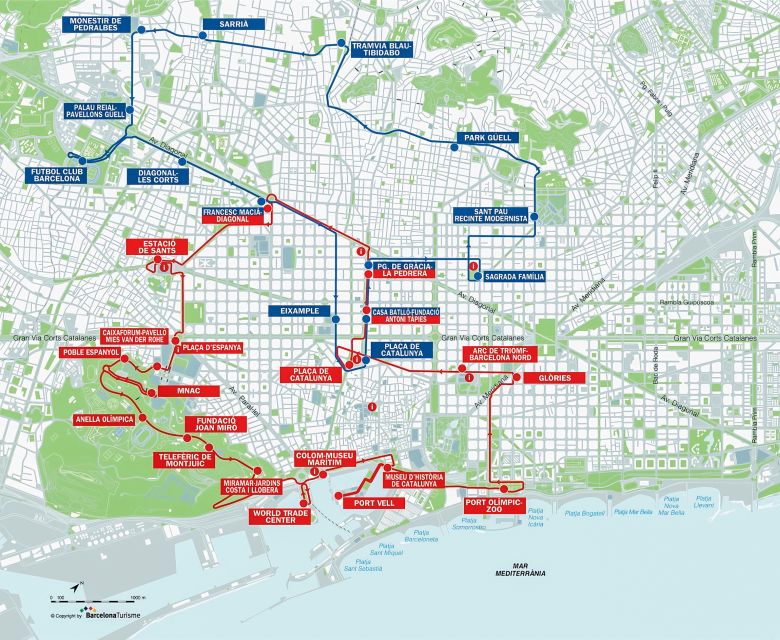
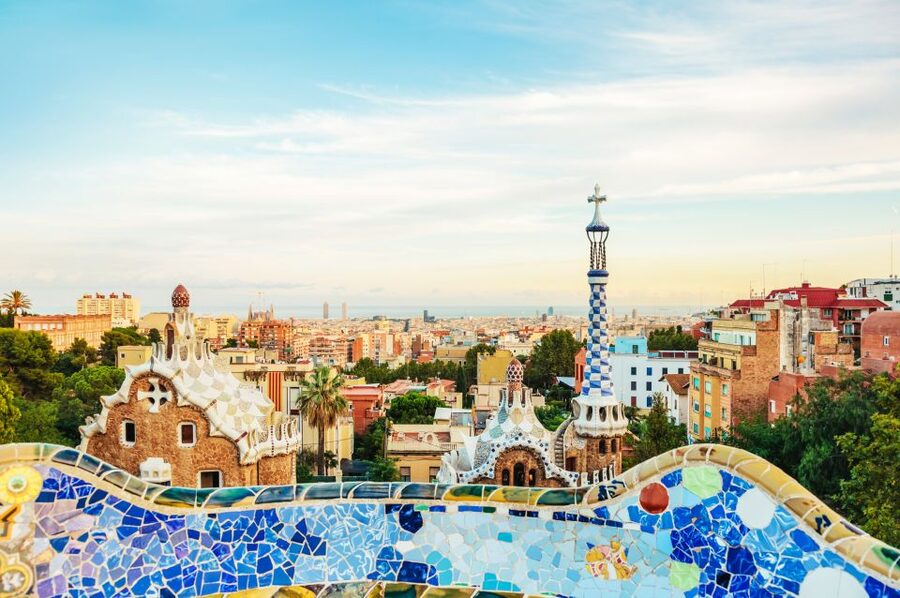
Barcelona is easy to explore on foot in small sections, but its major sights are not packed into one compact center. Sagrada Familia, Park Güell, Montjuïc, the Olympic area, the beaches, Pedralbes, and Camp Nou sit in different parts of town. The hop-on hop-off bus links them without requiring you to learn several metro connections on your first morning.
I like starting with a full ride, especially if you have only a day or two. The audio explains what you are seeing as the bus moves through the city, and the map helps you decide which places deserve a proper visit. The commentary is available in 16 languages and is generally informative without drowning you in dates.
The bus also cuts down on walking. That matters in Barcelona’s summer heat, with young children, or if someone in your party has limited mobility. The open upper deck gives you a fine view, though it can be hot in the sun and chilly in winter. Some buses have a roof that can close when rain begins, but air conditioning and Wi-Fi may vary from bus to bus.
More sightseeing bus options:
- Barcelona: 24 or 48-Hour Hop-On Hop-Off Bus Tour
★ 4.4 · 20,872 reviews - City Sightseeing Barcelona Hop-On Hop-Off Bus Tour: 24 or 48-Hour
★ 4.0 · 5,250 reviews - Barcelona City Tour Hop-On Hop-Off with Optional Boat
★ 4.0 · 3,012 reviews
Red Route: Montjuïc, the waterfront, and Gaudi’s great church
The Red Route is the better choice if you want Barcelona’s broadest mix of art, architecture, city views, and seaside stops. It begins at Plaça de Catalunya, a central starting point near La Rambla and the upper end of the Gothic Quarter.
The next stops include Casa Batlló and the Fundació Antoni Tàpies. Casa Batlló is one of Antoni Gaudi’s most playful apartment buildings, with a tiled facade and curved forms that look especially good from the bus. You can get off here for Passeig de Gràcia and continue on foot toward La Pedrera, another major Gaudi work covered by the Blue Route.
The Red Route then moves toward Sants and Plaça d’Espanya before climbing into the Montjuïc area. CaixaForum and the Mies van der Rohe Pavilion are good stops for modern art and architecture. Poble Espanyol presents a built-for-tourism version of Spanish regional architecture, so it is not an untouched old village, but it can be a convenient stop if you want shops, craft displays, and a compact cultural visit.
The Museu Nacional d’Art de Catalunya, the Olympic Ring, the Joan Miró Foundation, and the Montjuïc cable car area give this section real variety. You can use the bus as a way to survey Montjuïc, but you should choose your stop carefully. The hill contains several attractions, and seeing everything in one hop-on hop-off circuit is not realistic.
From Montjuïc, the bus heads down toward Miramar, the Costa i Llobera gardens, the World Trade Center, and the Columbus monument at the bottom of La Rambla. The Colom stop is handy for the waterfront, the lower end of La Rambla, and the Museu d’Història de Catalunya.
La Rambla is worth walking, but keep your expectations sensible. It is a famous pedestrian avenue lined with food stalls, shops, restaurants, and constant activity. It is a good connector between the port and Plaça de Catalunya, not a place to rush through while staring only at the pavement.
Red Route: beaches, Poblenou, and Sagrada Familia

The bus continues east along the port toward Port Olímpic and the beaches at Bogatell and Nova Mar Bella. These stops show a different Barcelona, one shaped by the city’s Olympic redevelopment and its long seafront. If you want a break from churches and museums, get off near the beach and walk before catching a later bus.
The Forum, Diagonal Mar, Poblenou, and Torre Glòries reveal the newer side of the city. Poblenou combines older industrial traces with newer development, while Torre Glòries provides one of Barcelona’s most recognizable modern silhouettes. This part of the route is less rewarding if your only goal is medieval streets and Gaudi, but it helps you understand how large Barcelona really is.
The Sagrada Familia stop is one of the busiest on the entire network. It is a practical place to get off for the basilica, but do not assume that a bus ticket includes entry. Attraction tickets are not included, and timed admission to major sights must be arranged separately.
The church is Gaudi’s most famous work and one of Barcelona’s essential visits. The exterior alone rewards a slow look, with towers, sculpture, and changing surfaces that are hard to take in from a moving bus. Allow proper time if you enter, since a quick photo stop does not do the building justice.
There is a useful photo area behind Sagrada Familia, and the bus stop is well placed for seeing the church from different angles. It can be less clear how to find the stop when you are ready to leave, so keep the printed map or phone voucher available and check the stop signs before walking away.
The Red Route finishes its major circuit through Arc de Triomf and returns toward the center. The stop is close to the broad pedestrian promenade leading to Parc de la Ciutadella. It is also a short walk from the Gothic Quarter and the Picasso Museum, though the museum itself is not included in your ticket.
Blue Route: Gaudi, Tibidabo, and the western city
The Blue Route is shorter in feel but important if Park Güell, FC Barcelona, or the elegant western districts are on your list. It begins at Plaça de Catalunya and passes Casa Batlló before reaching Passeig de Gràcia and La Pedrera.
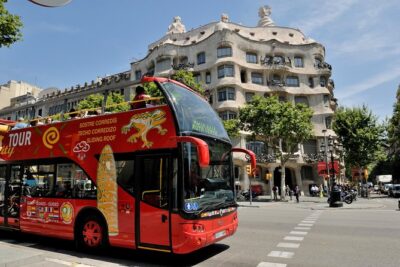
La Pedrera, also called Casa Milà, is another Gaudi landmark. Its undulating stone facade and unusual rooftop make it a natural companion to Casa Batlló. If you plan to visit both, note that they are separate attractions with separate admission costs.
Next comes the Sant Pau Recinte Modernista, a superb stop for anyone interested in architecture. This former hospital complex is one of the city’s notable modernist sites and offers a quieter alternative to the packed area around Sagrada Familia.
Park Güell is the route’s headline stop. The park is closely tied to Gaadi’s imagination, with tiled surfaces, winding forms, and city views. The important practical point is the walk. The bus does not drop you directly at the main entrance, and the route from the stop is steep. If hills are a concern, plan extra time and energy rather than treating this as a quick hop-off.
The bus then reaches Tramvia Blau and Tibidabo, followed by Sarrià and the Monestir de Pedralbes. This section takes you beyond the usual central circuit. Pedralbes gives you a calmer look at Barcelona, while Tibidabo points toward the high ground above the city.
The route continues through Palau Reial, the Güell Pavilions, and the FC Barcelona stop. Football fans will want to check the current stadium situation before planning the visit, since the bus ticket covers transportation only, not admission or any attraction experience.
The final Blue Route stops pass through Diagonal, Les Corts, Francesc Macià, Eixample, and Sant Antoni. This is useful for seeing the city’s planned grid and for reaching areas where you might choose a restaurant or hotel. It is not the route to choose if you want a nonstop sequence of headline monuments, but it fills in the city between them.
A few more Barcelona options worth an hour of your trip
- Barcelona: Park Güell Admission Ticket
★ 4.4 · 76,534 reviews - Barcelona: Casa Batlló Entry with Self-Audioguide Tour
★ 4.7 · 25,359 reviews - Barcelona: Park Guell Guided Tour with Skip The Line Entry
★ 4.7 · 17,563 reviews - Barcelona in 1 Day: Sagrada Familia, Park Guell,Old Town & Pickup
★ 5.0 · 13,541 reviews
How to plan one day without racing the clock
The full loop takes around two hours, and buses are scheduled about every 20 minutes. In busy periods, the operator says specially branded buses may arrive more often, but you should still leave room for a crowded bus, a missed connection, or a stop where the first bus is full.
For one day, I would not attempt all 38 stops. Start with the Blue Route for Sagrada Familia, Sant Pau, Park Güell, and the western districts, then use the Red Route for Montjuïc, La Rambla, the port, beaches, and the waterfront. That gives you a broad view, but only if you keep your actual visits selective.
A better plan is to choose three or four major stops. For example:
- Sagrada Familia and Sant Pau in the morning
- Park Güell after lunch, with extra time for the uphill walk
- Montjuïc or La Rambla in the afternoon
- The waterfront or Arc de Triomf if time remains
If you start after lunch, your 24-hour ticket may be useful the following morning. Several visitors make the mistake of treating 24 hours as one calendar day. It is a rolling 24-hour period from first use, so an afternoon start can be quite practical.
The 48-hour ticket is most useful if you want to use the bus as both sightseeing and transportation. It must be used on consecutive days, so do not buy it expecting to spread the rides across separate parts of a longer trip.
Audio, seating, and the practical ride
You receive headphones on site, though you can bring your own. The audio is a useful middle ground: more helpful than riding in silence, but not a substitute for a private guide. It gives background while you are moving, then lets you explore independently once you get off.
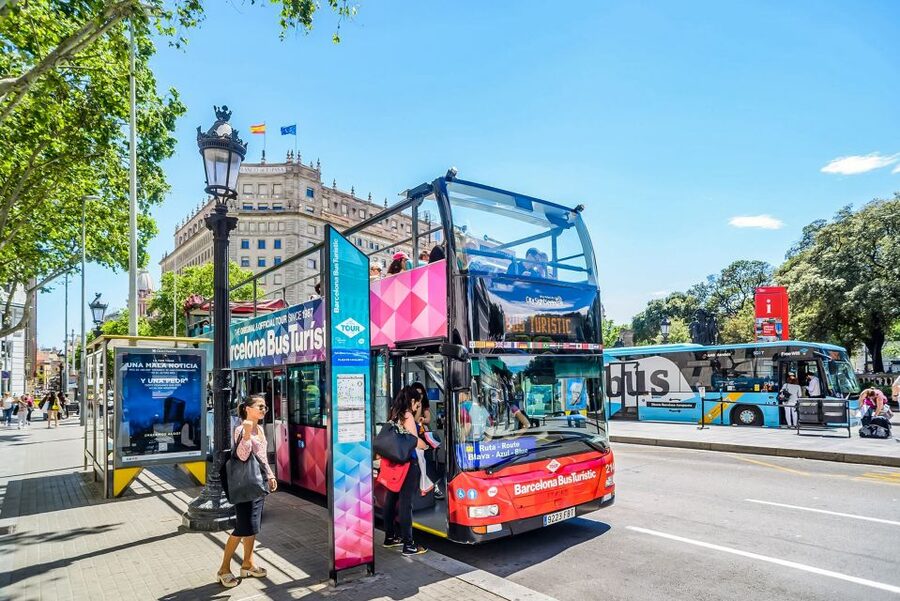
The buses are branded Barcelona Bus Turistic, which makes them easier to identify at street stops. A city map is included, along with a discount booklet for selected attractions, food, and shopping. Treat the booklet as a small bonus rather than the reason to buy the ticket.
The upper deck is the best place for photos and views, but it is exposed to sun, wind, and rain. In summer, the breeze can help, but the heat can still be strong. In December, bring an extra layer. If you need to sit downstairs, you will lose some of the open-air view but gain shelter.
Give yourself time to get seated before the bus moves. A short stop may not leave much time to climb to the upper deck, especially when boarding with children or luggage. At Sagrada Familia and other popular stops, the first arriving bus may be full.
Price, value, and who should buy it
At about $39 per person, the ticket is not the cheapest way to move around Barcelona. The metro and regular city buses can cost less for point-to-point transportation, and they may be faster when you already know exactly where you are going.
The value here comes from combining transport, orientation, and commentary. If you use both routes, get off at several places, and avoid separate taxis between distant districts, the price becomes easier to justify. It is also useful for families, older adults, and anyone who wants to reduce long walks.
I would not buy it simply to reach one attraction. A regular public bus or metro ticket may be more efficient for that. I would buy it during a first visit when Barcelona’s major sights are scattered across your itinerary and you want a simple way to compare neighborhoods before committing to longer visits.
The tour runs most of the year, except January 1 and December 25. Buses normally begin at Stop 1 at 9am, with the last departure from Stop 1 at 7pm. That last detail matters: the service does not necessarily carry you back to your starting point after 7pm. Plan your final stop with your evening route in mind.
Mobile and printed vouchers are accepted, and cancellation is available up to 24 hours before the activity for a full refund. The ticket also offers flexible access for up to three months from the selected travel date at checkout, subject to availability.
My recommendation for different kinds of visitors

I recommend this bus most strongly for first-time visitors, families with children, people who dislike complicated transfers, and anyone who wants a city overview with limited walking. It is also a sensible choice for a short stay, since you can see the character of many districts without spending the whole day underground.
It suits independent sightseers who want commentary but do not want to follow a fixed walking group. You decide when to get off, how long to stay, and which places deserve your time.
I would be more cautious if you are visiting Barcelona for several days and already know the metro system. In that case, the bus may feel slow, especially when traffic stretches the ride between stops. It is also not ideal for a tightly scheduled day of timed museum entries.
Should you book the Barcelona hop-on hop-off bus?
Book it if you want a relaxed overview of Barcelona, plan to use both the Red and Blue Routes, and value seeing the city from above while someone explains what you are passing. Start early, select only a few stops, and use the 24-hour ticket across two parts of your itinerary when possible.
Skip it if your plan is built around one or two fixed attractions or if you need the fastest possible transport. For most first visits, though, the combination of Sagrada Familia, Park Güell, Montjuïc, the waterfront, beaches, Gothic Quarter access, and FC Barcelona makes this a practical introduction to a large and wonderfully eccentric city.
FAQ
How long is the Barcelona hop-on hop-off ticket valid?
You can choose a 24-hour or 48-hour ticket. The 48-hour ticket must be used on consecutive days.
How many routes and stops are included?
The tour includes two routes with a total of 38 stops. You can use both the Red and Blue Routes with your ticket.
What time do the buses operate?
The first bus departs from Stop 1 at 9am, and the last bus departs from Stop 1 at 7pm. The complete tour duration is about 120 minutes.
How often do the buses arrive?
The scheduled frequency is about every 20 minutes. During high season, the operator says exclusive buses may run every five minutes.
Is an audio guide included?
Yes. Audio commentary and headphones are included. You can also bring your own headphones.
Which languages are available for the audio guide?
The audio guide is available in Spanish, Catalan, Chinese, English, French, German, Italian, Japanese, Portuguese, Russian, Dutch, Hebrew, Swedish, Arabic, Turkish, and Norwegian.
Are attraction admission tickets included?
No. The bus ticket does not include admission to attractions, food, or drinks.
Can I use a mobile voucher?
Yes. Mobile and printed paper vouchers are accepted.
Is the tour available every day of the year?
The tour operates year-round except January 1 and December 25. You should check availability for your selected date before booking.
Just added around Barcelona
- GoCar Full Day Tour★ 4.0 · 6 reviews
- Sagrada Familia and Barcelona Highlights: Private Guided 4-Hour Driving Tour★ 5.0 · 6 reviews
- Barcelona: Highlights & Gems Private Tour with Tapa & Drink★ 3.9 · 6 reviews
- Gothic Quarter and Born District: Photographic Workshop★ 5.0 · 6 reviews
- Gobbi Yacht Rental in Barcelona 9 Pax 2/4/8hs★ 5.0 · 6 reviews
- Barcelona: Gothic Quarter & La Sagrada Familia Private Tour★ 4.9 · 6 reviews
- Private Sailboat Ride at Sunset from Sitges★ 5.0 · 6 reviews
- Barcelona: Private Tour of Casa Batllo with Reserved Access★ 3.5 · 6 reviews
City Tours, compared.
Barcelona City Tour Hop-On Hop-Off with Optional Boat
Read our review →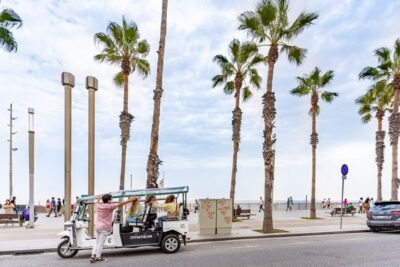

Flamenco Show Ticket at Theatre Barcelona City Hall
Read our review →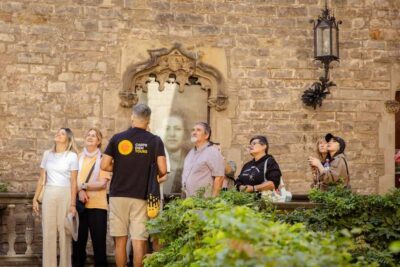
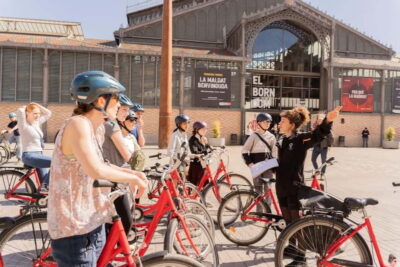
Sagrada Familia or Coastal City Sights by eBike
Read our review →
Go City Explorer Pass – Choose 2 to 4 Attractions
Read our review →
Browse the lists this tour appears in