
Reviewed · CITY TOURS
Barcelona Urban Planning Tour – Towards a Sustainable Smart City
Barcelona’s most interesting sights are not always monuments. This private tour follows the city’s experiment with superblocks, traffic reduction, and new public space, showing how streets can change the way a city works. You move from the old town to Sant Antoni, Eixample, and the former industrial zone of Glòries.
I like the way the route connects Barcelona’s past with its future, rather than treating urban design as an abstract lecture. I also like the private format, which gives you a better chance to ask about government choices, architecture, and daily life. The main catch is the price, $210.28 per person, and the fact that bicycle use is not included.
In This Review
- Key points to know
- Why this tour looks at Barcelona differently
- Starting at El Gato de Botero in the Raval
- Sant Antoni and the superblock idea
- Consell de Cent and the new Eixample street
- Glòries and the 22@ innovation district
- Walking or arranging an eBike
- Is $210.28 a fair price?
- Who will get the most from this experience?
- Practical details before you reserve
- Should you book Barcelona’s urban planning tour?
- FAQ
- Where does the Barcelona urban planning tour begin?
- Where does the tour end?
- How long does the tour last?
- Is the tour offered in English?
- Is this a private tour?
- What is included in the price?
- Is bicycle use included?
- How can I rent an eBike?
- Are admission tickets required at the stops?
- Can I cancel for a full refund?
Key points to know
- Four very different districts: Start in the historic Raval, then see Sant Antoni, Eixample, and the 22@ district.
- Superblocks in real life: The Sant Antoni stop shows how Barcelona reduces through traffic and returns space to local streets.
- A changing Eixample: Spend about 30 minutes along Consell de Cent, a newly traffic-reduced or traffic-free axis.
- Barcelona’s innovation district: Glòries introduces the 22@ zone, where old industrial land has been adapted for startups and new activity.
- Private English-language format: Only your group takes part, with an expert guide.
- Bike costs extra: An eBike can be rented and paid for through the RideMovi application.
Why this tour looks at Barcelona differently
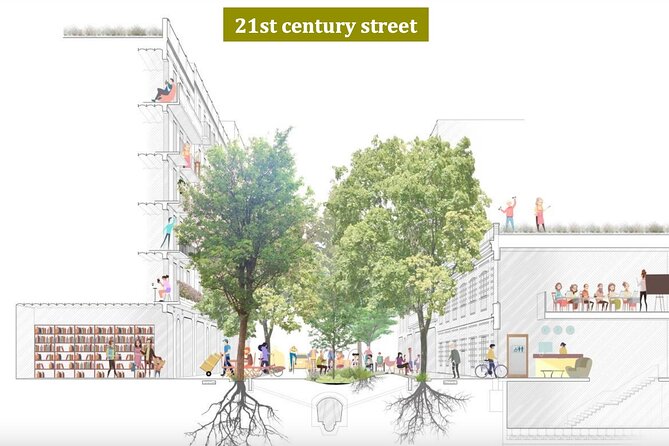
This experience is for you if Barcelona’s street plan interests you as much as its churches and markets. You will not simply pass through neighborhoods. You will look at why streets were built in certain ways, how traffic affects public space, and what the city is trying to change.
The route is useful because each stop offers a different chapter. The Raval supplies the old-town setting. Sant Antoni shows the superblock idea in a lived-in neighborhood. Eixample gives you a clear example of a street being redesigned. Glòries then shifts the story toward technology, business, and former industrial land.
You get an expert guide throughout, and the activity is private. That matters here. Urban planning can raise practical questions that do not fit a fixed group script. You may want to ask about cars, bicycles, housing, business access, or how residents respond to street changes. A private group makes those questions easier.
The experience lasts about two to four hours. That is a fairly wide time range, so your exact pace may depend on the guide, transport choice, and how much discussion your group wants. Plan it as a focused half-day activity rather than a quick sightseeing stop.
A few more Barcelona options worth an hour of your trip
- Barcelona: Park Güell Admission Ticket
★ 4.4 · 76,534 reviews - Barcelona: Casa Batlló Entry with Self-Audioguide Tour
★ 4.7 · 25,359 reviews - Barcelona: 24 or 48-Hour Hop-On Hop-Off Bus Tour
★ 4.4 · 20,872 reviews
Starting at El Gato de Botero in the Raval
The tour begins at El Gato de Botero on Rambla del Raval, in Ciutat Vella. This is a good starting point for a discussion about Barcelona before its modern planning projects took shape.
You spend about 20 minutes here, with no admission ticket required. The focus is the historic situation of the old town. That gives you a useful baseline: dense streets, older urban patterns, and the pressures faced by a major city trying to improve daily life without losing its character.
The Raval is not presented simply as a photo stop. It sets up the central question of the experience: how can Barcelona make older, crowded districts more liveable? You will likely get more from this opening if you pay attention to the contrast between the old urban fabric and the newer ideas introduced later.
There is no entrance fee, but the value comes from the explanation. Without a guide, you might walk through the Raval and see only a busy old-town neighborhood. With the planning angle, the first stop becomes a way to understand why later projects matter.
Sant Antoni and the superblock idea
The second stop is Sant Antoni, where you spend about 15 minutes looking at a neighborhood with a superblock. This is one of the clearest parts of the tour for anyone who wants to understand Barcelona’s approach to traffic.
A superblock groups several ordinary city blocks into a larger zone where through traffic is reduced. The point is not simply to close every street to cars. It is to change which streets carry traffic and create calmer space within the block group.
You should expect this stop to be short but important. The guide can connect the street layout to the wider question of who gets priority in a city: cars passing through, people walking, residents, cyclists, or businesses needing access.
This is also where the tour becomes practical. You are not studying a plan on paper. You are seeing how a planning idea appears in a working neighborhood. The supplied information does not promise a particular facility or feature at the stop, so I would come ready to observe rather than expecting a formal exhibition.
The limited time is the one drawback. Fifteen minutes is enough for an introduction, but not for a long discussion about every benefit and criticism of superblocks. If this subject matters to you, use the private format to ask focused questions.
Consell de Cent and the new Eixample street
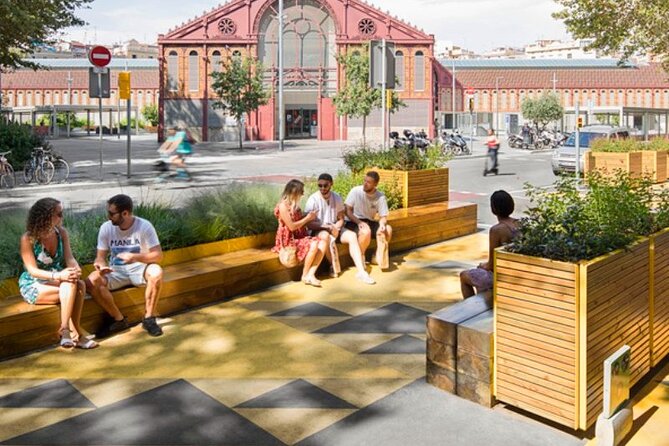
The longest central stop is in Eixample, along Consell de Cent. You spend about 30 minutes on this newly traffic-reduced or traffic-free axis that crosses Barcelona.
Eixample is especially helpful for understanding how a planned district can be adjusted over time. The street structure is already there, but the city is changing how some of that space works. Consell de Cent gives you a direct example of traffic reduction rather than a general talk about sustainability.
I like this section because it lets you compare the original purpose of a street with its newer role. A traffic-reduced axis can affect noise, movement, public space, and the feel of a neighborhood. The guide can also explain how such changes fit into Barcelona’s larger smart-city goals.
The wording traffic reduced or free suggests that conditions may vary along the route, so do not expect every part of Consell de Cent to function in exactly the same way. Still, this is likely the best stop for seeing a visible street intervention and asking how it changes everyday urban movement.
Architecture also gets more attention here. One past participant described learning about the history of architecture while walking through the city, and that is a useful way to approach this section. Look beyond the road surface. Notice how the street sits within the Eixample plan and how new traffic choices interact with the older buildings around it.
Same corner of Catalonia, a completely different day:
- Barcelona: Park Guell Guided Tour with Skip The Line Entry
★ 4.7 · 17,563 reviews - Barcelona in 1 Day: Sagrada Familia, Park Guell,Old Town & Pickup
★ 5.0 · 13,541 reviews - Barcelona Aquarium: Entry Ticket
★ 4.3 · 13,335 reviews - Barcelona: Sagrada Familia Skip-the-Line Entry Ticket & Tour
★ 4.8 · 12,789 reviews
Glòries and the 22@ innovation district
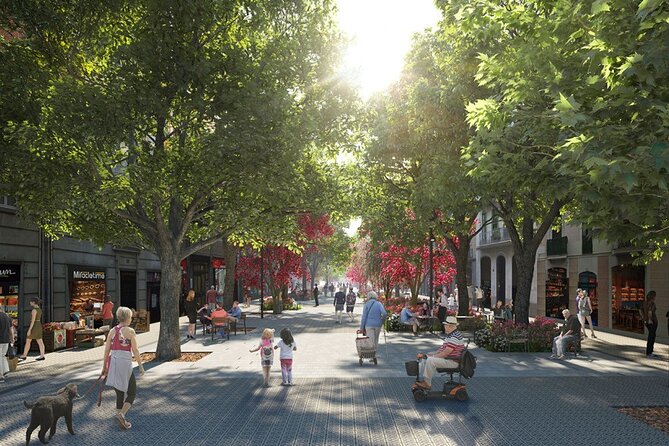
The final major stop is Glòries, where the tour turns to the 22@ district. You spend about 30 minutes in an area that was formerly industrial and is now associated with startups and innovation.
This part widens the discussion. The earlier stops focus mainly on streets and public space. Glòries asks what happens when a city converts former industrial land into a district linked to new businesses and technology.
The term smart city can sound vague, but this stop gives it a physical setting. You can consider how a district is planned for work, business, transport, and new development. The supplied details do not specify individual companies, buildings, or technology demonstrations, so the emphasis is on the district’s urban role rather than a list of named attractions.
For me, this is a strong finish because it shows that sustainability is not only about planting trees or limiting cars. It can also involve how a city uses old industrial zones, supports new economic activity, and connects changing parts of Barcelona.
The endpoint is El Parc i la Llacuna del Poblenou in Sant Martí. That means the tour finishes away from its Raval starting point, giving you a useful sense of movement across the city. You should plan your next activity from the Poblenou area rather than assuming you will return to Ciutat Vella.
Walking or arranging an eBike
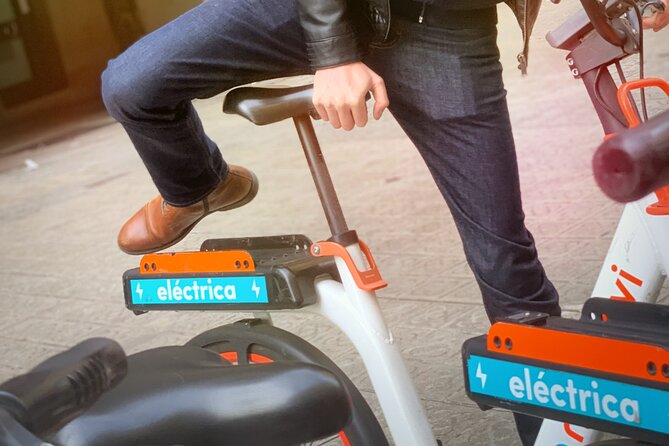
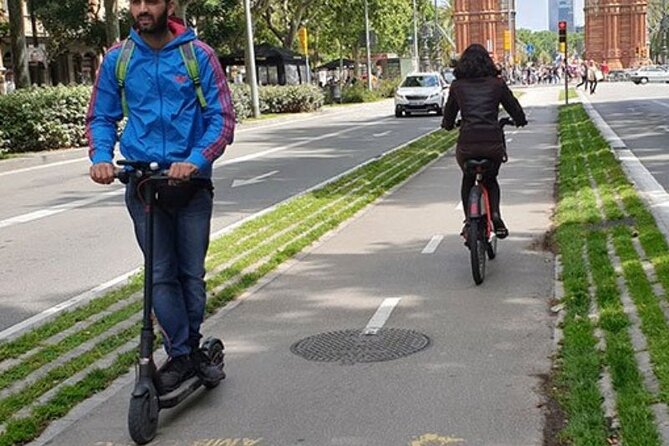
Bicycle use is not included in the $210.28 price. An eBike can be rented separately and paid for through the RideMovi application.
That detail matters because the experience appears suited to movement between several districts, and one past account describes discovering Barcelona by bike. Another describes the route as a bike route and mentions Yannis as a friendly and considerate driver of the experience. Onno is also named as a strong guide who helped explain city planning and government.
Those names may not guarantee who leads your departure, so confirm the guide and transport arrangement when booking. The official details only promise an expert guide and state that bicycle use is extra.
If you choose the bicycle option, remember to budget for the rental and make sure you can use the RideMovi application. If you prefer not to arrange an eBike, ask how the tour will be conducted for your group. The data describes the tour duration and stops, but it does not specify a fixed walking distance or a standard bicycle included with every booking.
The route’s private nature helps here. Your group can clarify the pace and transport plan instead of being tied to a large public departure. Still, do not assume the rental cost is hidden inside the tour fee.
Is $210.28 a fair price?
At $210.28 per person, this is not a bargain city walk. The value depends heavily on your interest in planning and on the number of people in your private group.
For one person or a couple, the price is a serious splurge. You are paying for a specialized subject, a private format, and an expert guide rather than admission tickets. All four stops are free, so the fee is about interpretation and organization, not access to paid sights.
For a larger group using the group discount, the calculation may look better. A private tour can also be worthwhile if you are studying architecture, sustainability, transportation, public policy, or city design. You receive a connected explanation across four districts instead of piecing together isolated facts.
I would not book this simply because you have a spare morning in Barcelona. The subject needs to interest you. If it does, the tour offers a kind of access that a standard monument tour cannot: a way to read streets, traffic patterns, and redevelopment choices.
The average booking lead time is 81 days. That suggests you should reserve early if your dates are fixed, especially since the activity is private. Free cancellation is available up to 24 hours before the start time, but changes or cancellations inside that window are not accepted for a refund.
Who will get the most from this experience?

You are a good match for this tour if you enjoy seeing how cities function. It suits architecture students, planning professionals, sustainability-minded visitors, and anyone who has wondered why Barcelona keeps changing the way its streets are used.
It also works for repeat visitors. If you have already seen the major Gaudí sites and want a different side of the city, this route gives you a fresh subject without adding admission fees.
Families and mixed-interest groups may find the private format helpful, but the experience is discussion-based. It is not designed as a conventional attraction tour with a constant parade of famous sights. Children or companions who need nonstop visual highlights may find the planning subject less engaging.
Most people can participate, and the meeting points are near public transportation. Still, the route takes you from the Raval to Sant Martí, so confirm the physical demands and transport arrangement if anyone in your group has mobility concerns. Specific accessibility details are not provided.
Practical details before you reserve
You meet at El Gato de Botero, Rambla del Raval, in Ciutat Vella. The tour ends at El Parc i la Llacuna del Poblenou in Sant Martí. These are different parts of Barcelona, so allow time to reach the starting point and plan your onward route from the endpoint.
The activity is offered in English and includes an expert guide. Only your group participates, which is one of its strongest practical features.
Confirmation arrives at booking, and the meeting area is near public transportation. The duration is approximately two to four hours. Because the range is broad, ask about the expected length for your chosen date and whether your group will walk, cycle, or use an eBike.
The route visits public urban areas, and admission tickets are free at each listed stop. The extra cost to watch is bicycle rental through RideMovi. Bring a phone suitable for the application if you plan to rent an eBike, and do not count on the tour price covering it.
Should you book Barcelona’s urban planning tour?
Book it if you want to understand Barcelona beyond its famous buildings. The strongest parts are the clear progression from old-town problems to superblocks, traffic reduction, and the redevelopment of industrial land. The private English-language format also gives you room to ask direct questions.
Skip it if you want a classic sightseeing tour, a low-cost walk, or a route centered on major monuments. The $210.28 price is easiest to justify for a private group with a real interest in cities, architecture, government, or sustainability.
For the right person, this is a smart use of a half-day. You finish not just knowing more about four neighborhoods, but seeing Barcelona as an ongoing experiment in how streets and districts can serve people.
FAQ
Where does the Barcelona urban planning tour begin?
The tour begins at El Gato de Botero, Rambla del Raval, s/n, Ciutat Vella, 08001 Barcelona, Spain.
Where does the tour end?
It ends at El Parc i la Llacuna del Poblenou in the Sant Martí area of Barcelona.
How long does the tour last?
The stated duration is approximately two to four hours.
Is the tour offered in English?
Yes. The experience is offered in English.
Is this a private tour?
Yes. Only your group participates in the activity.
What is included in the price?
An expert guide is included.
Is bicycle use included?
No. Bicycle use is not included in the price.
How can I rent an eBike?
An eBike can be rented separately and paid for through the RideMovi application.
Are admission tickets required at the stops?
No admission tickets are listed for Rambla del Raval, Sant Antoni, Eixample, or Glòries.
Can I cancel for a full refund?
Yes, if you cancel at least 24 hours before the experience start time. Cancellations or changes made less than 24 hours before the start time are not accepted for a refund.
Just added around Barcelona
- GoCar Full Day Tour★ 4.0 · 6 reviews
- Sagrada Familia and Barcelona Highlights: Private Guided 4-Hour Driving Tour★ 5.0 · 6 reviews
- Gobbi Yacht Rental in Barcelona 9 Pax 2/4/8hs★ 5.0 · 6 reviews
- Barcelona: Highlights & Gems Private Tour with Tapa & Drink★ 3.9 · 6 reviews
- Gothic Quarter and Born District: Photographic Workshop★ 5.0 · 6 reviews
- Barcelona: Gothic Quarter & La Sagrada Familia Private Tour★ 4.9 · 6 reviews
- Private Sailboat Ride at Sunset from Sitges★ 5.0 · 6 reviews
- Barcelona: Private Tour of Casa Batllo with Reserved Access★ 3.5 · 6 reviews
City Tours, compared.
Barcelona City Tour Hop-On Hop-Off with Optional Boat
Read our review →

Flamenco Show Ticket at Theatre Barcelona City Hall
Read our review →
Sagrada Familia or Coastal City Sights by eBike
Read our review →
Go City Explorer Pass – Choose 2 to 4 Attractions
Read our review →
Browse the lists this tour appears in