
Reviewed · MUSEUMS
Girona Film Museum – Entrance
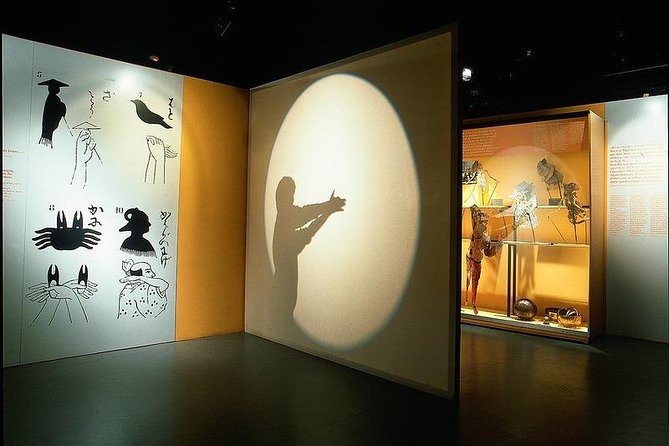
Girona’s Cinema Museum turns the birth of film into a hands-on story. You begin with early attempts to capture light and movement, then follow the path through shadow plays, magic lanterns, optical toys, motion pictures, and television. The subject sounds technical, but the displays keep it lively.
I like the interactive exhibits, especially the chance to experiment with old visual effects rather than simply stare at glass cases. I also like the clear route through about 500 years of image-making, which gives the visit a strong sense of progress.
The main consideration is time. You can walk through in about an hour, but the short films, audio material, and hands-on displays can easily stretch the visit to two hours or more. If cinema history does not interest you, some of the technical detail may feel slow.
In This Review
- Key points at a glance
- Girona’s museum of moving images
- Begin with the introductory film
- Shadow play, magic lanterns, and the road to film
- From optical tricks to motion pictures
- What makes the displays work
- How long should you spend inside?
- Is $8.40 good value?
- Access, transport, and practical details
- Who will enjoy this museum most?
- A smart place to fit into your Girona day
- Should you book the Girona Film Museum?
- FAQ
- Where is the Girona Film Museum located?
- How much does admission cost?
- How long does a visit take?
- Is the ticket offered in English?
- What does the museum cover?
- Is the museum accessible for people with mobility issues?
- Can I cancel for a refund?
Key points at a glance
- Five centuries of moving images: Follow the story from shadow play and magic lanterns to film and television.
- Interactive magic lantern displays: Digital and hands-on elements help explain how early image projection worked.
- A short film starts the visit: The introduction sets up the museum’s main themes before you explore the collection.
- Historic equipment from the Tomàs Mallol collection: See rare pre-cinema instruments and early film objects in one place.
- Good value at $8.40: The low admission price makes a one-hour stop easy to justify, with enough material for a longer visit.
- Easy for many visitors: The museum is near public transportation, service animals are allowed, and lifts reach the different levels.
Girona’s museum of moving images
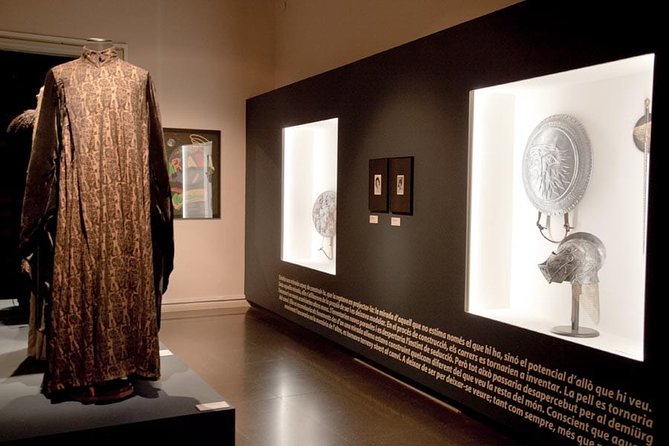
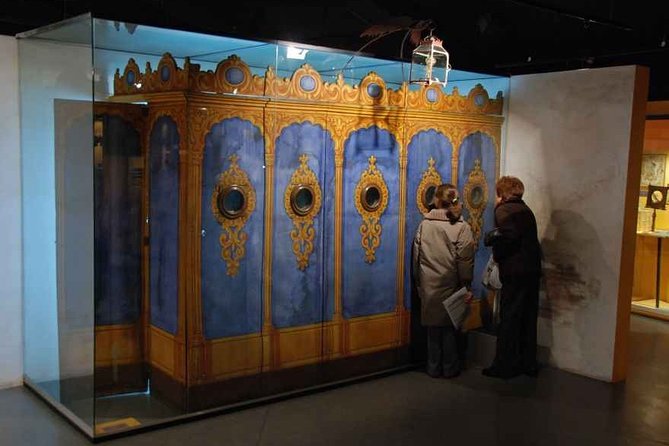
The Cinema Museum Girona, or Museu del Cinema, is not mainly about famous actors, Hollywood costumes, or movie posters. Its subject is more basic and more interesting: how people learned to create the illusion of movement.
That makes this a useful stop even if you are not a film expert. You see how image-makers worked before cinema existed, and how simple visual tricks gradually became projected pictures and motion pictures.
The museum was inaugurated in 1998 inside the former Casa de les Aigües. Its collection is linked to Tomàs Mallol, whose historic equipment forms the backbone of the displays. The result is a museum about invention, curiosity, and the human desire to make still images move.
I appreciate this approach because it explains cinema as a process rather than presenting it as a sudden invention. The first film camera makes more sense after you have seen the earlier tools and ideas that led toward it.
More Girona days from Girona:
- Girona & Costa Brava Small-Group Tour with Pickup from Barcelona
★ 5.0 · 6,955 reviews - Montserrat, Girona & Costa Brava Guided Day Trip from Barcelona
★ 5.0 · 5,128 reviews - Girona & Dali Museum Small Group Tour with Pick-up from Barcelona
★ 5.0 · 2,965 reviews
Begin with the introductory film
Your visit starts with a short introductory film. It gives you the basic idea of what follows: the long human fascination with light, images, movement, and spectacle.
This opening is useful because the collection covers a large span of time. Without some orientation, early projection devices can seem like a jumble of unfamiliar boxes, lenses, discs, and painted images. The film gives you a simple framework before you start looking closely.
After the introduction, the museum route takes you through the collection in historical order. One practical way to handle the building is to take the lift to the upper level and then work your way down through the displays. That arrangement helps the story move from earlier image techniques toward cinema and television.
Allow at least an hour for a basic visit. If you stop for the video clips, try the interactive displays, and listen to the audio material, plan closer to two hours. One particularly interested family spent a little more than two hours, and a film or theater student would have plenty to examine.
Shadow play, magic lanterns, and the road to film
The early sections are the museum’s strongest feature. They show that cinema did not appear out of nowhere. Long before movie theaters, people were projecting images, changing pictures, and creating visual illusions for an audience.
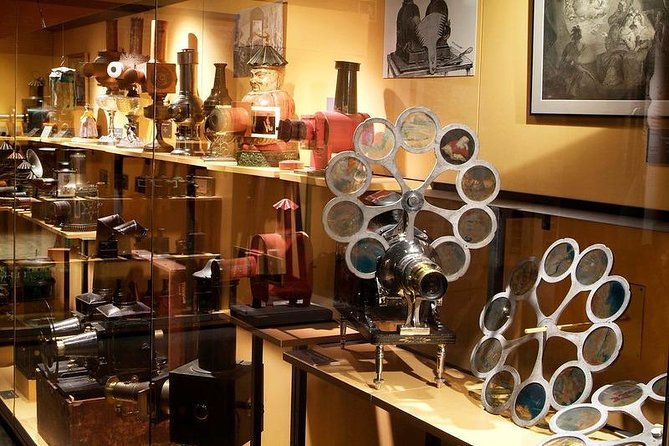
You might see examples connected with shadow play and magic lantern projection, along with other pre-motion-picture instruments. These objects explain how light, lenses, painted glass, and mechanical movement were combined to create an experience that felt almost magical to an audience of the time.
The magic lantern collection is especially important. Historic lanterns can look like simple cabinets, but the interactive displays show what they did. Digital versions of lantern images let you understand how a projected picture could change, move, or surprise the viewer.
This is where the museum becomes more than a collection of old equipment. You get a chance to understand the viewer’s role. Early image shows depended on darkness, timing, a skilled operator, and an audience ready to believe in the illusion.
I would give this section extra time. It is the part most likely to interest both serious film students and families who want something children can actually do. The displays explain techniques without requiring a background in film history.
From optical tricks to motion pictures
As you continue, the museum traces the shift from individual projected images to the first moving pictures. The change is not presented as one dramatic moment. Instead, you see how many small inventions and experiments helped create modern cinema.
The collection includes equipment and objects from the pioneers of animation and early motion pictures. Short video clips help connect the machinery with the images it produced. This matters because old projectors and cameras can be hard to understand from their shape alone.
The museum also looks at the spectator. That is a worthwhile angle. Cinema is not only about cameras and projectors. It is also about the room, the audience, the act of watching, and the social experience built around a screen.
Several short films appear throughout the visit. They give your eyes a break from labels and cases, and they show the results of the techniques explained nearby. If you are reading every panel, these clips will add time to your visit, but they also make the collection easier to follow.
The material continues into the early development of cinema and then toward the arrival of television, reaching roughly the 1970s. The final sections help connect the old devices with the moving-image culture you already know.
More museums and sites in Girona:
- From Barcelona: Girona, Figueres, Dalí Museum, and Cadaqués
★ 4.7 · 1,928 reviews - From Barcelona: Girona and Dalí Museum Small-group Day Tour
★ 4.7 · 1,592 reviews - Girona and Dali Museum Full Day tour from Barcelona
★ 4.5 · 996 reviews - From Barcelona: Girona Guided Tour & Dalí Museum in Figueres
★ 4.5 · 339 reviews
What makes the displays work
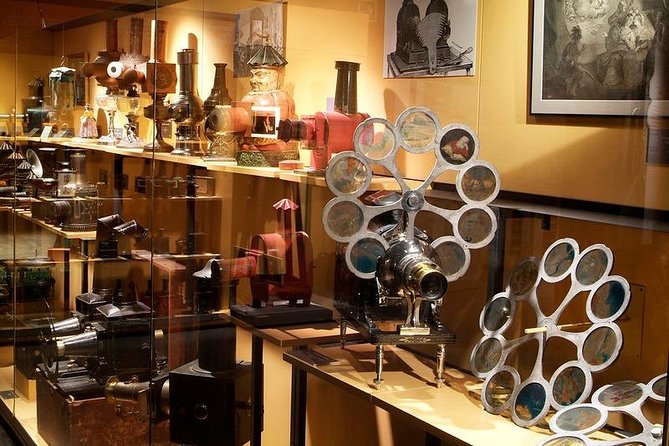
The museum’s best displays ask you to test an idea. Instead of simply explaining persistence of vision or projection, they show how an image can change when a mechanism moves or when separate frames are viewed in sequence.
That hands-on approach is valuable for children and teenagers, but adults benefit from it too. A technical explanation can seem abstract until you see the image flicker, rotate, appear, or shift in front of you.
The audio guide adds another layer. It is described as included with the admission, and it provides extra explanation as you move through the collection. The amount of time you need will depend on how closely you listen, so the audio option is useful for a focused visit but not essential if you are in a hurry.
The displays are clearly arranged, with plenty of visual material and short films. I would not treat this as a museum you rush through between major sights. Its pleasure comes from noticing how one technique leads to another.
How long should you spend inside?
The advertised visit can take from one to five hours, which is a wide range but understandable for this museum.
For a quick look, one hour is enough to see the main stages and several important objects. This works well if you are leaving Girona soon or want one final cultural stop after exploring the old city.
For a normal visit, allow around 90 minutes to two hours. That gives you time for the introductory film, the main historical route, the interactive displays, and selected video clips.
Five hours would suit a specialist who wants to study the collection closely, listen to the audio guide in detail, and spend time with every section. Most people will not need that long, but serious film professionals or students could find enough material to justify an extended visit.
Because the museum is self-paced, you are not tied to a fixed group schedule. You can slow down at the magic lanterns, skip a technical panel, or return to a display that catches your attention.
Is $8.40 good value?
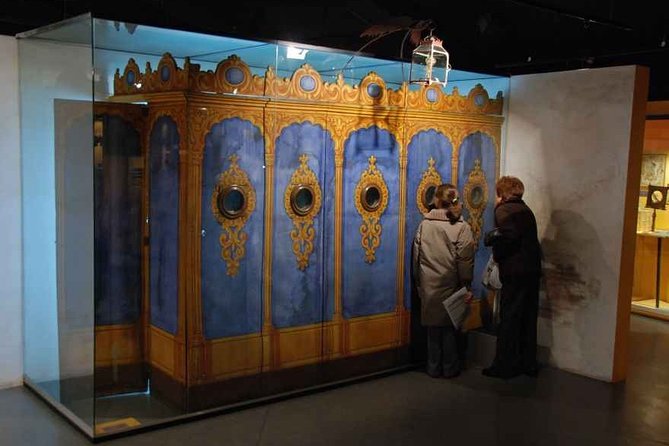
At $8.40 per person, this is an easy museum ticket to justify. The price is low enough for a short visit, yet the collection has enough depth to fill a substantial part of an afternoon.
Value depends on your interest. Film fans, theater students, families, and anyone curious about old technology should get strong value from the admission. The interactive displays and historic equipment give you more to do than a standard object-and-label museum.
If you have only an hour in Girona, the ticket still works because you can see the main sequence quickly. If you have two hours, the price looks even better. A low-cost museum with an audio guide, films, and hands-on displays can be a welcome change from heavily booked major sights.
Some visitors also use a Girona museum card that offers half-price admission to five museums. That option is worth checking if you already plan to visit several participating museums, but the card is not needed to make this individual ticket worthwhile.
Access, transport, and practical details
The museum is near public transportation, so it is practical to reach without a car. The ticket is mobile, and confirmation is received when you book.
Lifts serve the different levels. That is useful because the recommended route may take you to the upper floor first, followed by a gradual descent through the history of cinematography. People with mobility concerns should still check the exact building arrangements when booking, but the available information indicates that lifts reach all levels.
Service animals are allowed. Most people can participate, and the experience is not described as physically demanding.
The activity is offered in English. The displays also depend heavily on objects, demonstrations, images, and films, so you can still gain something from the visit even if you prefer not to read every panel.
Free cancellation is available if you cancel at least 24 hours before the scheduled start time. Cancellations made inside that period are not refunded, and changes made less than 24 hours before the start are not accepted. Cut-off times use Girona’s local time.
Who will enjoy this museum most?
I would put this near the top of the list for anyone who enjoys film, theater, animation, photography, or old technology. The museum explains the roots of cinema in a way that rewards curiosity rather than specialist knowledge.
It also works well for families with older children and teenagers. The interactive displays give younger visitors a reason to stay engaged, while the equipment and short films provide enough substance for adults.
Film professionals and students may want more time than the average sightseer. The collection of magic lanterns and other pre-cinema instruments is unusually strong, and the museum offers a rare chance to see the tools that shaped visual entertainment before modern film.
I would be less likely to recommend it to someone who wants only famous movie memorabilia or celebrity stories. This is about mechanisms, ideas, spectators, and the slow development of moving images. It is thoughtful and practical rather than glamorous.
A smart place to fit into your Girona day
The museum is a good choice near the end of an overnight stay or before leaving Girona, especially if you want a compact indoor attraction. You can enter with a flexible plan and stay for an hour or extend the visit if the displays grab you.
The route also makes a useful change of pace after walking through Girona’s historic center. Instead of another view, church, or street, you get a close look at the tools behind one of the modern world’s most powerful forms of storytelling.
I would avoid scheduling it too tightly before a train or other fixed departure. The official duration ranges widely, and the interactive elements can hold your attention longer than expected. Give yourself room to stop without watching the clock.
Should you book the Girona Film Museum?
Book it if you want to understand where cinema came from, not simply look at film memorabilia. The strongest reasons are the rare pre-cinema equipment, the magic lantern displays, the clear historical route, and the low $8.40 price.
Skip it if you have almost no interest in images, technology, or the history of entertainment. For most curious visitors, though, it is a practical and affordable Girona stop. Plan for 90 minutes to two hours, take your time with the early projection displays, and use the lift-first, descend-through-time route to make the most of the visit.
FAQ
Where is the Girona Film Museum located?
The experience takes place at the Cinema Museum Girona, also called the Museu del Cinema, in Girona, Spain.
How much does admission cost?
The listed price is $8.40 per person.
How long does a visit take?
The estimated duration is between one and five hours. A shorter visit can cover the main displays, while a longer visit allows time for the films, interactive exhibits, and audio guide.
Is the ticket offered in English?
Yes. The experience is offered in English.
What does the museum cover?
The museum covers about 500 years of image history, from early visual techniques and shadow play through magic lanterns, early motion pictures, and the arrival of television.
Is the museum accessible for people with mobility issues?
Lifts are available to reach the different levels of the museum. Most people can participate.
Can I cancel for a refund?
Yes. You can cancel at least 24 hours before the experience start time for a full refund. Cancellations or changes made less than 24 hours before the start time are not accepted for a refund.
Just added around Girona
- Besalú, Banyoles Lake & Volcanic Castellfollit from Girona★ 5.0 · 6 reviews
- Dalí & Wine | Premium Private Tour with Coastal or Girona Add-On★ 5.0 · 6 reviews
- Private Andorra or Pyrinees Ski / Snowboard Tour Day trip★ 5.0 · 6 reviews
- From Girona: Dalí Museum and Girona Small Group Tour★ 4.8 · 7 reviews
- City Explorer: Girona Private Day Trip★ 5.0 · 7 reviews
- Dalí Triangle & Cadaqués Day-Trip From Girona★ 5.0 · 7 reviews
- Olot: Espai Cràter Volcanology Center Entry Ticket★ 4.7 · 7 reviews
- Private tour: Dali Museum and Girona from Barcelona★ 5.0 · 7 reviews
Museums, compared.

FC Barcelona Museum “Barça Immersive Tour” Ticket
Read our review →
Park Güell and Gaudí House Museum Entry Ticket
Read our review →
Girona & Dali Museum Small Group Tour with Pick-up from Barcelona
Read our review →

Dali Museum, House & Cadaques Small Group Tour from Barcelona
Read our review →Browse the lists this tour appears in