
Reviewed · CYCLING TOURS
Private electric bike tour – Discovery of Barcelona
Barcelona is a city made for connecting the dots, and this private e-bike tour does exactly that. In about four hours, you ride from medieval squares and Gothic churches to the beach, Gaudí’s great buildings, and the hilltop views of Montjuïc. It is a fast, lively way to get your bearings before settling in for a longer stay.
I like the freedom of having Jean-Pierre guide only your group. You can stop for photos, ask questions, and adjust the pace without waiting for a busload of strangers. I also like the range: this is not just a Gaudí outing. You get Catalan politics, Gothic architecture, the Olympic waterfront, modernisme, museums, and city views in one ride.
The main consideration is the riding itself. The route covers more than 20 kilometers and includes hills, especially around Montjuïc. Electric assistance makes the climbs far easier, but pedestrians, crowds, and city traffic can still make some sections demanding. A morning departure is the smarter choice, particularly in warm weather.
In This Review
- Key points to know before booking
- Why this private e-bike route works so well
- From Plaça de Sant Jaume to the cathedral
- Music, markets, and Gothic stone
- Port Vell and the workers’ waterfront
- Gaudí in the Eixample
- Plaça d’Espanya and the 1929 exhibition grounds
- Montjuïc: museums, Olympics, and wide views
- What the riding feels like in real terms
- The value of $96.11 per person
- Who should book this Barcelona ride?
- My verdict: a smart first look at Barcelona
- FAQ
- How long does the private e-bike tour last?
- What is included in the price?
- Are attraction tickets included?
- Where does the tour begin and end?
- Is this a group tour?
- Is the tour offered in English?
- What happens if the weather is poor?
Key points to know before booking
- Private from start to finish: Only your group rides with Jean-Pierre, so the pace and photo stops can be adjusted.
- A true city overview: The route links the Gothic Quarter, Barceloneta, Gaudí’s Eixample, Plaça d’Espanya, and Montjuïc.
- About 20 kilometers of riding: The e-bike does the hard work on Barcelona’s hills, but you should still be comfortable on a bicycle.
- Jean-Pierre leads the tour: He focuses on Catalan history, architecture, and practical riding support, and he speaks English, French, and Spanish.
- No attraction admissions included: You see and discuss the exteriors, but tickets for places such as the Sagrada Família or museums cost extra.
- Best taken early in your stay: The tour gives you a useful map of the city and helps you decide where to return for a longer visit.
Why this private e-bike route works so well
Barcelona can feel spread out on a first visit. The Gothic Quarter is compact, the Eixample is broad, Barceloneta faces the sea, and Montjuïc rises above the center. Walking between all of those areas would take much of your day, while a standard bus tour can leave you seeing the city through a window.
An e-bike offers a useful middle ground. You cover ground quickly, but you still feel the streets, hear the city, and pause beside buildings rather than simply passing them. Jean-Pierre also takes time at the stops, so the ride is not just a succession of quick photographs.
The private format matters here. If one person in your group wants more time at a building, or another needs a slower pace up Montjuïc, the guide can adapt. One group even had to shorten the route because of other plans, and the tour was adjusted around its schedule.
You meet at Bike rental, Carrer de Cervantes, 5, in Ciutat Vella. The activity returns to that same meeting point. A mobile ticket is accepted, and confirmation is provided when you book.
More bike days around Barcelona:
- Barcelona 3-hour Bike or E-Bike Tour: Highlights and Hidden Gems
★ 5.0 · 1,429 reviews - Barcelona: 2.5-Hour Bike or E-Bike Historical Tour
★ 4.5 · 1,262 reviews - Barcelona E-Bike Photography Tour
★ 5.0 · 843 reviews
From Plaça de Sant Jaume to the cathedral
The tour begins in Plaça de Sant Jaume, the civic heart of old Barcelona. The square faces both Barcelona City Hall and the Palace of the Catalan Government. It is a good place to begin because the city’s political story and Catalan identity are tied closely to this small open space.
Jean-Pierre uses the square to explain Barcelona’s origins before moving into the old center. This is not a stop where you enter a monument, so your time is spent looking, listening, and getting the larger story in place. The scheduled visit lasts about 15 minutes.
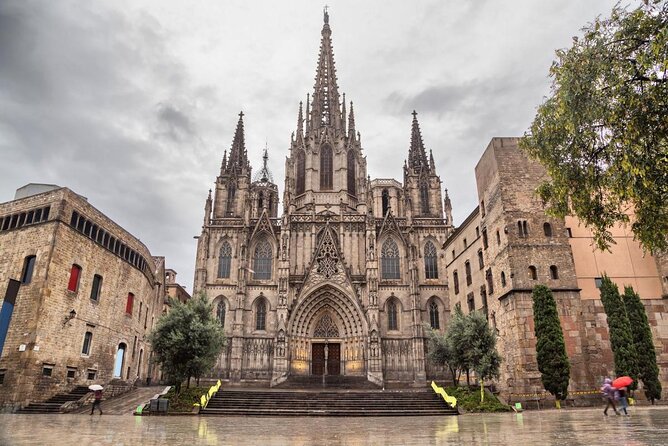
Barcelona Cathedral is next, with roughly 10 minutes on the square. The focus is on the building’s place in the city’s past and the key points of its history. Since admission is not included, the stop is best understood as an introduction rather than a cathedral visit.
If the cathedral is high on your list, note the distinction. You can return later with an admission ticket and spend more time inside. The tour gives you context and orientation, which can make a later visit more rewarding.
Music, markets, and Gothic stone
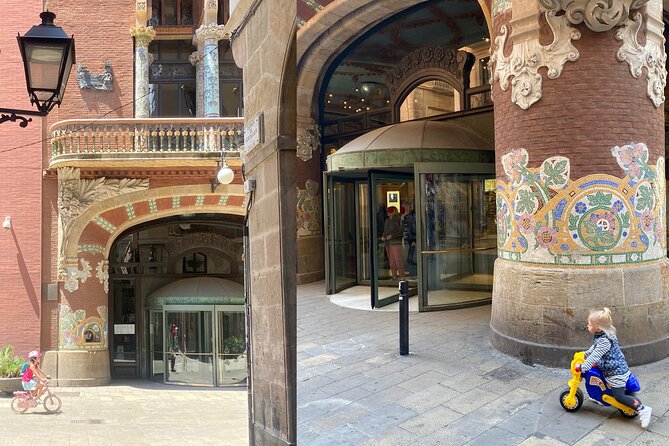
At the Palace of Catalan Music, Jean-Pierre explains Catalan modernisme and the work of architect Lluís Domènech i Montaner. This is one of the most useful architecture stops because it shifts attention away from Gaudí and shows that Barcelona’s design story has more than one major figure.
You stop at the entrance for about 15 minutes. There is no admission to the concert hall included, so plan a separate visit if you want to see the celebrated interior. Even from outside, the stop helps you recognize the ideas behind Barcelona’s early 20th-century architecture.
The Mercado de Santa Caterina gets a short five-minute pause. This former 19th-century neighborhood market was transformed in the early 20th century, making it a handy example of how old and new Barcelona sit side by side. The short stop keeps the tour moving, but it also means you should not expect time to shop or eat inside.
At the Basilica de Santa Maria del Mar, the focus is the city’s Gothic tradition. The stop is also brief, about five minutes, and centers on the church exterior and its place in Barcelona. If you want to go inside, you will need to return on your own and pay any required admission.
This early section is strong for orientation. You see several important buildings close together, while Jean-Pierre connects civic power, religious architecture, music, markets, and neighborhood life.
Port Vell and the workers’ waterfront
The route then rolls toward Port Vell, Barcelona’s old port. The harbor area was radically changed before the 1992 Olympic Games, and the stop gives you a clear look at how Barcelona turned its waterfront toward public use and recreation.
You spend about 10 minutes here. It is less about one landmark than about seeing the relationship between the historic center and the sea. The port also provides a change of pace after the close streets of Ciutat Vella.
At La Barceloneta, the tour pauses for about 25 minutes. This district began as a neighborhood for workers and fishermen, and its beaches remain one of the city’s most recognizable public spaces. The scheduled terrace break gives you time to quench your thirst, rest your legs, and take in the waterfront.
That break is practical, not decorative. Four hours on a bike can pass quickly, but it is still physical activity. Use the pause to check how you feel before the ride continues toward the major Gaudí stops and the climb to Montjuïc.
A few more Barcelona options worth an hour of your trip
- Barcelona: E-Bike Tour with Montjuic Cable Car & Boat Ride
★ 4.6 · 817 reviews - Barcelona: Sagrada Familia or Coastal City Sights by eBike
★ 4.8 · 812 reviews - Barcelona e-Bike Tour: Gaudí & Old Town Small Group
★ 5.0 · 769 reviews - Barcelona E-Bike Small Group Tour with Tapas & Wine Tasting
★ 5.0 · 638 reviews
Gaudí in the Eixample
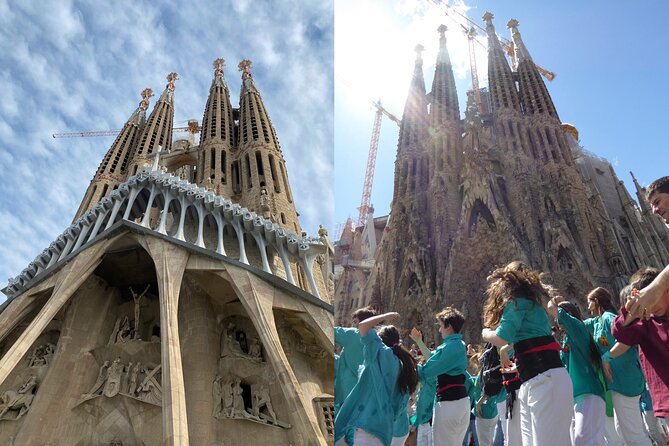
The Sagrada Família receives about 20 minutes, the longest single architecture stop on the central-city portion of the route. Jean-Pierre presents Antoni Gaudí’s most important work and explains why it is such a central monument in Barcelona.
The tour does not include entry. That keeps the price lower and allows the group to see more of the city, but you should not book this experience expecting an interior visit. If you want to go inside the basilica, reserve a separate ticket and allow extra time on another day.
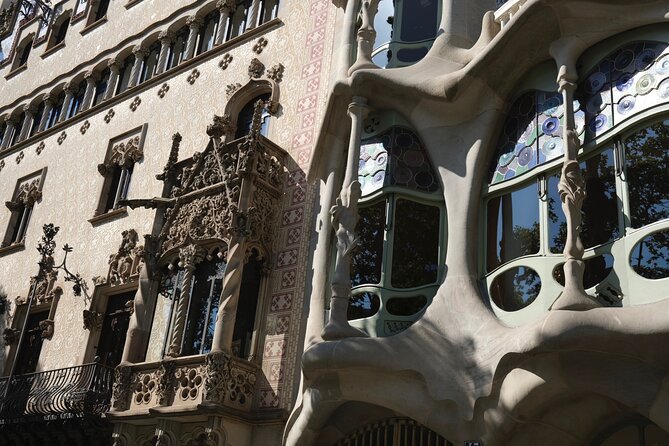
Casa Milà, known as La Pedrera, comes next for around 10 minutes. It was Gaudí’s last civilian commission, and its unusual exterior makes a strong contrast with the older Gothic buildings seen earlier. Casa Batlló follows with another 10-minute stop.
Seeing these two houses together is useful. You can compare Gaudí’s approach across the same broad Eixample area rather than treating each building as an isolated sight. The stops are exterior-focused, so photography and explanation matter more than extended sightseeing inside.
The e-bike is especially valuable here because the route links several areas that are not directly beside one another. You save energy for the hill later while still moving through the city at street level.
Plaça d’Espanya and the 1929 exhibition grounds
Plaça d’Espanya marks another shift in Barcelona’s story. The square, its arena, and its fountain were part of the layout created for the 1929 Universal Exhibition. The stop lasts about 15 minutes and also points toward the Magic Fountains, CaixaForum, and the Mies van der Rohe Pavilion.
This is a good reminder that Barcelona’s public spaces were shaped by international exhibitions as well as medieval growth and modernisme. The area can feel grand and open after the tight lanes of the old quarter.
You also stop briefly at the entrance to Poble Espanyol, the Spanish Village built for the 1929 World’s Fair. It is an artificial village, so it should not be confused with an authentic historic town. Its value is in understanding how the exhibition presented Spain through architecture and regional styles.
Admission to Poble Espanyol is not included. Five minutes is enough to see the entrance and hear the background, but not enough for a full visit.
Montjuïc: museums, Olympics, and wide views
The route continues to the Museu Nacional d’Art de Catalunya, originally the Spanish pavilion for the 1929 exhibition. Today it is the city’s most important museum, and its position offers a fine view over Barcelona.
The stop lasts roughly 10 minutes. Again, this is an exterior and viewpoint visit rather than a museum tour. If you want to see the collections, set aside another block of time and buy admission separately.
The Estadi Olímpic is next, with about 12 minutes devoted to the Olympic stadium and the Olympic ring. The wider complex includes the Palau de Sant Jordi and a telecommunications tower designed by Santiago Calatrava. The stop connects the 1992 Olympic Games to the physical rebuilding and presentation of Barcelona.
At the Joan Miró Foundation, the tour pauses for about five minutes. The foundation sits on the heights of Montjuïc and adds a modern art note to a route that has already covered Gothic churches, modernisme, Gaudí, and exhibition architecture.
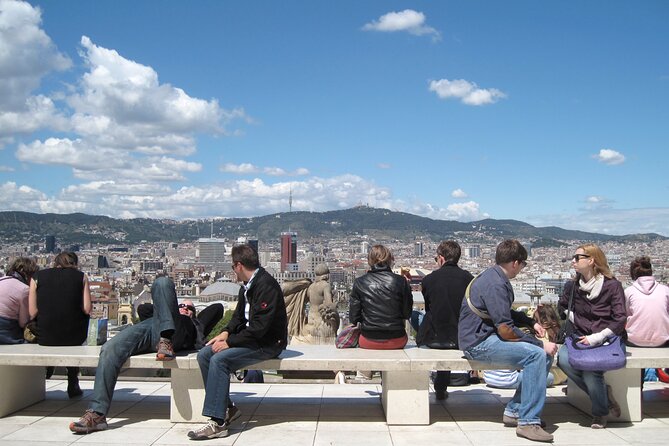
The final stop is the Jardins del Mirador del Alcalde, where you get a view over the city and port. The 10-minute pause is a fitting finish to the uphill section. You have seen Barcelona from its streets, beaches, plazas, and now from above.
Montjuïc is where the electric motor earns its keep. One rider described the route as a 20-plus-kilometer ride up and down the hills, while another specifically praised the assistance on the climbs. You still pedal and steer, but the bike reduces the strain that could otherwise make this ambitious route tiring.
What the riding feels like in real terms
You do not need to be a serious cyclist, but you should be willing to ride in an urban setting. The bikes are described as smooth and easy to use, and Jean-Pierre takes time at the start to explain their operation. Helmets and e-bikes are included.
That introduction is especially helpful if you are new to electric bikes. One group included several first-time riders, and the guide spent time explaining the equipment and maintaining a careful focus on safety. Smaller bike models are available through the rental company, which is useful for shorter riders.
The route can be exhilarating, but it is not effortless in every sense. You must remain alert around pedestrians, especially as the day gets busier. Some city sections may feel daunting if you are not used to riding near crowds.
I would choose a morning start whenever possible. The city is usually less congested early, and summer temperatures are easier to manage before the warmest part of the day. Morning also leaves you with time to revisit the places that caught your attention.
The advertised duration is approximately four hours, but the actual experience can run longer depending on stops, questions, photographs, and the group’s pace. Some outings lasted more than four hours, while another covered the route in just over three hours. Treat the schedule as a half-day framework rather than a minute-by-minute promise.
The value of $96.11 per person
At $96.11 per person, this costs more than a basic group bike ride, but the comparison is not quite fair. You are paying for a private guide, an electric bike, a helmet, a broad route, and the ability to shape the pace around your own group.
The price makes the most sense if you have limited time. Cruise passengers with only a day in Barcelona can use the ride to see the old city, waterfront, Gaudí buildings, and Montjuïc without organizing several separate taxi or public transport trips. It also works well as a first-day overview during a longer visit.
The value is weaker if you want extended interior visits. Tickets to the Sagrada Família, Palace of Catalan Music, Poble Espanyol, museums, and other attractions are not included. You will need extra time and money to return to those sites.
For a private activity, the cost is also easier to justify when shared among a small family or group. You avoid a large party and gain flexibility. If you prefer a slow, focused visit to one or two monuments, book those sites separately instead.
Who should book this Barcelona ride?
I would recommend it to first-time visitors who want a broad picture of the city quickly. It suits couples, families, and small groups who value a personal guide and do not want to follow a fixed group schedule.
It is also a good fit for architecture fans. The route covers Gothic buildings, Catalan modernisme, Gaudí’s residential work, exhibition design, Olympic architecture, and modern art. Jean-Pierre’s strongest role is connecting those styles and periods rather than simply naming buildings.
This is less suitable if you dislike bicycles, have difficulty with hills, or want a quiet walking tour. The electric motor helps, but the route remains long and urban. Crowds can also affect the ride, particularly later in the day or around busy public areas.
Jean-Pierre is the central part of the experience. He is described as friendly, patient, flexible, and well informed about Barcelona’s history and architecture. He also speaks English, French, and Spanish, which can help multilingual groups feel more at ease.
My verdict: a smart first look at Barcelona
Book this tour if you want to see a large slice of Barcelona in half a day and are comfortable riding an e-bike through city streets. The private format, strong guide support, and Montjuïc views give it more personality than a standard sightseeing circuit.
Book it early in your stay, preferably in the morning. Use it to mark the buildings and neighborhoods you want to revisit, then return later for the interiors that require tickets. If you want a single museum or monument explored in depth, choose a dedicated visit instead.
At $96.11, it is not the cheapest way to see Barcelona, but it delivers a lot of ground, useful context, and genuine flexibility. For a short visit, that combination can be worth the cost.
FAQ
How long does the private e-bike tour last?
The tour lasts approximately four hours. The actual time can vary with the group’s pace, questions, photographs, and stops.
What is included in the price?
Use of the electric bike and a helmet is included.
Are attraction tickets included?
No. Tickets for attractions and museums are not included. The route visits or discusses sites from outside, and you can return later for interior visits.
Where does the tour begin and end?
You meet at Bike rental, Carrer de Cervantes, 5, Ciutat Vella, Barcelona. The tour ends back at the same meeting point.
Is this a group tour?
No. It is a private activity, and only your group participates.
Is the tour offered in English?
Yes. English is one of the offered languages. Jean-Pierre is also described as speaking French and Spanish.
What happens if the weather is poor?
The experience requires good weather. If poor weather causes cancellation, you can choose a different date or receive a full refund. You can cancel for a full refund up to 24 hours before the start time.
Just added around Barcelona
- GoCar Full Day Tour★ 4.0 · 6 reviews
- Sagrada Familia and Barcelona Highlights: Private Guided 4-Hour Driving Tour★ 5.0 · 6 reviews
- Barcelona: Highlights & Gems Private Tour with Tapa & Drink★ 3.9 · 6 reviews
- Gothic Quarter and Born District: Photographic Workshop★ 5.0 · 6 reviews
- Gobbi Yacht Rental in Barcelona 9 Pax 2/4/8hs★ 5.0 · 6 reviews
- Private Sailboat Ride at Sunset from Sitges★ 5.0 · 6 reviews
- Barcelona: Gothic Quarter & La Sagrada Familia Private Tour★ 4.9 · 6 reviews
- Barcelona: Private Tour of Casa Batllo with Reserved Access★ 3.5 · 6 reviews
Cycling Tours, compared.
Barcelona 3-hour Bike or E-Bike Tour: Highlights and Hidden Gems
Read our review →
E-Bike Tour with Montjuic Cable Car & Boat Ride
Read our review →
Sagrada Familia or Coastal City Sights by eBike
Read our review →
Barcelona e-Bike Tour: Gaudí & Old Town Small Group
Read our review →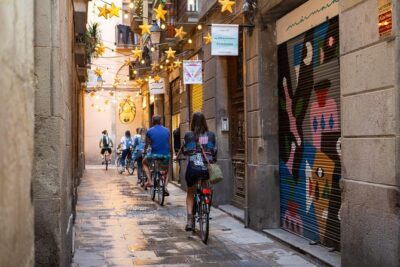

Barcelona E-Bike Small Group Tour with Tapas & Wine Tasting
Read our review →Browse the lists this tour appears in