
Reviewed · CITY TOURS
Barcelona City Tour Hop-On Hop-Off and Aquarium
Barcelona’s bright red buses give you a quick way to understand the city’s shape, from Montjuïc and Plaça d’Espanya to the beaches, Gaudí buildings, and Port Vell. The best part is the freedom to get off when a sight catches your eye, then continue when you are ready.
I especially like the two-route setup and the included Aquarium visit. You can use the orange west route for Montjuïc, Camp Nou, and Sagrada Família, then take the green east route for the waterfront, Park Güell, and the Modernist buildings. The main drawback is time: seeing every major stop from the bus in about four hours is possible, but exploring several of them properly is not.
In This Review
- Key points to know
- What the red buses let you see in one day
- The orange west route from Montjuïc to Sagrada Família
- The green east route along Barcelona’s coast
- Planning the Aquarium visit at Port Vell
- Is the $69.41 price good value?
- How to build a sensible four-hour plan
- Audio, access, and the small practical details
- Who should book this Barcelona combination?
- Should you book the Barcelona City Tour and Aquarium?
- FAQ
- How long does the Barcelona City Tour and Aquarium experience last?
- What time does Barcelona City Tour operate?
- Is Aquarium admission included?
- What routes are included?
- Is there an audio guide?
- Where does the experience start and end?
Key points to know
- Two useful city loops: The orange west route covers Montjuïc, Plaça d’Espanya, Camp Nou, La Pedrera, and Sagrada Família, while the green east route reaches the coast, Park Güell, and the Gothic-area sights.
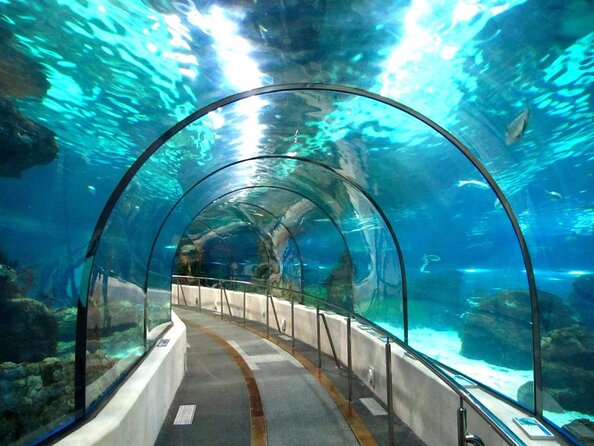
- Aquarium entry is included: Your ticket covers one visit to L’Aquarium de Barcelona, including its long acrylic Oceanarium tunnel.
- Buses run roughly every 30 minutes: Service operates from 9 AM to 7 PM, with the last return at 7 PM.
- Audio is multilingual: The system includes a looping setup for passengers with auditory disabilities, with marked priority seats.
- The ticket saves walking: This is useful in a spread-out city where Montjuïc, the waterfront, Gaudí sites, and Camp Nou are not close together.
- The ticket includes discounts: A booklet may reduce the cost of other attractions, adding some value if you plan more sightseeing.
What the red buses let you see in one day
Barcelona is easy to explore on foot within individual neighborhoods, but its headline sights are spread across the city. Montjuïc rises southwest of the center. Park Güell is uphill to the north. The Olympic Port, Barceloneta, and the Aquarium line the water. Camp Nou sits west of the center, while Sagrada Família and the Modernist buildings occupy different points in the Eixample.
That makes a hop-on, hop-off bus useful as a moving sightseeing platform and a practical connector. You get an overview from the upper deck, then leave the bus for the places you want to examine.
The route runs from about 9 AM to 7 PM, and buses arrive at stops roughly every 30 minutes. That frequency is reasonable, but it is not instant. If you get off at a major sight, note the time and allow for the next bus, especially late in the day.
You receive a multilingual audio guide, so you can follow explanations about the neighborhoods, buildings, and monuments along the way. This is a self-guided outing, not a walking tour with a named guide. You control the pace, but you also need to decide how much time to give each stop.
More sightseeing bus options:
- Barcelona: 24 or 48-Hour Hop-On Hop-Off Bus Tour
★ 4.4 · 20,872 reviews - Barcelona: City Sightseeing Hop-On Hop-Off Bus Tour
★ 4.4 · 10,061 reviews - City Sightseeing Barcelona Hop-On Hop-Off Bus Tour: 24 or 48-Hour
★ 4.0 · 5,250 reviews
The orange west route from Montjuïc to Sagrada Família
The orange route is the stronger choice for Barcelona’s grand viewpoints, museums, exhibition spaces, and western landmarks. Starting near the World Trade Center, it moves through the port area toward the slopes of Montjuïc.
At the World Trade Center and Miramar Gardens, you get a sense of Barcelona’s position between the sea and the hill. The route then reaches the Joan Miró Foundation and the Olympic Ring, a useful pairing if you want modern art and the city’s Olympic-era architecture in one outing.
The National Art Museum of Catalonia, or MNAC, is one of the route’s major stops. Even if you do not enter, the building and its position above Plaça d’Espanya make this a worthwhile section of the ride. Plaça d’Espanya is one of the best orientation points on the route, with broad avenues leading toward Montjuïc and the city center.
Poble Espanyol is another substantial stop. It is a constructed village-style attraction devoted to Spanish architecture, crafts, and regional traditions. The included bus ticket does not include entry, but the discount booklet may help if you plan to visit.
Nearby, CaixaForum and the Mies van der Rohe Pavilion offer a different look at Barcelona. The pavilion is compact and modern, so it works well for visitors who want a short architectural stop rather than another large museum.
The bus then continues through Sants and toward Camp Nou and the FC Barcelona Museum. The ticket gets you to the stadium area, but admission to the museum is not included. Sports fans may want to use this stop as a main visit, while others may prefer to stay on the bus and save time.
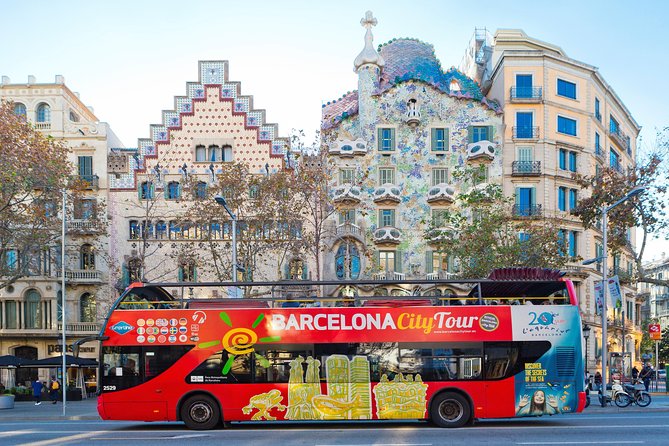
The western route also passes L’Illa Diagonal and the broad Avinguda Diagonal before reaching La Pedrera. This is one of Antoni Gaudí’s most famous apartment buildings, known for its unusual stone facade and rooftop forms. Again, you can get off here, but the attraction entry is separate.
Sagrada Família is the route’s biggest architectural draw. The bus gives you a convenient approach to the basilica, but the time needed to visit inside is much greater than a brief stop. If you want to enter, check your schedule carefully and treat the bus as your transport, not as the whole experience.
The route continues past Estació del Nord, the Zoo and Poblenou, Port Olímpic, Pla de Palau, and Passeig de Colom. This final section brings you back toward the historic center and the waterfront. It is a good way to connect the inland sights with the port without walking the full distance.
The green east route along Barcelona’s coast
The green route begins around Pla de Palau and then heads through Barceloneta. This is the city’s best route for sea views, beaches, newer waterfront development, and several major Gaudí and Modernist stops.
Barceloneta gives you the classic coastal side of Barcelona. From the bus, you can see how the old waterfront district connects with Port Olímpic and the beaches. If you want time by the sea, get off around Barceloneta or Port Olímpic and plan for at least one later bus.
The route continues by Platja del Bogatell and Nova Mar Bella before reaching the Fòrum. These areas show a more modern side of the city, with open spaces and redevelopment along the coast. The views are different from the dense old center, but this section takes time, so it is best suited to visitors who want to see Barcelona beyond the standard core.
Torre Glòries is a prominent landmark on the route. From here, the bus continues to the Recinte Modernista de Sant Pau, a former hospital complex with striking architecture. Sant Pau is often overshadowed by Sagrada Família, but its decorative details and large complex make it a valuable stop for architecture fans.
Park Güell is another major reason to choose the green route. The bus takes you toward Gaudí’s hilltop park, but you should allow time for the visit and for the uphill setting. The included ticket does not cover every attraction admission, so check the exact entry terms before getting off.
The route then passes La Pedrera, Casa Batlló, and Plaça Catalunya. These stops put three central Barcelona highlights in one stretch. Casa Batlló is especially easy to combine with a walk along Passeig de Gràcia, while La Pedrera gives you another chance to see Gaudí’s work from outside or enter if you have arranged admission.
The final section includes the Arc de Triomf and El Born near Parc de la Ciutadella. This is a good place to leave the bus for a neighborhood walk. El Born has narrow streets, historic buildings, and a more intimate feel than the wide Eixample avenues. The bus cannot replace exploring on foot here, but it gets you close.
Planning the Aquarium visit at Port Vell
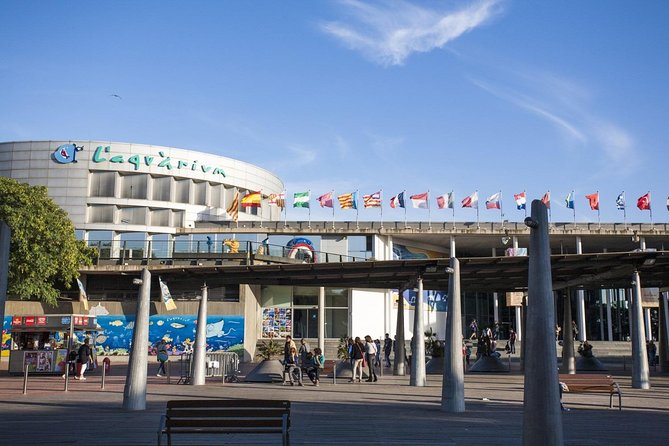
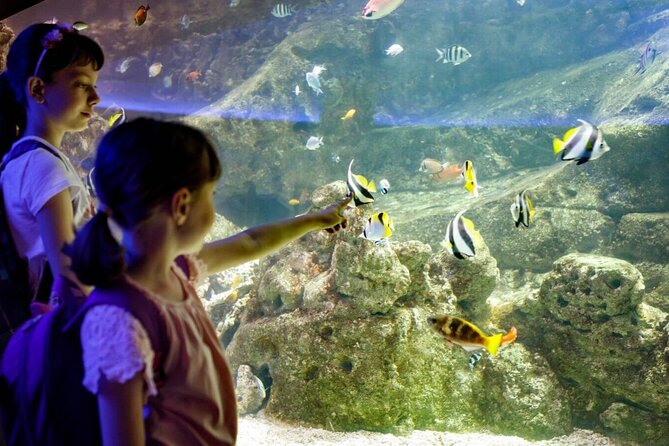
The Aquarium is at Moll d’Espanya in Port Vell, near the waterfront and the listed end point of the experience. Its focus is the Mediterranean, with 14 aquariums representing different marine communities.
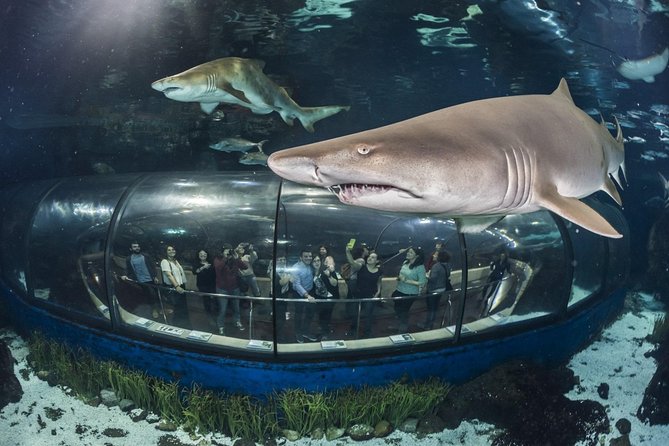
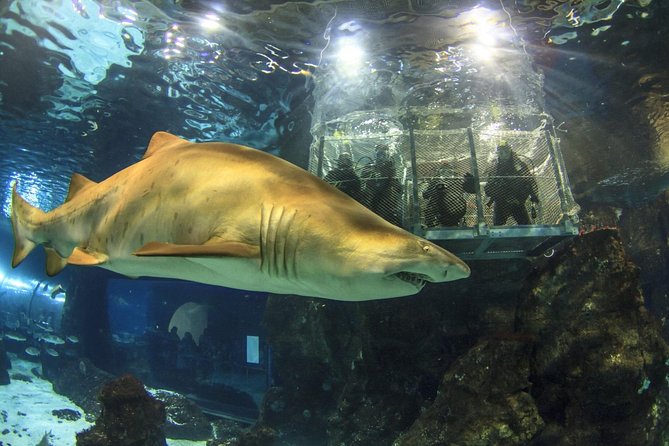
You can expect displays about the species and habitats connected with the Mediterranean coast, including areas inspired by the Ebro Delta and the Medes Islands. The Oceanarium is the main visual payoff. Its acrylic tunnel runs through the aquarium, giving you views of sharks and other sea life above and around you.
The aquarium visit takes about 1 hour and 30 minutes. That timing fits neatly after a bus ride, but do not assume you can leave and re-enter. Aquarium admission is valid for one use only, even if your Barcelona City Tour ticket remains valid for one or two consecutive days.
The aquarium opens daily at 10 AM. Since the bus service begins at 9 AM, an early start can work well for a short orange or green route ride before entering. You should still check the closing time for your date, since the supplied schedule is incomplete.
For families, the Aquarium adds a clear focus to a flexible sightseeing day. It also gives you an indoor activity if you need a break from walking and city streets. Adults who are mainly interested in architecture may find it less essential, but the Oceanarium tunnel is a strong reason to include it if you are already visiting Port Vell.
A few more Barcelona options worth an hour of your trip
- Barcelona Aquarium: Entry Ticket
★ 4.3 · 13,335 reviews - Barcelona: Hop-On Hop-Off Bus & Aquarium Tour
★ 4.5 · 221 reviews - Barcelona Aquarium Skip the Line Ticket
★ 4.0 · 109 reviews - From Costa Brava: Barcelona Day Trip with Aquarium Visit
★ 3.9 · 41 reviews
Is the $69.41 price good value?
At $69.41 per person, this is not the cheapest way to see Barcelona. Its value depends on how much you use the bus and whether you would visit the Aquarium anyway.
If you ride only once and spend most of the day walking, the price is harder to justify. Public transportation can move you around Barcelona for less, and many of the best sights are enjoyable on foot once you are in the right district.
The calculation improves if you use both routes, get off several times, and visit the Aquarium. You are paying for transport, the open double-decker viewpoint, the audio system, a route guide, attraction discounts, and aquarium entry in one package. For a first visit, that combination can save planning time.
The bus is also valuable if you want to avoid long walks between unrelated parts of the city. One day might otherwise involve separate trips to Montjuïc, Camp Nou, Sagrada Família, the coast, and Park Güell. The bus will not eliminate all walking, but it reduces the amount between these areas.
The experience receives a 4.3 rating from six published reviews, with particular praise for seeing both the red and green routes, saving walking, and the family appeal of the Aquarium. That matches the tour’s real strength: it is a practical overview, not a deep visit to every landmark.
How to build a sensible four-hour plan

The advertised duration is about four hours, including roughly two hours for the city bus portion and 1 hour 30 minutes at the Aquarium. That is a compact plan. You can use it as a sample schedule, but you should not expect a full visit inside several museums, monuments, or stadiums during the same outing.
A good plan is to choose one main route and treat the other as a scenic bonus. For architecture, use the green route for Casa Batlló, La Pedrera, Sant Pau, and Park Güell. For Montjuïc, Plaça d’Espanya, Camp Nou, and Sagrada Família, use the orange route.
If the Aquarium is your priority, begin with the bus and finish at Port Vell. The listed start point is in the Catalunya and Eixample area, with a 9 AM start, and the listed end point is L’Aquàrium de Barcelona. This arrangement reduces backtracking.
You can also split the experience across the ticket’s valid period if your ticket option allows one or two consecutive days. The Aquarium remains a single-use visit, so choose the day and time with care.
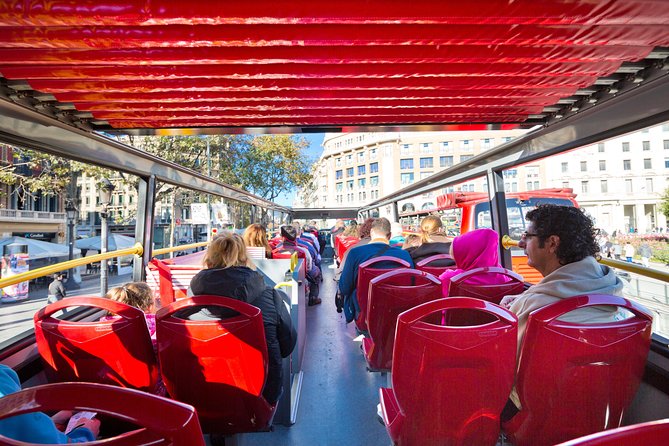
The buses have air conditioning and an open upper deck. The upper deck gives better views, but conditions can change in the sun or wind. The lower section is more practical if you want shelter or need easier access.
Audio, access, and the small practical details
The audio guide is available in multiple languages and explains the areas you pass. Bring or use the supplied headphones as directed, and remember that this system is designed for listening while the bus is moving, not for personal conversation with a guide.
An audio system adapted for people with auditory disabilities uses a multilingual looping setup without wires. Marked seats have priority for passengers who need that system. This is a specific and useful feature, though the tour remains self-guided.
The activity allows a maximum of 40 participants, but you ride on scheduled city buses rather than in a small private group. The maximum matters most for the organized element of the experience, not for creating a personal guide relationship.
The route can change because of demonstrations, sporting events, cultural events, official acts, or force majeure. Barcelona regularly hosts large public events, so keep some flexibility in your plan. If a stop is important to you, do not schedule a timed attraction too tightly after the bus.
Free cancellation is available up to 24 hours before the start time. Changes or cancellations inside that window are not accepted for a refund.
Who should book this Barcelona combination?
I would choose this for a first visit, a short stay, families, and anyone who wants a broad city introduction without arranging several separate transport plans. It is also useful if walking long distances is tiring or if your group has different interests.
Families may like the Aquarium because it gives children a focused attraction after the open-ended bus ride. Architecture fans can use the routes to compare Gaudí sites with Sant Pau, the Mies van der Rohe Pavilion, and the Olympic areas.
I would be more cautious if you already know Barcelona well, prefer public buses and metro trains, or want long interior visits at Sagrada Família, Park Güell, Camp Nou, and the museums. The bus can take you to these places, but it does not replace individual admission tickets or the time needed inside.
Should you book the Barcelona City Tour and Aquarium?
Book it if you want easy transport, citywide orientation, and one Aquarium visit in a single package. Use the bus actively, not just as a one-way ride: ride both routes when possible, note the return times, and get off only where you have enough time to explore.
Skip it if your plans already center on a few specific neighborhoods and you are comfortable using Barcelona’s regular public transportation. At $69.41, the ticket earns its keep through repeated use and the included Aquarium, not through a single short ride.
For most first-time visitors with a compact schedule, this is a sensible overview of Barcelona. Just keep your expectations clear: you will see a lot, but you cannot thoroughly visit everything the buses pass.
FAQ
How long does the Barcelona City Tour and Aquarium experience last?
The total duration is approximately four hours. The city tour portion is listed at about two hours, and the Aquarium visit takes about 1 hour and 30 minutes.
What time does Barcelona City Tour operate?
Barcelona City Tour operates from 9 AM to 7 PM, with the last return at 7 PM. Buses arrive approximately every 30 minutes at the stops.
Is Aquarium admission included?
Yes. The ticket includes entrance to L’Aquarium de Barcelona. The Aquarium ticket is valid for one use only, even if the bus ticket is valid for one or two consecutive days.
What routes are included?
One ticket covers the orange west route and the green east route, along with all listed stops on both routes.
Is there an audio guide?
Yes. A multilingual audio guide system is included. The tour also provides an audio setup adapted for people with auditory disabilities, with marked priority seats.
Where does the experience start and end?
The listed start point is in the Catalunya and Eixample area of Barcelona, with a 9 AM start. The listed end point is L’Aquàrium de Barcelona at Moll d’Espanya in Port Vell.
Just added around Barcelona
- GoCar Full Day Tour★ 4.0 · 6 reviews
- Sagrada Familia and Barcelona Highlights: Private Guided 4-Hour Driving Tour★ 5.0 · 6 reviews
- Barcelona: Highlights & Gems Private Tour with Tapa & Drink★ 3.9 · 6 reviews
- Gothic Quarter and Born District: Photographic Workshop★ 5.0 · 6 reviews
- Gobbi Yacht Rental in Barcelona 9 Pax 2/4/8hs★ 5.0 · 6 reviews
- Private Sailboat Ride at Sunset from Sitges★ 5.0 · 6 reviews
- Barcelona: Gothic Quarter & La Sagrada Familia Private Tour★ 4.9 · 6 reviews
- Barcelona: Private Tour of Casa Batllo with Reserved Access★ 3.5 · 6 reviews
City Tours, compared.

Barcelona City Tour Hop-On Hop-Off with Optional Boat
Read our review →

Flamenco Show Ticket at Theatre Barcelona City Hall
Read our review →
Sagrada Familia or Coastal City Sights by eBike
Read our review →
Go City Explorer Pass – Choose 2 to 4 Attractions
Read our review →
Browse the lists this tour appears in