
Reviewed · HIDDEN GEMS AND LOCAL WALKS
Barcelona: Guided Walking Tour of Top Sights and Hidden Gems
Barcelona’s Gothic Quarter is easiest to understand when you connect its narrow lanes, grand squares, and old stones to the people who shaped them. This two-hour walk traces the city from the Roman colony of Barcino through the medieval Golden Age, the Spanish Inquisition, and the Spanish Civil War, with plenty of odd legends along the way.
I like the compact route, which packs Roman, medieval, Jewish, religious, and modern Catalan stories into one walk. I also like the guides’ lively approach. Names praised for clear storytelling and humor include Jordan, Darren, Mariah, Petra, Lindsay, Sara, Tamara, and Kiki, though your guide will depend on the date. The main drawback is that cathedral and basilica entry is not included, so this is a history walk around the buildings rather than a ticketed interior tour.
In This Review
- Key points at a glance
- Why this walk works in Barcelona
- Starting at Plaça Nova and Roman Barcino
- Els Quatre Gats and Barcelona’s creative side
- The Kiss of Freedom and public memory
- Barcelona Cathedral, La Casa de l’Ardiaca, and the Bisbe lane
- Plaça de Sant Felip Neri and the city’s darker past
- MUHBA El Call and Barcelona’s Jewish quarter
- Plaça de Sant Jaume and the center of Catalan public life
- Plaça del Rei and the medieval Golden Age
- Plaça de l’Àngel and the old city crossroads
- Plaça de Santa Maria and the finish
- What the $22 price gets you
- Guide style and who will enjoy it
- Practical advice before you go
- Should you book this Barcelona walking tour?
- FAQ
- How long does the Barcelona walking tour last?
- What language is the tour conducted in?
- Where does the tour start?
- Where does the tour finish?
- Are cathedral and basilica admission tickets included?
- What should you bring?
- How much does the tour cost?
- Can you cancel the booking?
Key points at a glance
- Roman Barcelona begins at Barcino: Start beside the large Barcino sculpture at Plaça Nova and learn how the modern city grew from a Roman colony.
- A story-led Gothic Quarter route: The walk links cathedrals, lanes, courtyards, and squares instead of treating each sight as an isolated photo stop.
- The Pont del Bisbe skull legend: Hear the strange story connected with Carrer del Bisbe and what supposedly happens if you look at the secret skull.
- A broad view of Catalan identity: History covers the Golden Age, the Inquisition, the Civil War, local traditions, and unusual cultural figures.
- Good value at $22: For two hours with a live English-speaking guide, the price is modest, especially if you take the tour early in your stay.
- Bring sensible shoes: You will walk through old streets and squares for the full two hours, with no promise of cathedral interiors or long seated breaks.
Why this walk works in Barcelona
Barcelona can feel like several cities laid on top of one another. Roman walls sit beside medieval churches. Government buildings face squares that have witnessed political conflict. A narrow lane may look decorative until someone explains its religious, civic, or military past.
That layering is the real reason to take this tour. You are not simply moving from one famous building to another. The guide gives you a thread to follow, so the Gothic Quarter becomes easier to read later when you explore on your own.
The walk also gives you a useful first look at Catalan culture. The stories touch on local traditions, the Golden Age, religious power, political struggle, and the influence of the Spanish Civil War. You get a sense of why Barcelona feels distinct from other Spanish cities.
The tone appears to be conversational rather than academic. Guides such as Mariah, Lindsay, Sara, Petra, and Darren are praised for humor, patience, clear English, and the ability to answer questions. That matters in a historic quarter where a short explanation can make an otherwise confusing street memorable.
More local corners of Barcelona:
- Barcelona 3-hour Bike or E-Bike Tour: Highlights and Hidden Gems
★ 5.0 · 1,429 reviews - Barcelona: El Born and Gothic Quarter Wine & Tapas Bar Tour
★ 4.8 · 674 reviews - Barcelona: El Born Food Walking Tour with Tapas and Drinks
★ 4.9 · 662 reviews
Starting at Plaça Nova and Roman Barcino
The meeting point is Plaça Nova, at number 40, directly in front of the sculpture with the large letters Barcino. Look for the guide holding a yellow Carpe Diem Tours sign.
This is a fitting place to begin because the tour starts with Barcelona’s oldest known layer. The Roman colony of Barcino provides the basic map for the rest of the walk. You begin to see the Gothic Quarter not as a random maze, but as a city that developed around an ancient settlement.
The guide will explain how Barcelona’s 2,000-year story reaches back to Roman times. That opening context is useful if you plan to visit other historic areas later, since you will already have a rough sense of the city’s early foundations.
The starting point is also practical. Plaça Nova is central and easy to recognize, but the old quarter can still be confusing if you arrive without a few spare minutes. Give yourself time to find the Barcino sculpture and the yellow sign. Wear comfortable shoes and clothes suited to walking.
Els Quatre Gats and Barcelona’s creative side
The first listed stop is Els Quatre Gats, a famous historic café associated with Barcelona’s artistic life. The guide spends about 10 minutes here.
This stop adds a different note after the Roman opening. You move from ancient foundations to the cultural figures and social circles that helped shape the city’s modern identity. The exact focus can vary with the guide, but the point is to connect the building with Barcelona’s creative traditions.
I appreciate this kind of stop because it keeps the tour from becoming a procession of churches and government buildings. Barcelona’s past is also made by artists, writers, eccentrics, and café regulars.
The visit is guided, not a meal stop. Plan to hear the story and look closely rather than sit down for a full café experience.
The Kiss of Freedom and public memory
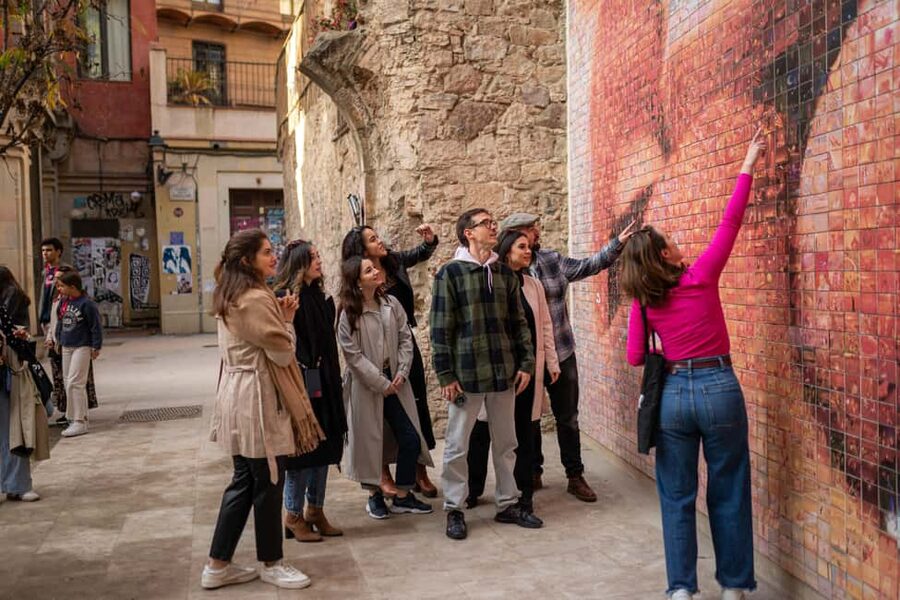
The Kiss of Freedom is another 10-minute guided stop. Its large photographic image shows a couple kissing and is tied to ideas of freedom and public memory.
Here, the tour shifts toward the way Barcelona presents its past in public spaces. A single image can carry political meaning, personal memory, and local identity. Your guide will help explain why this work belongs in a walk through the old quarter.
This is also a good example of the tour’s mix. You are not spending two hours on medieval architecture alone. The route combines old buildings with more recent cultural symbols, helping you see Barcelona as a living city rather than a preserved museum.
More walking tours in Barcelona:
- Barcelona Tapas and Wine Experience Small-Group Walking Tour
★ 5.0 · 5,804 reviews - Barcelona: Tapas Walking Tour with Food, Wine, and History
★ 4.8 · 4,261 reviews - Barcelona Tapas Walking Tour: Food, Wine & History
★ 4.5 · 1,928 reviews - Barcelona: Tapas Food Crawl Walking Tour with Tastings
★ 4.9 · 1,798 reviews
Barcelona Cathedral, La Casa de l’Ardiaca, and the Bisbe lane
Barcelona Cathedral receives about 10 minutes of guided attention. The tour does not include entry into cathedrals or basilicas, so you should treat this as an exterior and surrounding-area visit.
Even without going inside, the cathedral gives the guide a strong setting for discussing Barcelona’s religious and medieval past. It also helps explain how the Gothic Quarter became a center of civic and spiritual life.
Next comes La Casa de l’Ardiaca, or the Archdeacon’s House. This historic building adds another piece to the quarter’s institutional story. It is the sort of place you might pass quickly without a guide, especially when the surrounding lanes are crowded with visual details.
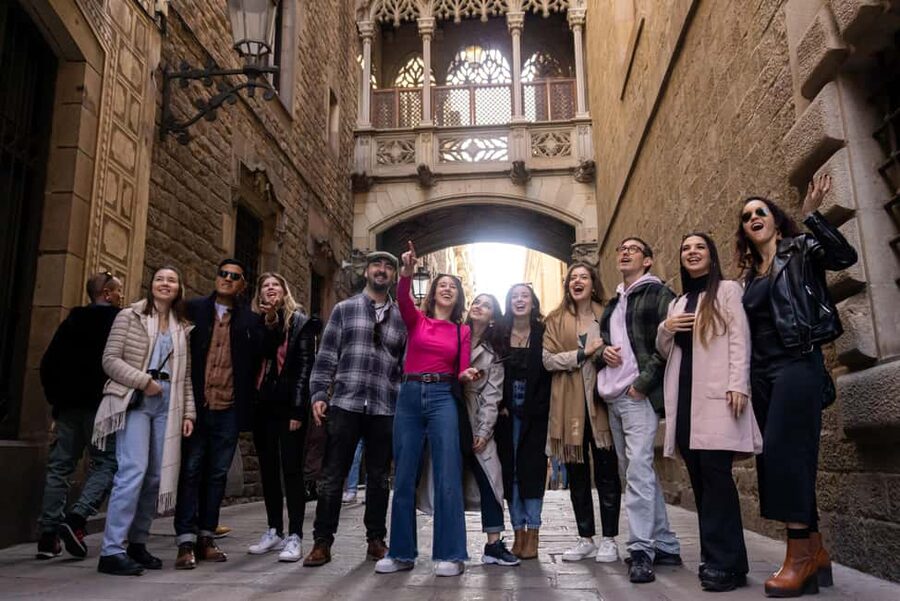
Then you walk along Carrer del Bisbe. This narrow street is one of the quarter’s most photographed corners because of its striking bridge. The guide will tell you the legend of the secret skull connected with Pont del Bisbe, including what supposedly happens if you look at it.
The skull story is exactly the sort of odd local tale that helps a place stick in your mind. It gives you a reason to look up and inspect the bridge instead of simply taking the standard photograph.
Do not expect the story to replace the architecture. The value comes from having both: the carefully framed medieval-looking street and the slightly unsettling legend attached to it.
Plaça de Sant Felip Neri and the city’s darker past
Plaça de Sant Felip Neri is one of the most emotionally charged stops on the route. The guide spends about 10 minutes here, discussing Barcelona’s darker history, including the Spanish Civil War.
The square is quieter and more enclosed than the larger public plazas. That change in mood gives the tour room to move beyond charming anecdotes. You will hear about conflict, loss, and the ways historical violence remains visible in the city.
This is an important balance. A Gothic Quarter walk can easily become a string of pretty lanes and entertaining myths. Sant Felip Neri reminds you that Barcelona’s old center has also seen fear, political struggle, and tragedy.
The guide’s skill matters here. The strongest approach is clear and respectful, without turning the subject into a sensational story. The positive comments about guides being patient, engaging, and good storytellers suggest that this tour places real weight on presentation.
MUHBA El Call and Barcelona’s Jewish quarter
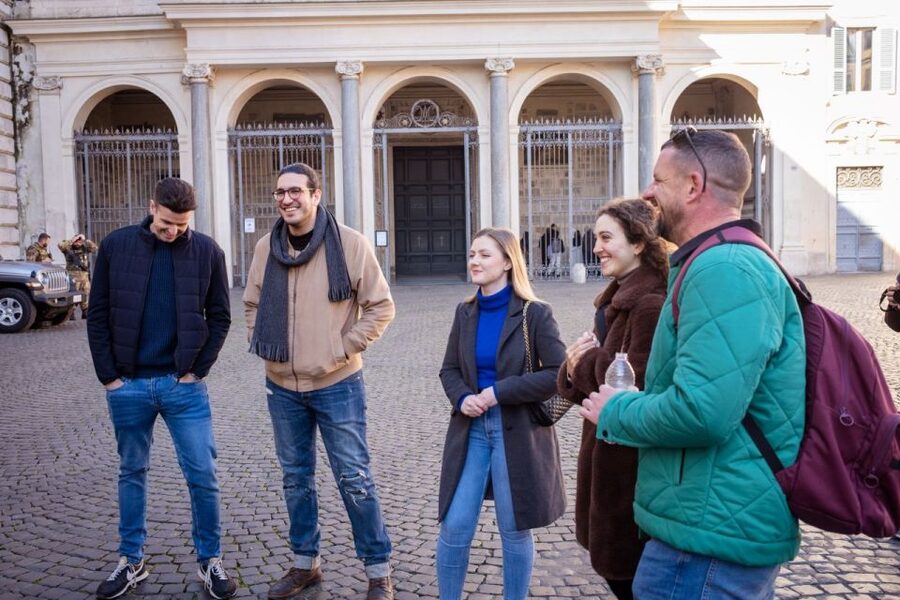
The route continues to MUHBA El Call, the historic Jewish quarter. This stop gives you a chance to think about the communities that lived in medieval Barcelona and how religious and civic power shaped daily life.
El Call is a valuable inclusion because it adds social history to the better-known architectural sights. You are not only looking at stone walls and church façades. You are learning about the people and communities who lived within the old city.
The stop also connects naturally with the discussion of the Spanish Inquisition. Religious policy was not an abstract matter here. It affected real communities, their beliefs, their homes, and their place in Barcelona.
The guide will provide the explanation, since the route is not described as an interior museum visit. If you want a longer treatment of the Jewish quarter, you would need additional time beyond this walk. Within two hours, expect an introduction rather than a full study.
Plaça de Sant Jaume and the center of Catalan public life
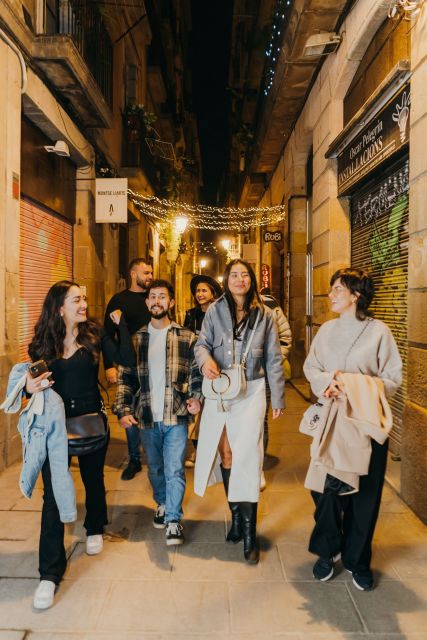
Plaça de Sant Jaume is one of the city’s key civic squares. It is where Barcelona’s main municipal and Catalan government institutions face one another, making it a natural place to discuss politics, public identity, and Catalan traditions.
This stop helps bring the tour into the present. Earlier sections focus on Roman origins, medieval religion, and historic communities. Here, the guide can show how Barcelona’s public life continues to gather around the same old center.
The square may feel more open and official than the lanes around it. That contrast is useful. You will see how the Gothic Quarter contains both intimate corners and major civic spaces.
I would pay close attention to recommendations offered here. Several guides, including Sara and Lindsay, are praised for answering questions and suggesting ways to enjoy the rest of a Barcelona visit. Since the walk takes place in a central area, it is a good moment to ask about places you plan to see afterward.
Plaça del Rei and the medieval Golden Age

Plaça del Rei brings the tour back to Barcelona’s medieval power. The square is associated with the city’s royal and historic center, making it a strong setting for discussion of the medieval Golden Age.
This is one of the stops where the route’s structure pays off. You have already heard about Roman Barcelona and religious institutions. Now the guide can show how the city grew in status, wealth, and political importance.
The square also rewards patience. Rather than rushing through for a photograph, take time to look at the surrounding buildings and imagine how the space functioned when Barcelona’s rulers and officials held greater influence there.
The guide spends around 10 minutes at this stop. That is enough for a useful explanation, but not enough for an extended architectural lecture. If you enjoy medieval buildings, you may want to return later at your own pace.
Plaça de l’Àngel and the old city crossroads
Plaça de l’Àngel is another public space on the route. It helps show how the Gothic Quarter is connected by movement, commerce, and changing urban life.
This is not presented as a major ticketed attraction. Its value comes from the guide’s interpretation and from seeing how one square fits into the broader old-city map.
Short stops like this keep the walking pace steady. Each location receives roughly 10 minutes, so you continue moving instead of spending most of the tour in one place. That format suits you if you want a broad first orientation rather than a slow, specialized architecture tour.
Plaça de Santa Maria and the finish
The final listed stop is Plaça de Santa Maria, at number 1. It gives the walk one more historic square and another chance to connect Barcelona’s religious architecture with its public spaces.
The route then finishes back at the meeting point. That return is useful if you need to collect your bearings before heading to another part of the city. It also makes the tour easier to fit into a morning or afternoon plan.
The exact rhythm depends on the guide and the group. The listed stops are each designed for about 10 minutes, but questions and crowd conditions can affect the pace. The most useful approach is to treat the route as a guided introduction, not a timed checklist.
What the $22 price gets you
At $22 per person, this is a low-cost way to spend two hours with a live English-speaking guide. The price includes the guide but not cathedral or basilica admission.
I see the value in the interpretation, not in the number of buildings alone. Barcelona’s Gothic Quarter is free to walk, but understanding the Roman grid, the Jewish quarter, the Inquisition, the Civil War, and the local legends gives the walk a purpose you would not get from wandering without context.
The price is especially fair if you take the tour near the start of your visit. You can use the route to understand the old city, then return to the places that interest you most. One strong guide can also point out details you might otherwise miss, as several guides are praised for noticing architectural features and offering practical suggestions.
The limitation is clear: this is not an admission-based cathedral tour. If stepping inside religious buildings is your main goal, budget separately for entry and allow more time after the walk.
Guide style and who will enjoy it
The experience is conducted in English. Guide assignments vary, but the named guides praised for clear explanations, humor, warmth, and good pacing include Jordan, Darren, Mariah, Petra, Lindsay, Sara, Tamara, and Kiki.
The strongest fit is someone who likes history delivered through stories. You will hear facts about 2,000 years of Barcelona, but you will also get legends, cultural characters, political episodes, and small details that make the city easier to remember.
It suits first-time visitors particularly well. You get a map in your head and a useful introduction to the old center before spending time at museums, churches, cafés, or other neighborhoods.
It can also work for repeat visitors. One person who had lived in Barcelona for two years still found new information in the walk, which suggests that the route can reveal details even if you already know the main streets.
Families and older children may enjoy the strange stories, though the serious discussion of the Inquisition and Civil War may call for some preparation. Anyone who dislikes walking, narrow streets, or a story-focused tour should think twice.
Practical advice before you go
Wear comfortable shoes. The experience lasts two hours and takes place on foot through historic streets and squares.
Bring a camera if you want photographs of the cathedral area, Carrer del Bisbe, Plaça de Sant Felip Neri, Plaça del Rei, and the other old-city settings. A camera is useful, but listen first. The tour’s best details are spoken, not displayed on a sign.
Comfortable clothes are recommended. Check the starting time when booking, and arrive at Plaça Nova with enough time to find the Barcino sculpture and the yellow Carpe Diem Tours sign.
The activity offers free cancellation up to 24 hours in advance, and you can reserve now and pay later. Those terms are helpful if your schedule is still shifting, but the main planning issue remains the starting time and the location of the meeting point.
Should you book this Barcelona walking tour?
Book it if you want a well-priced introduction to the Gothic Quarter that mixes major sights with Roman origins, Jewish history, political conflict, architecture, and unusual local stories.
I would choose it early in a Barcelona visit. The two-hour length is manageable, the route covers a lot without requiring a full day, and the guide’s recommendations can help shape the rest of your stay.
Skip it if you need cathedral interiors, a private guide, or a slow architectural study of every building. Entry tickets are separate, and the route is designed to keep you moving.
For most visitors who want history with a human voice, the $22 cost is easy to justify. Put on good shoes, find the Barcino sculpture, and keep an eye out for that skull on Pont del Bisbe.
FAQ
How long does the Barcelona walking tour last?
The tour lasts two hours. Starting times depend on availability when you book.
What language is the tour conducted in?
The live guided tour is conducted in English.
Where does the tour start?
The guide meets you at Plaça Nova, 40, in front of the large Barcino sculpture. Look for the guide holding a yellow Carpe Diem Tours sign.
Where does the tour finish?
The activity ends back at the meeting point.
Are cathedral and basilica admission tickets included?
No. Entry into cathedrals and basilicas is not included in the tour price.
What should you bring?
Bring comfortable shoes, a camera, and comfortable clothes.
How much does the tour cost?
The listed price is $22 per person.
Can you cancel the booking?
Yes. You can cancel up to 24 hours in advance for a full refund. You can also reserve now and pay later.
Just added around Barcelona
- GoCar Full Day Tour★ 4.0 · 6 reviews
- Sagrada Familia and Barcelona Highlights: Private Guided 4-Hour Driving Tour★ 5.0 · 6 reviews
- Gobbi Yacht Rental in Barcelona 9 Pax 2/4/8hs★ 5.0 · 6 reviews
- Barcelona: Highlights & Gems Private Tour with Tapa & Drink★ 3.9 · 6 reviews
- Gothic Quarter and Born District: Photographic Workshop★ 5.0 · 6 reviews
- Barcelona: Gothic Quarter & La Sagrada Familia Private Tour★ 4.9 · 6 reviews
- Private Sailboat Ride at Sunset from Sitges★ 5.0 · 6 reviews
- Barcelona: Private Tour of Casa Batllo with Reserved Access★ 3.5 · 6 reviews
Hidden Gems and Local Walks, compared.
Barcelona 3-hour Bike or E-Bike Tour: Highlights and Hidden Gems
Read our review →
El Born and Gothic Quarter Wine & Tapas Bar Tour
Read our review →
El Born Food Walking Tour with Tapas and Drinks
Read our review →
Barcelona Old Town Tapas Tour: Vermouth, Bites & Hidden Gems
Read our review →
Barcelona Highlights & Hidden Gems Private Tour
Read our review →
Barcelona Food Tour: Tapas, Drinks and Delights with a Local
Read our review →
Barcelona Historical Walking Tour: Gothic Quarter and El Born
Read our review →
Welcome to Barcelona: Private Tour with a Local
Read our review →Browse the lists this tour appears in