
Reviewed · HISTORICAL TOURS
Barcelona’s Dark History Night Tour
Barcelona’s darkest stories unfold after sunset on this two-hour walk from Arc de Triomf to El Born. You’ll hear how the Spanish Inquisition worked, what public executions looked like, and why medieval punishments shaped the city’s public spaces. Guides such as Elena, Noah, Sara, and Annemarie are praised for turning grim material into lively storytelling.
I like the small-group format, which keeps the guide close and makes it easier to ask questions. I also like the clever use of a projector, props, and radio headsets, especially in busy old streets. The main drawback is the subject matter: executions and torture are discussed plainly, so this is not a good choice for young children or anyone seeking a light ghost walk.
In This Review
- Key points to know before you book
- Barcelona’s dark past after the sun goes down
- Starting at Arc de Triomf
- The Spanish Inquisition explained in plain terms
- Executions, torture, and medieval punishment
- Cemeteries and the changing city
- Walking through El Born at night
- How the guide and equipment shape the experience
- Is $25.41 good value?
- Who should book this walk?
- Practical advice for a better evening
- Should you book Barcelona’s Dark History Night Tour?
- FAQ
- Where does Barcelona’s Dark History Night Tour begin?
- Where does the tour end?
- How long does the tour last?
- What time does the tour start?
- Is this a ghost tour?
- What topics are covered?
- Is the tour suitable for children?
- What is included in the price?
- Are food and drinks included?
- What happens if it rains?
Key points to know before you book
- This is history, not a ghost tour: Legends may appear, but the focus is documented darkness from Barcelona’s past.
- The walk links two useful areas: Begin at Arc de Triomf and finish beside El Born Centre, near restaurants, taxis, and metro stations.
- Twilight timing changes by season: Start times are around 7 p.m. in winter and 9 p.m. in summer.
- Expect vivid subject matter: Inquisition practices, executions, public punishment, cemeteries, and medieval penalties all form part of the talk.
- Guides make the difference: Elena is often singled out for humor and energy, while Noah, Sara, Annemarie, and Eleanor have also led engaging walks.
- The $25.41 price is fair for a two-hour guided walk: You pay for a focused topic, a professional guide, headsets, and visual aids rather than entry to a major monument.
Barcelona’s dark past after the sun goes down
Barcelona is easy to admire in daylight. Gaudí, beaches, markets, and grand boulevards get most of the attention. This tour takes a different route through the city’s past, asking you to consider what public life looked like when punishment was meant to frighten an entire population.
The walk begins as evening settles in. That timing matters. Old streets feel different under streetlights, and the shift from daylight to darkness gives the stories a natural setting without turning the experience into a theatrical fright show.
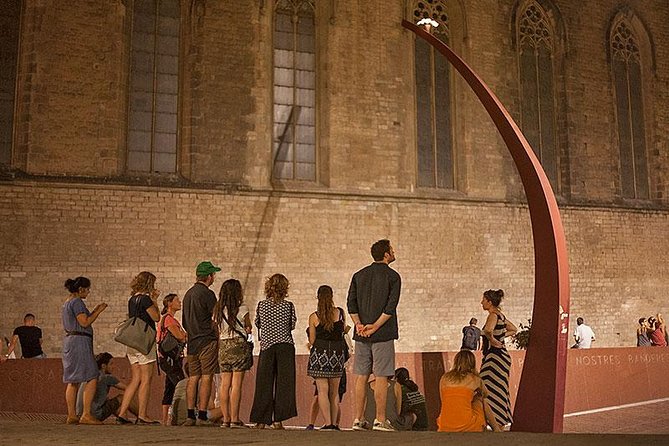
You meet your guide and a small group near Arc de Triomf. From there, the route heads toward El Born, using the old city as a backdrop for stories about authority, religion, crime, punishment, and death.
The tone is serious, but it is not solemn for two straight hours. Guides use humor, questions, props, projected images, and small bits of audience participation to keep the material moving. Elena, in particular, is praised for her energy, warmth, and gift for storytelling. That matters here because a lecture about punishments can become heavy fast.
The best guides make the history understandable without making it cute. They can explain why these practices existed, who controlled them, and how ordinary people encountered them. You get entertainment, but the point remains the past itself.
A few more Barcelona options worth an hour of your trip
- Barcelona: Tapas Walking Tour with Food, Wine, and History
★ 4.8 · 4,261 reviews - Barcelona Tapas Walking Tour: Food, Wine & History
★ 4.5 · 1,928 reviews - Barcelona: 2.5-Hour Bike or E-Bike Historical Tour
★ 4.5 · 1,262 reviews
Starting at Arc de Triomf
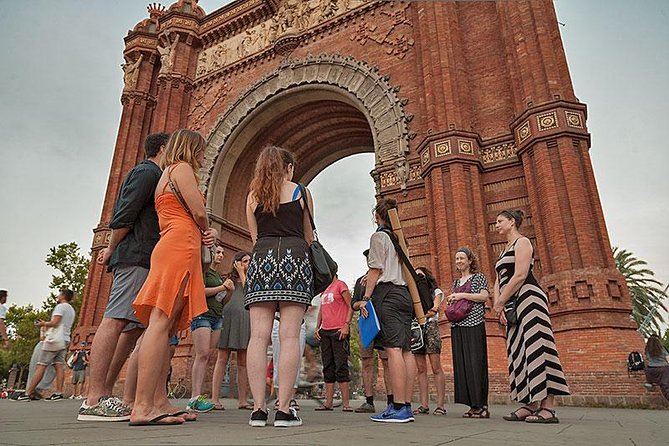
Arc de Triomf is a practical meeting point. It is central, easy to recognize, and close to public transportation. The meeting stop itself is brief, so arrive ready to walk rather than expecting a long introduction at the arch.
The monument also sets up a useful contrast. Today, the area feels open and pleasant. The tour then leads you into older parts of Barcelona where the city’s public spaces carried very different meanings.
You should wear comfortable shoes. The walk lasts about two hours, and the route includes old-town streets rather than a single indoor venue. Bring water, since food and drinks are not included. A small drink is especially sensible during the later summer start times.
The tour continues in light rain, so bring an umbrella if the forecast looks unsettled. Bad weather does not automatically cancel the experience. That policy is useful, but it also means you should dress for the actual evening instead of assuming the late start will be dry.
The Spanish Inquisition explained in plain terms
The central subject is the Spanish Inquisition. You learn what it was, what its officials believed, how it operated, and how its methods affected people in Barcelona.
This is more useful than simply hearing a string of shocking facts. The guide places the punishments within a system of religious control and public authority. You hear about the logic used to justify the process, then about the human cost of those ideas.
The tour also covers Acts of Faith, public ceremonies connected with the Inquisition. These events were not private matters. They could turn punishment into a public display, allowing authorities to send a message to a much larger audience.
That public side is one of the strongest parts of the experience. You begin to see punishment as theater used by the state and religious institutions. The crowds, ceremony, symbols, and spectacle all played a role.
The material can be disturbing. The tour discusses brutality directly, and it is aimed at people aged 14 and older. Families with teenagers should think about temperament, not just age. Some 14-year-olds may find the subject fascinating, while others may find it upsetting.
Executions, torture, and medieval punishment
The walk goes beyond the Inquisition to examine executions in Barcelona and the different penalties used in medieval society. You hear what public executions consisted of and how punishment could become part of everyday city life.
The appeal is not simply shock value. A good guide connects each practice to the social order of the time. Who had power? Who was allowed to accuse? Why were punishments carried out in public? What did authorities want people to remember?
The subject includes some gruesome details. You should not book this expecting gentle folklore. The title is accurate, and the tour earns its darker label.
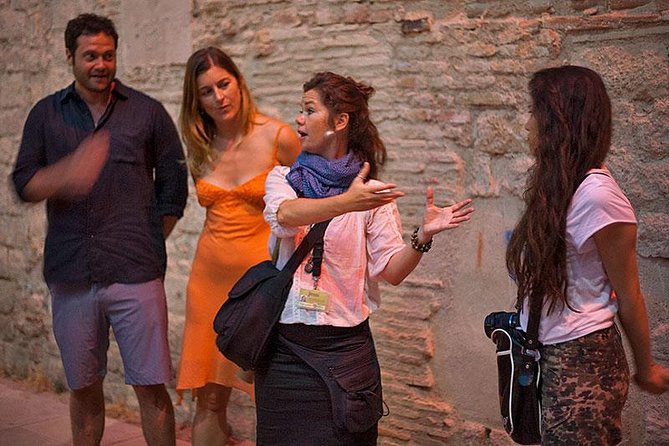
At the same time, the guides keep the evening approachable. Elena has been praised for getting the group involved, sometimes asking participants to reenact parts of historical scenes. That approach will appeal to people who learn best through a story rather than a list of dates.
If you prefer quiet, academic commentary, the interactive style may feel a little lively. If you enjoy a guide who keeps asking questions and drawing the group into the subject, it should work well.
Same corner of Catalonia, a completely different day:
- Barcelona: Park Güell Admission Ticket
★ 4.4 · 76,534 reviews - Barcelona: Casa Batlló Entry with Self-Audioguide Tour
★ 4.7 · 25,359 reviews - Barcelona: 24 or 48-Hour Hop-On Hop-Off Bus Tour
★ 4.4 · 20,872 reviews - Barcelona: Park Guell Guided Tour with Skip The Line Entry
★ 4.7 · 17,563 reviews
Cemeteries and the changing city
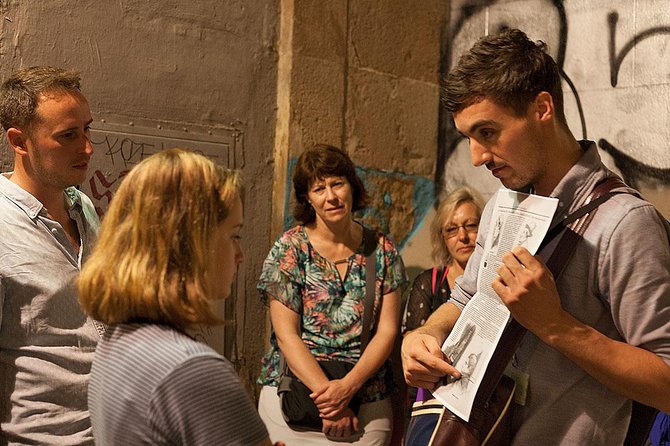
One less obvious theme is the development of cemeteries. This gives the walk more range than a simple catalogue of punishments.
Cemeteries reflect changing ideas about death, religion, public health, and urban space. You will not spend the whole tour looking at burial sites, but the subject helps explain how a city dealt with the dead and how those arrangements changed over time.
This is the kind of detail that makes the experience more than a collection of gruesome tales. Barcelona’s dark past includes institutions and city planning, not only individual crimes and punishments.
The same is true of the hidden symbols and local legends included along the way. The guide may point out details you would likely pass without noticing. These small observations make the old city feel less like a postcard and more like a place shaped by centuries of fear, belief, and rumor.
Walking through El Born at night
El Born is where the walk gains much of its atmosphere. The route ends at El Born Centre de Cultura i Memòria, also called El Born CC, on Plaça Comercial.
The neighborhood is a strong place to finish an evening walk. You are near restaurants, wine bars, metro stations, and taxi stops, so you can continue with dinner or head back to your hotel. Ask the guide for suggestions before the group breaks up. Several stops along the route may tempt you to return later for food or a drink.
The finish is also practical for first-time visitors. You are not left in an isolated area at the end of a late-night activity. The surrounding streets offer plenty of choices, though you should still keep normal city awareness after dark.
Do not expect an extended visit inside the Born Centre itself. The attraction is the walk and the storytelling. El Born provides the setting and the ending point rather than a separate admission visit.
How the guide and equipment shape the experience
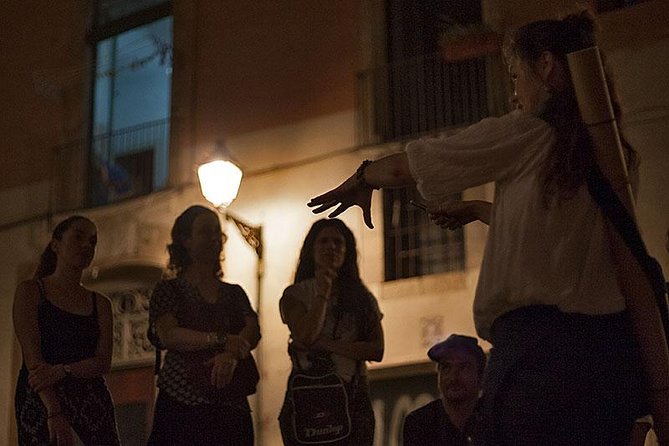
The advertised group is limited to 15 people, though the booking information also lists a maximum of 17. If group size matters greatly to you, confirm the current limit before booking.
Even a group of 15 to 17 is much easier to manage than a large city walk. You can hear the guide, move through narrow streets with less confusion, and ask questions without waiting through a long line of people.
Radio guides are included. This is a real advantage in Barcelona’s old quarters, where traffic, conversation, and nearby activity can make a normal walking talk hard to follow. You can stay a little farther from the guide without losing the thread.
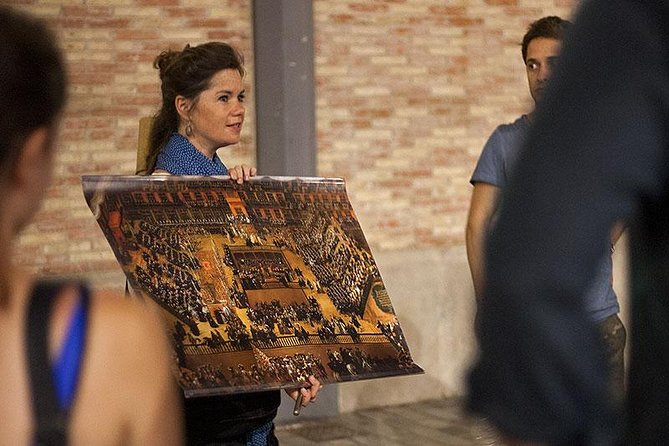
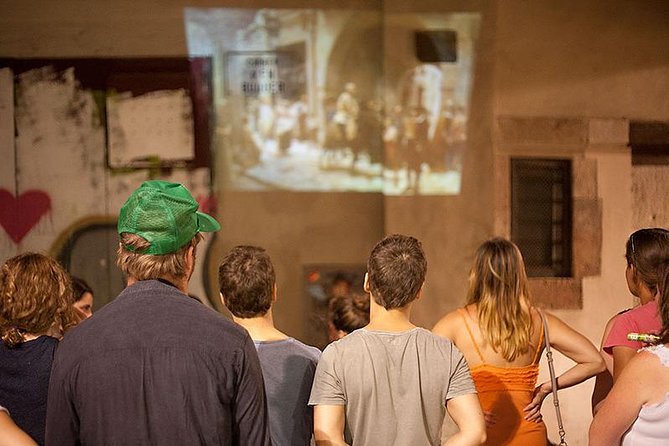
A small projector is also used to show images. Props and visual aids help with topics that are hard to picture from words alone. The equipment does not replace the city around you, but it gives the guide a way to show people, symbols, or scenes connected with the stories.
The quality of the evening will depend partly on your guide. Elena receives especially warm praise for being funny, welcoming, and energetic. Noah is noted for his grasp of neighborhood history, while Sara and Annemarie are also described as strong storytellers. Eleanor, an Irish guide, has been praised for enthusiasm and well-prepared visual aids.
You cannot choose the guide from the information provided, so book for the subject and format first. A lively guide is a welcome bonus.
Is $25.41 good value?
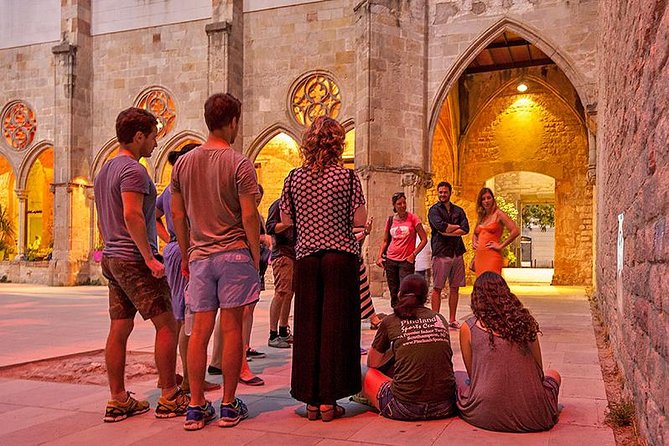
At $25.41 per person, this is reasonably priced for a two-hour guided activity in central Barcelona. You are not paying for museum admission or a major landmark ticket. You are paying for a specialist topic, a local guide, a small group, radio communication, and visual material.
The value depends on how you like to explore. If you want famous sights and interior visits, put the money toward a museum or monument. If you want context that changes how you see the old city, this walk gives you a focused evening without taking up an entire day.
The timing also helps. A late walk leaves daylight hours for Sagrada Família, Park Güell, markets, or museums. In summer, the start may be as late as 9 p.m., which can work well after dinner, though you should check the exact time before planning your meal.
There are no snacks or drinks included. That is not a serious issue because the route ends near many places to eat, but budget for your own refreshment.
The 98 percent recommendation rate and 4.9 rating from 181 submitted ratings indicate very strong satisfaction, with 181 ratings recorded at the time of the supplied information. I would treat those figures as a sign that the format works well, not as a promise that every guide or group will suit you.
Who should book this walk?
I would recommend it to you if you:
- Enjoy social history, crime history, or medieval Europe
- Want something different from Barcelona’s standard sightseeing circuit
- Like walking tours with a lively guide and audience participation
- Are comfortable hearing about executions, torture, and religious persecution
- Prefer a small group to a large coach or crowded audio tour
- Want an evening activity that ends near restaurants and transport
It is also a good choice for solo visitors. The small group gives you an easy way to meet people, and one solo participant found it especially pleasant to walk beside the guide and chat during the evening.
Families with older teenagers should read the subject description carefully. Two teenagers, aged 14 and 18, enjoyed the tour, but the content is plainly dark. Children younger than 14 are not recommended.
A wheelchair user with a manual chair found the route accessible, which is encouraging. Still, the official information does not provide detailed route specifications, so anyone using mobility equipment should contact the provider before booking if curb surfaces, slopes, or restroom access are important concerns.
Practical advice for a better evening
Arrive at Arc de Triomf a little early so you can find the group without rushing. The meeting point is central, but the walk itself begins promptly.
Wear shoes you can use comfortably for two hours. Bring an umbrella in wet weather and water in warm weather. Since the tour is not cancelled simply because of rain, your comfort depends on what you pack.
Expect the start time to change through the year. Winter departures are around 7 p.m., while summer departures are around 9 p.m. Twilight is part of the mood, so the schedule is designed around sunset rather than a fixed daily hour.
Keep your evening flexible after the walk. The end near El Born CC is convenient for dinner, and you may want to return to one of the bars or restaurants you pass along the way.
Free cancellation is available if you cancel at least 24 hours before the local start time. Changes or cancellations made inside that window are not accepted for a refund.
Should you book Barcelona’s Dark History Night Tour?
Book it if you want a smart, entertaining walk through the less comfortable parts of Barcelona’s past. The combination of Inquisition history, public punishment, dark legends, projected images, and El Born after twilight gives the evening a clear identity.
Skip it if you want a supernatural ghost hunt, a gentle family outing, or a tour centered on famous architecture. This is an historical walk with gruesome material, not a haunted-house performance.
For most history-minded visitors aged 14 and older, the price is fair and the route is well chosen. I would especially consider it early in your Barcelona stay, since the walk may reveal corners of El Born and the old city that you will want to revisit in daylight.
FAQ
Where does Barcelona’s Dark History Night Tour begin?
The tour begins at Arc de Triomf in central Barcelona, at Ciutat Vella, 08018 Barcelona.
Where does the tour end?
It ends at El Born Centre de Cultura i Memòria, also called El Born CC, at Mercat del Born, Plaça Comercial, 12.
How long does the tour last?
The walking tour lasts about two hours. The listed duration is approximately 2 hours and 2 minutes.
What time does the tour start?
The start time changes with the season. It begins around 7 p.m. in winter and around 9 p.m. in summer, because the tour starts around twilight.
Is this a ghost tour?
No. The tour focuses on the historical side of Barcelona’s darker past. Some legends may be included, but the main subjects are the Spanish Inquisition, punishments, executions, cemeteries, and public ceremonies.
What topics are covered?
You learn about Inquisition methods, medieval punishments, executions in Barcelona, public executions, the development of cemeteries, Acts of Faith, and dark Barcelona legends.
Is the tour suitable for children?
It is not recommended for children younger than 14 because of the dark and gruesome subject matter.
What is included in the price?
The experience includes a professional local guide, a small-group walking tour, a projector for images, and radio guides for communication.
Are food and drinks included?
No. Food and drinks are not included, so bring water or plan to eat after the walk. The tour ends near restaurants and bars in El Born.
What happens if it rains?
The tour is not cancelled because of weather conditions. Bring an umbrella if rain is expected.
Just added around Barcelona
- GoCar Full Day Tour★ 4.0 · 6 reviews
- Sagrada Familia and Barcelona Highlights: Private Guided 4-Hour Driving Tour★ 5.0 · 6 reviews
- Barcelona: Highlights & Gems Private Tour with Tapa & Drink★ 3.9 · 6 reviews
- Gothic Quarter and Born District: Photographic Workshop★ 5.0 · 6 reviews
- Gobbi Yacht Rental in Barcelona 9 Pax 2/4/8hs★ 5.0 · 6 reviews
- Barcelona: Gothic Quarter & La Sagrada Familia Private Tour★ 4.9 · 6 reviews
- Private Sailboat Ride at Sunset from Sitges★ 5.0 · 6 reviews
- Barcelona: Private Tour of Casa Batllo with Reserved Access★ 3.5 · 6 reviews
Historical Tours, compared.
Tapas Walking Tour with Food, Wine, and History
Read our review →
Barcelona Tapas Walking Tour: Food, Wine & History
Read our review →
Barcelona Erotic Museum – Explore Art, History & Fun
Read our review →
Andorra Original History and Sightseeing Tour (Private, Pickup)
Read our review →
Tarragona and Sitges Small Group Tour – Roman History & Culture
Read our review →
Girona History and Legends Tour Small Group from Girona
Read our review →Browse the lists this tour appears in