
Reviewed · DALI MUSEUM DAY TRIPS
Figueres: Dalí Theatre-Museum Entry Ticket
Dalí’s Theatre-Museum is not simply a building full of paintings. The building itself is part of the artwork, with giant eggs, golden figures, optical tricks, and a red facade that looks like it came straight from the artist’s imagination. Inside, you’ll find paintings, sculptures, installations, jewelry, and the unusual final resting place of Salvador Dalí.
I like the sheer variety here. You can move from a classic painting to a playful three-dimensional trick, then into a room devoted to Dalí’s jewelry. I also like that the museum asks you to look twice. Some works change depending on where you stand, so this is a place for curiosity, not just quiet admiration.
The main drawback is crowding. Entry is tied to a stated date and time, and another group may be admitted every 15 minutes. That system helps control access, but the interior can still feel cramped, and the room sequence is not always easy to follow. There is no guided tour or audio guide included, so you’ll need to explore at your own pace.
In This Review
- Key points to know before you go
- Why the building matters as much as the art
- Inside the largest collection of Dalí’s work
- Optical illusions and installations that make you look twice
- The dome and Dalí’s final resting place
- A surprising stop: Dalí’s jewelry
- Rotating exhibitions and changing reasons to return
- How much time should you allow?
- Timed entry, bags, and what you cannot bring
- Is the $27 ticket good value?
- Who will enjoy this museum most?
- Should you book the Dalí Theatre-Museum?
- FAQ
- Where is the Dalí Theatre-Museum?
- How much does admission cost?
- How long is the ticket valid?
- Is transportation included?
- Is a guided tour included?
- What can I see inside the museum?
- Can I bring a large bag or umbrella?
- Is the museum wheelchair accessible?
Key points to know before you go
- The red exterior is part of the show: Giant eggs, golden statues, and the geodesic dome prepare you for Dalí’s unusual way of seeing.
- Expect more than paintings: Sculptures, optical illusions, 3D displays, installations, and jewelry fill the museum.
- Look beneath the dome: Dalí’s final resting place is located under the museum’s iconic geodesic roof.
- Allow at least two hours: One visitor spent more than two hours and still wished for extra time.
- Book an early entry if possible: The museum can become crowded as timed groups arrive throughout the day.
- This is a self-guided visit: The ticket covers entry, but not transportation, food, a guide, or an audio guide.
Why the building matters as much as the art

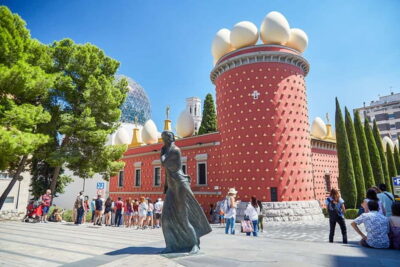
I would begin outside, before thinking about the ticket or the galleries. The museum’s exterior is loud, theatrical, and deliberately strange. Giant eggs sit above the red walls, golden figures decorate the roofline, and the dome gives the whole structure a dreamlike profile.
That matters because Dalí did not treat the museum as a neutral container. The building sets the tone for everything inside. You are not entering a standard white-walled gallery where paintings hang in neat rows. You are entering a visual world designed to unsettle your expectations.
The exterior also makes the visit feel tied to Figueres rather than copied from a major museum in Madrid or Barcelona. This is Dalí’s hometown museum, and the setting gives the collection a strong sense of place. I like that you can understand the basic idea of the museum before seeing a single artwork: expect theatre, humor, surprise, and a little confusion.
Take a few minutes outside for a proper look. The details are easy to miss if you hurry straight toward the entrance. The gold figures and eggs are not just decoration for photographs. They announce that this visit will be as much about spectacle and imagination as it is about art history.
More Dalí museum runs:
- From Barcelona: Girona, Figueres, Dalí Museum, and Cadaqués
★ 4.7 · 1,928 reviews - From Barcelona: Girona Guided Tour & Dalí Museum in Figueres
★ 4.5 · 339 reviews - From Barcelona: Private Girona and Figueres with Dali Museum Tour
★ 5.0 · 113 reviews
Inside the largest collection of Dalí’s work
Once inside, you get access to the largest collection of Dalí’s works. The range is the real strength. You may see paintings from different periods, sculptures, installations, optical effects, and objects that show how broadly Dalí worked.
I find this more useful than a display focused only on his most famous images. A single famous painting can give you one version of Dalí: the dreamer with the melting clocks and strange creatures. Here, you get a wider look at his methods and interests. His work appears in two and three dimensions, and the presentation often asks you to participate by shifting your position or changing your focus.
The museum’s layout is labyrinthine. That can be exciting, since you never know exactly what the next room will contain. It can also be frustrating. The route is not always obvious, and a crowded room makes it harder to decide whether you have seen everything.
I suggest resisting the urge to rush from room to room. Stop when a piece catches your eye, then look for the trick. Ask yourself what changes when you move, step back, or view the object from another angle. The museum rewards attention more than speed.
This is also a good place for people who do not normally spend hours looking at paintings. The 3D displays and optical illusions give you something active to do. Families and younger visitors may find the visual effects easier to connect with than a room of traditional portraits, though children under 12 must be accompanied by an adult.
Optical illusions and installations that make you look twice
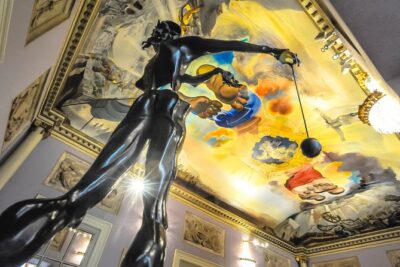
Dalí’s work often plays with perception, and the museum makes that idea physical. You may encounter images that seem to change depending on your distance from them, along with installations that turn ordinary objects into theatrical scenes.
I like this part of the visit because it explains why Dalí remains so accessible. You do not need to identify every artistic period or understand every symbol to enjoy a visual trick. The displays encourage you to test your own eyes.
The effect is strongest when you take your time. If a room seems confusing at first, move slowly and consider what Dalí wants you to notice. Some works are meant to be read as paintings, while others operate more like stage sets or puzzles.
The downside is that these popular pieces can attract small clusters of people. In a quiet gallery, you could study an illusion at your own pace. In a busy period, you may need to wait for a clear view or accept that the room will feel more like an attraction than a traditional museum.
That mix is not a flaw, but it is important to know what you are buying. This is not a calm, chronological survey of Surrealism. It is a lively, highly visual museum where art and entertainment often overlap.
The dome and Dalí’s final resting place
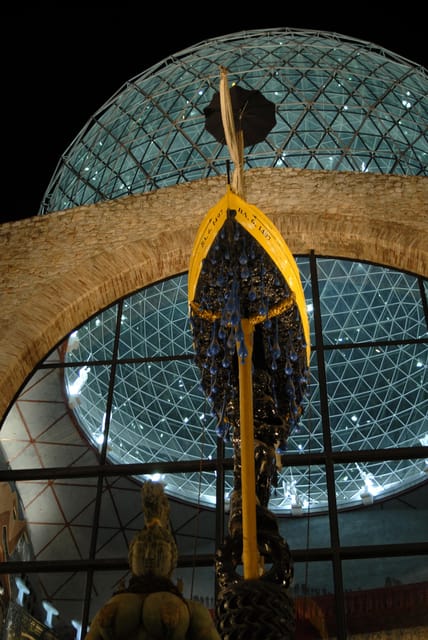
The museum’s geodesic dome is its most recognizable architectural feature. Look up as you move through the building, since the dome changes the feeling of the visit and gives the museum a strong visual center.
Dalí’s final resting place is located beneath the dome. It is a brief part of the visit, but it adds weight to the building. This is not only a collection assembled around a famous artist. It is also the place where Dalí chose to be buried.
I would not expect a large memorial ceremony or a long historical explanation here. The importance comes from the setting. You are inside a museum Dalí helped shape, beneath the roof that has become its visual signature, with his tomb below.
For some people, this will be the most meaningful stop. For others, the artwork and architecture will be the main attraction. Either way, it gives the museum a sense of completion. The building functions as exhibition space, monument, and final statement all at once.
More Figueres trips:
- Costa Brava – Kayaking and Snorkeling “Sea Caves” Tour
★ 5.0 · 567 reviews - Girona and Figueres Full-Day Tour with Hotel Pick Up
★ 4.8 · 304 reviews - Costa Brava – Sant Feliu de Guíxols / Kayaking & Snorkelling Tour
★ 5.0 · 108 reviews - Costa Brava: Via Ferrata Cala del Molí
★ 4.5 · 107 reviews
A surprising stop: Dalí’s jewelry
The jewelry section is easy to underestimate. Many people arrive expecting paintings and surreal sculptures, then discover a dedicated display of Dalí’s jewelry creations.
I especially like this part because it shows how his imagination worked on a smaller scale. Jewelry requires attention to shape, surface, materials, and presentation. The pieces offer another way to see his interest in symbols and unusual forms without relying on a large room or dramatic installation.
This section also helps break up the visit. After several large paintings or theatrical rooms, the jewelry gives you a more concentrated experience. You can look closely at the objects and consider how Dalí translated his ideas into wearable designs.
If you have limited time, do not skip it automatically. The collection offers a side of Dalí that is less familiar than his paintings and sculptures. It is one of the clearest examples of why this museum feels broader than a standard art exhibition.
Rotating exhibitions and changing reasons to return
The museum includes rotating exhibitions featuring Dalí and other artists. That means the visit may not be identical every time, and it can add context to the permanent displays.
I would think of these exhibitions as a bonus rather than the main reason to buy your ticket. The permanent collection, building, dome, and interactive works provide enough for a first visit. Still, temporary material can help you see Dalí in a new way or place his work alongside other artists.
The changing displays are also useful if you have already seen the museum. A second visit can feel less repetitive when there is fresh material to explore. The museum’s one-day ticket is intended for a single visit on the date and time you book, so returning requires another plan and another admission.
Because the museum’s displays cover different forms of art, you may find that one temporary exhibition appeals to you more than another. I would keep your schedule flexible enough to spend extra time if something catches your attention.
How much time should you allow?
The ticket is valid for one day, but this does not mean you should treat the museum as a quick stop. I would allow at least two hours for a useful visit, and more if you want to study the art carefully.
One person spent more than two hours inside and still wanted additional time. That feels realistic. The collection is large, the building can slow you down, and the optical displays work best when you give them a second look.
If you are visiting Figueres as part of a larger day, plan carefully. A short visit can cover the exterior, several major rooms, the dome, and the jewelry section. It will not give you time to examine every painting or pause at every installation.
An earlier entry is the safer choice if you dislike crowds. As the day continues, more timed groups arrive. The quarter-hour admission pattern can create congestion, especially in rooms where people gather around interactive displays.
The museum is wheelchair accessible, which is useful for visitors who need step-free access. Still, crowding can affect how easily you move through the interior, so an early time may make the visit more comfortable.
Timed entry, bags, and what you cannot bring
You must visit on the stated date and time printed with your reservation. If you miss that slot, the reservation may be canceled, and entry will depend on availability at that moment. I would not treat this as a flexible ticket.
Bring only what you need. Bags and backpacks are searched at the entrance. Objects larger than 35 by 35 by 25 centimeters are not allowed, along with rucksacks, umbrellas, pushchairs, luggage, and other items staff consider a security risk.
The museum has a consignment office for bags, umbrellas, luggage, and other large objects. However, do not use it for jewelry, money, valuables, living beings, or dangerous items. Assistance dogs are allowed, but other pets are not.
Food and drinks are not permitted inside. Smoking indoors is prohibited, and flash photography is not allowed. These rules are easy to follow, but knowing them ahead of time can save you an awkward delay at the entrance.
Is the $27 ticket good value?
At $27 per person, this is not a bargain-basement museum ticket, but I think the price is reasonable if you care about Dalí or enjoy unusual museum design. You are paying for access to a large collection, a distinctive building, interactive displays, the jewelry section, the dome, and rotating exhibitions.
The value is weaker if you plan to spend only 30 minutes inside. The museum works best when you give it enough time to absorb the different types of art. At two or more hours, the cost becomes easier to justify, especially since the building itself is part of the attraction.
The ticket includes the booking fee and museum access. It does not include food, drinks, transportation, or a guided tour. If you want historical explanation as you go, you may find the lack of an included audio guide a drawback. An audio guide would also help make sense of the rooms when the route feels unclear.
You can reach the museum independently, but this ticket does not arrange transportation. That gives you control over your day, though you need to plan your own route to Figueres and the museum.
Who will enjoy this museum most?
I would recommend it strongly to anyone with a real interest in Dalí, Surrealism, sculpture, design, or unusual architecture. You do not need specialist art knowledge. The optical illusions and installations give you plenty to enjoy even if you cannot name the artistic movement behind each piece.
It also suits families, provided children under 12 stay with an adult. The interactive quality gives younger visitors more to do than simply read labels, though crowded rooms may test everyone’s patience.
Photography-minded visitors will appreciate the exterior and the bold presentation, but remember that flash photography is forbidden. People who prefer a quiet, chronological museum may find the layout and crowds tiring.
I would be less enthusiastic about booking this as a rushed add-on between other appointments. The timed entrance means you need to arrive at the right moment, and the museum deserves more than a hurried glance.
Should you book the Dalí Theatre-Museum?
I would book this ticket if you are in or near Figueres and want to see Dalí in a setting shaped around his imagination. The mix of architecture, paintings, sculptures, optical effects, jewelry, installations, and the tomb beneath the dome makes this far more distinctive than a standard art museum.
Choose an early time, travel light, and allow at least two hours. Go in expecting a self-guided visit with an eccentric route rather than a formal lecture. If you need a guide or audio commentary, this ticket alone will not provide it.
For a Dalí fan, the $27 admission is easy to defend. For a casual visitor, it is still worthwhile if you enjoy theatrical displays and unusual buildings, but only if you can give the museum enough time. If you are already nearby, this is one of Figueres’ most memorable stops.
FAQ
Where is the Dalí Theatre-Museum?
The museum is in Figueres, Catalonia, Spain. Go directly to the Dalí Theatre and Museum for entry.
How much does admission cost?
The listed price is $27 per person. The booking fee is included.
How long is the ticket valid?
The ticket is valid for one day, but you must visit on the stated date and time shown with your reservation.
Is transportation included?
No. Transportation to the Dalí Theatre-Museum is not included.
Is a guided tour included?
No. The ticket does not include a guided tour. An audio guide is also not listed as included.
What can I see inside the museum?
You can see paintings, sculptures, installations, optical illusions, 3D displays, jewelry created by Dalí, rotating exhibitions, and Dalí’s final resting place beneath the geodesic dome.
Can I bring a large bag or umbrella?
No. Objects larger than 35 by 35 by 25 centimeters, along with large bags, rucksacks, umbrellas, pushchairs, and luggage, cannot be brought inside. These items should be left at the consignment office.
Is the museum wheelchair accessible?
Yes. The activity is listed as wheelchair accessible.
More Museums Worth an Hour
- Dali Museum, Figueres & Cadaques Private Tour with Hotel pick-up
★ 5.0 · 46 reviews - Girona, Figueres, Dalí Museum and Cadaqués Tour from Barcelona
★ 4.5 · 36 reviews - Dalí 2 Museums, Figueres and House of Portlligat small group from Girona
★ 4.5 · 29 reviews - Girona, Figueres, Dalí and Cadaqués Museum from Barcelona
★ 4.5 · 19 reviews
Just added around Figueres
- Toy Museum: Anna Maria and Salvador Dalí and García Lorca’s toys.★ 4.8 · 6 reviews
- Guided tour to the Museum of Dalì★ 4.5 · 7 reviews
- From Barcelona: Private Figueres & Pubol Full-Day Tour★ 4.9 · 10 reviews
- Private tour: Dali Museum in Figueres and Púbol Tour with Hotel pick-up★ 5.0 · 12 reviews
- Costa Brava: 2-hours Windsurfing session★ 5.0 · 16 reviews
- Escape Room Outdoor (on foot) Bartolomew Roberts Treasure★ 5.0 · 17 reviews
- Girona, Figueres, Dalí and Cadaqués Museum from Barcelona★ 4.5 · 19 reviews
- Escape Room Outdoor (kayak) Secrets of Tramontana★ 5.0 · 26 reviews
Dali Museum Day Trips, compared.

Girona & Dali Museum Small Group Tour with Pick-up from Barcelona
Read our review →
Dali Museum, House & Cadaques Small Group Tour from Barcelona
Read our review →
Girona and Dali Museum Full Day tour from Barcelona
Read our review →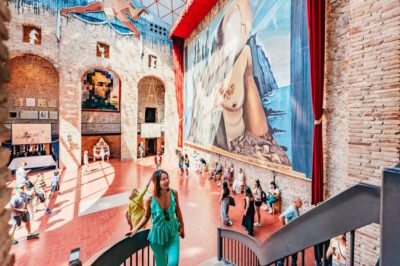

Dali Museum & Cadaques Small Group Tour with Hotel pick-up
Read our review →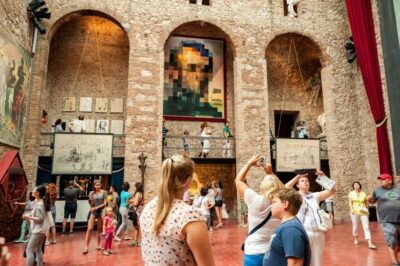
Browse the lists this tour appears in