
Reviewed · STREET ART
Raval Street Art and Graffiti Guided Tour in Barcelona
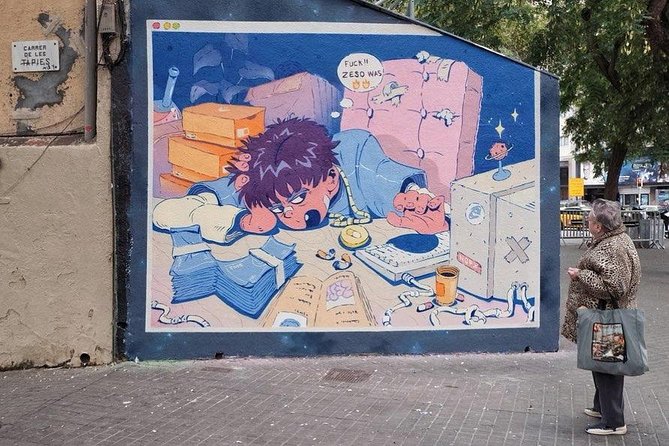
Raval’s street art is not decoration added to an old neighborhood. It is part of the neighborhood’s daily conversation. On this two-hour walk, you look past the obvious sights to find murals, painted shutters, paste-ups, and small works tucked above street signs. A guide such as Juan, who is also a street artist, can explain who made them, how they were created, and what they say about Barcelona.
I like the maximum group size of 15, which keeps the walk personal, and I like the stop at Tres Chemineas, a legendary skate spot where you can pause and watch local life. I also like that the route finishes near MACBA, a useful central location for continuing your day.
The main drawback is that street art changes fast. A work may be painted over, removed, or less impressive than expected on the day of your tour. The meeting points also require care, since the starting point and ending point are in different parts of central Barcelona.
In This Review
- Key points at a glance
- Why Raval street art deserves two hours
- Starting at Jardins Talía in Sant Antoni
- Reading Barcelona through shutters and paste-ups
- Raval beyond the postcard
- Tres Chemineas, a pause with local character
- A small group makes the art easier to discuss
- What the $32.58 price buys you
- The route ends beside MACBA
- What can go wrong
- Who should book this walk?
- Booking and cancellation details
- Should you book the Raval street-art tour?
- FAQ
- How long is the Raval Street Art and Graffiti Guided Tour?
- Where does the tour begin?
- Where does the tour end?
- Is the tour offered in English?
- What is the maximum group size?
- Does the tour include hotel pickup and drop-off?
- Are food and drinks included?
- What is the cancellation policy?
Key points at a glance
- Small groups of up to 15: You get a better chance to ask about artists, techniques, and local issues.
- A walk through Raval: The route connects street art with an old central neighborhood facing major social change.
- Guides with personal art experience: Juan is a street artist, while Olga, Jeanne, Cynthia, and Anaïs have also led highly praised walks.
- Tres Chemineas stop: You spend time at a well-known skate spot rather than simply passing through it.
- Central finish near MACBA: The walk ends at Plaça dels Àngels, close to one of Barcelona’s key contemporary art venues.
- $32.58 for about two hours: The price is fair if you want interpretation and local context, not just a list of photo stops.
Why Raval street art deserves two hours
I find street art tours useful because they change how you walk through a city after the tour is over. A painted metal shutter can look like background clutter until someone explains the artist’s style or points out how the work fits into the neighborhood.
That is especially true in Raval. The tour presents the area as an old popular neighborhood in the city center, with layers of architecture, local life, art, and social change. You are not only looking at walls. You are learning how artists use public space and how the neighborhood reacts to that use.
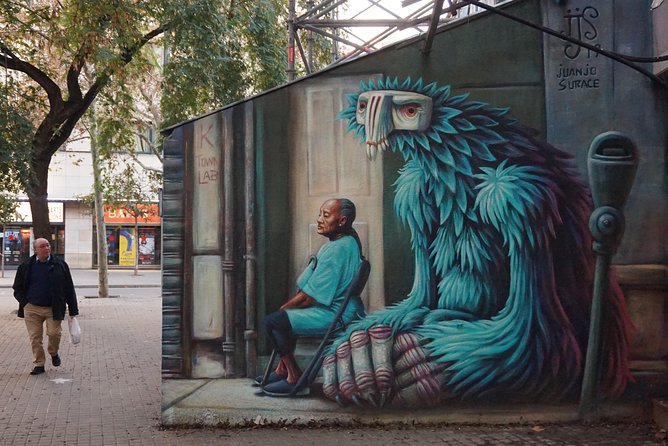
The best part is the combination of close observation and storytelling. Guides explain different forms of street art, including murals, paste-ups, and work painted on shutters. You might walk past details you would never notice alone, especially pieces placed high above eye level or tucked into side streets.
Several guides have been praised for their personal style. Juan is a practicing street artist who has led visitors through the area with stories about artists, gentrification, and local life. Olga has been praised for her detailed knowledge of the Barcelona art community. Jeanne has led French-language tours, while Cynthia and Anaïs have also guided the route.
Guide assignments can change, so you should not book on the assumption that one particular person will lead your walk. Still, the range of praised guides suggests that the experience depends heavily on the individual guide’s ability to connect art with place.
A few more Barcelona options worth an hour of your trip
- Barcelona Street Art and Graffitti Bicycle Tour
★ 5.0 · 361 reviews - Barcelona Street Art Tour with Exclusive Artist Studios Visit
★ 5.0 · 152 reviews - Barcelona: Raval Street Art and Graffiti Walking Tour
★ 4.9 · 60 reviews
Starting at Jardins Talía in Sant Antoni
The official starting point is Jardins Talía in the Sant Antoni area of Eixample, at Carrer del Comte Borrell, Barcelona 08015. The route then moves toward Raval and finishes near MACBA.
Pay attention to the meeting details when you book. The start and end points are not the same, and one booking-map problem has sent people to the ending point at MACBA instead of Jardins Talía. That mistake can cost you 15 to 20 minutes by subway and create needless panic before the walk begins.
I would save both addresses before leaving your hotel and check the route to Jardins Talía separately. The tour is offered in English, and it is near public transportation, but you still need to arrive at the correct end of the route. If you are delayed, contact the operator as soon as possible rather than assuming the guide can reverse the walk.
The meeting point can be difficult to spot, especially if you are unfamiliar with the Sant Antoni streets. Give yourself extra time. A calm start matters here because the walk is built around conversation and careful looking.
Reading Barcelona through shutters and paste-ups
The tour’s first major strength is its attention to small works. Barcelona’s street art is not limited to giant murals designed for a quick photograph. You may find art on shutters, stickers, paste-ups, and narrow wall spaces that vanish into the ordinary street scene.
A guide can help you see the difference between formats and techniques. You may learn why a piece was placed in a certain location, how an artist’s style can be recognized, or how temporary work differs from a more permanent mural. The exact pieces vary because public art changes constantly.
This changing quality is both a benefit and a limitation. You will see what is present on the day of your walk, not a fixed museum collection. A favorite work may have disappeared, while a newer piece may have appeared in its place. If you want a guaranteed list of famous murals, this is not the right kind of outing.
I prefer the uncertainty. It keeps the walk tied to the real city rather than to a frozen display. Still, your expectations should be realistic. The route’s artistic quality will depend partly on current conditions and your own taste.
Raval beyond the postcard
Raval has long been one of Barcelona’s central neighborhoods with a strong local identity. The tour uses street art as a way to discuss the district, including the pressure created by gentrification. One guide explained how rising costs have made it harder for some longtime residents to remain in the area.
That social context gives the art more weight. A mural or paste-up may be playful, political, commercial, or personal. The guide helps you consider who has access to public walls, who controls the image of a neighborhood, and how art can reflect conflict as well as creativity.
You also get a look at older buildings and everyday street life. One tour included a detour to an old church after a participant asked about it. The guide explained that the church predates Barcelona’s better-known Gothic churches and remains in use.
That kind of flexibility is valuable. It shows the benefit of a small group, where a question can shape the conversation without disrupting a large schedule. It also means the exact route may not feel identical from one date to another.
One particularly unusual account described a visit to a community garden that required a key and access through a local activist. You should not assume this garden is part of every tour, but the story shows what a local guide may be able to add when circumstances allow. It is a reminder that the most memorable parts of a neighborhood walk are sometimes not the official sights.
Same corner of Catalonia, a completely different day:
- Barcelona: Park Güell Admission Ticket
★ 4.4 · 76,534 reviews - Barcelona: Casa Batlló Entry with Self-Audioguide Tour
★ 4.7 · 25,359 reviews - Barcelona: 24 or 48-Hour Hop-On Hop-Off Bus Tour
★ 4.4 · 20,872 reviews - Barcelona: Park Guell Guided Tour with Skip The Line Entry
★ 4.7 · 17,563 reviews
Tres Chemineas, a pause with local character
The itinerary includes time at Tres Chemineas, described as a legendary skate spot. This is more than a quick photo stop. You hang around there and get a chance to watch a piece of local public life.
That pause gives the walk a different rhythm. Instead of moving from artwork to artwork without a break, you have time to take in the setting and consider how public spaces are used. Skaters, pedestrians, artists, and residents share the same urban stage, and the spot helps connect the art scene to everyday activity.
I would not book this tour expecting a formal skate demonstration or a dedicated skating lesson. The stated experience is to spend time at the spot. Its appeal comes from the atmosphere and the chance to feel less like you are being led between attractions.
For families and teenagers, this may be one of the more engaging moments. For anyone interested in how cities create informal gathering places, it adds useful texture to the walk.
A small group makes the art easier to discuss
With a maximum of 15 people, the tour is small enough for questions but not necessarily private. Some departures have had only two people, and one guide continued with just that pair. That can create a very personal experience, but you should not count on having a private tour.
The group size matters most when the guide stops beside a small work in a narrow passage. With a large crowd, people at the back would struggle to hear or see the details. Here, you have a better chance of getting close and asking about the artist.
The pace is an easy walk over roughly two hours. You should be comfortable walking through central streets and standing during explanations. The tour does not include hotel pickup or drop-off, so you make your own way to Jardins Talía and continue independently after reaching MACBA.
Most people can participate, and service animals are allowed. No food or drinks are included. Bring your own water, particularly if you are visiting during a warm part of the year, but keep the focus on walking and looking rather than expecting a food tour.
What the $32.58 price buys you
At $32.58 per person, this is not the cheapest way to walk through Raval. You can explore the neighborhood on your own for free. The question is what you want from the visit.
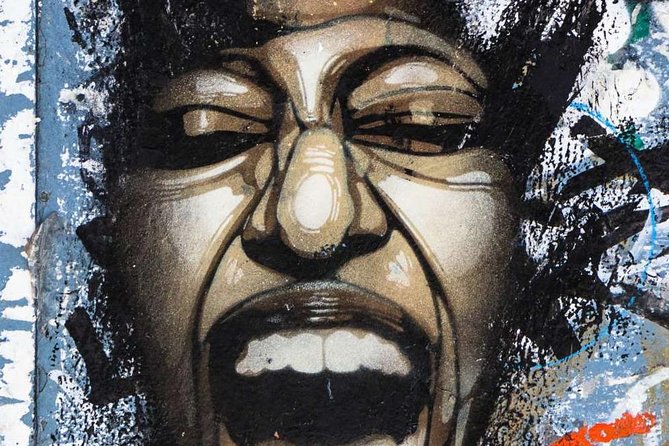
If you simply want to photograph colorful walls, the price may not seem worthwhile. You could find plenty of art by wandering, though you would not know which artists made it, what techniques were used, or how long the work is likely to remain.
I consider the price reasonable if you value interpretation. You are paying for a local guide, a planned route, help finding less obvious pieces, and a wider explanation of Barcelona’s art scene. The guide’s stories can also help you notice street art for the rest of your trip.
Several people returned to specific pieces later after learning how to look at them. That is the real value: the tour can sharpen your eye beyond the two-hour route. You finish with a better chance of spotting paste-ups, stencil work, and painted shutters in other neighborhoods.
The value is strongest for first-time visitors who want something beyond the standard monuments. It is less strong for someone already deeply familiar with Barcelona’s street-art scene or someone who dislikes temporary public art.
The route ends beside MACBA
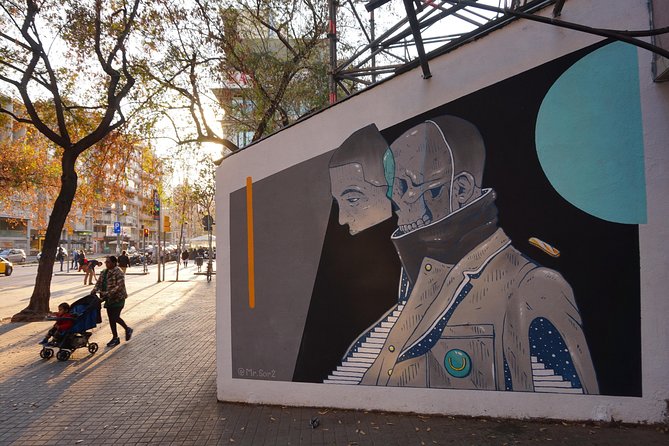
The official finish is Museu d’Art Contemporani de Barcelona, at Plaça dels Àngels, 1. This is a practical ending because it puts you in central Ciutat Vella, with plenty of options for the rest of the day.
You can continue exploring the surrounding area, stop for food on your own, or visit MACBA if its exhibits fit your schedule. The tour itself does not include museum admission, and it does not promise a museum visit. Think of the location as a convenient endpoint rather than part of the guided program.
Ending at MACBA also gives the route a clear sense of purpose. You begin in Sant Antoni, move through Raval’s streets and public spaces, and finish near a major contemporary art institution. That contrast helps show how formal and informal art can share the same city.
What can go wrong
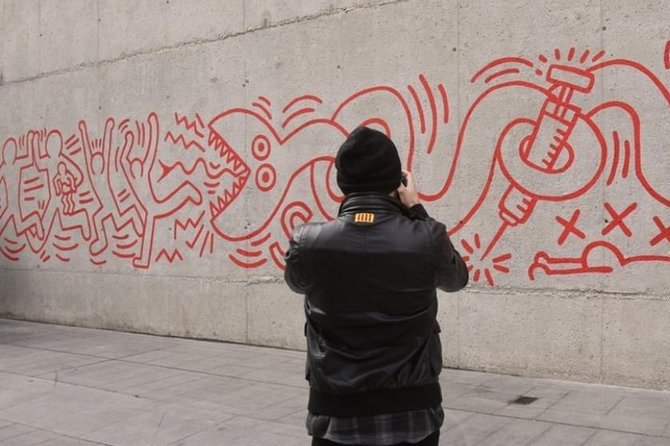
The strongest caution is reliability on a small operation. Two serious complaints involved guides being unable to lead the tour after an accident. In those cases, the operator said the tours were canceled and fully refunded, but one cancellation happened close to the start time.
That is not a normal feature of the experience, but it is worth knowing before you build a tightly packed morning around it. Keep the provider’s contact details handy and avoid scheduling a nonrefundable attraction immediately afterward.
The meeting-point confusion is another practical risk. Check that your confirmation clearly shows Jardins Talía as the starting point and MACBA as the ending point. Do not follow a map blindly if it takes you to Plaça dels Àngels before the walk begins.
One low-rated experience also found the route less interesting than expected and felt it did not reach the heart of Raval. Street art is subjective, and the available work changes. If you need major, permanent murals at every stop, you may find the route uneven.
The much stronger pattern is a well-received walk led by guides who explain art with energy and local context. I would treat the tour as an informed introduction, not a guaranteed greatest-hits display.
Who should book this walk?
I would book it early in your Barcelona stay. Once you learn how to spot the different forms of street art, you will see more during the rest of your visit.
It suits you if you:
- Want an offbeat alternative to monument-focused sightseeing
- Enjoy art, photography, design, or urban culture
- Prefer a walking tour with social and neighborhood context
- Like small groups and the chance to ask questions
- Want to see Raval with a local guide rather than only from a map
- Are open to temporary or imperfect works instead of a fixed museum collection
I would hesitate if you have limited mobility for street walking, though most people can participate. I would also think twice if your main goal is a particular mural or artist, since the route and artwork can change.
The English option makes it easy for most international visitors. The provider has also offered guides in French, including Jeanne and Jan, but you should confirm the language available for your date rather than assume it.
Booking and cancellation details
The tour is booked in advance by many people, with an average booking time of about 35 days before the date. That does not mean you must reserve that early, but it is sensible to book ahead if your schedule is fixed.
You receive confirmation at booking in most cases. If you book within two days of departure, confirmation can take up to 48 hours and depends on availability.
Free cancellation is available until 24 hours before the scheduled start time for a full refund. Changes or cancellations inside that 24-hour window are not accepted for a refund. The operator also requires a minimum number of participants, and if that minimum is not met, you should be offered another date or experience, or a full refund.
Should you book the Raval street-art tour?
Yes, if you want to understand Barcelona through its walls rather than only admire its grand buildings. The small group, flexible conversation, Tres Chemineas stop, and strong guide-led storytelling make this a useful two-hour introduction to Raval and the city’s street-art culture.
Book it with the right expectations. You are not guaranteed a permanent collection, a private tour, or access to every unusual local spot. Confirm Jardins Talía as your starting point, allow time to find it, and keep some flexibility in your schedule.
For the price, I think the tour earns its place on a Barcelona itinerary, especially near the beginning of your stay. It teaches you how to see the city after the walk is over, which is a better souvenir than another hurried photograph.
FAQ
How long is the Raval Street Art and Graffiti Guided Tour?
The tour lasts approximately two hours.
Where does the tour begin?
The tour begins at Jardins Talía in the Sant Antoni area of Eixample, Barcelona 08015.
Where does the tour end?
The tour ends at Museu d’Art Contemporani de Barcelona, Plaça dels Àngels, 1, in Ciutat Vella.
Is the tour offered in English?
Yes. English is one of the stated tour languages.
What is the maximum group size?
The tour allows a maximum of 15 participants.
Does the tour include hotel pickup and drop-off?
No. Hotel pickup and drop-off are not included.
Are food and drinks included?
No. Extra food and drinks are not included.
What is the cancellation policy?
You can cancel up to 24 hours before the start time for a full refund. Cancellations or changes made less than 24 hours before the start are not accepted for a refund.
Just added around Barcelona
- GoCar Full Day Tour★ 4.0 · 6 reviews
- Sagrada Familia and Barcelona Highlights: Private Guided 4-Hour Driving Tour★ 5.0 · 6 reviews
- Barcelona: Highlights & Gems Private Tour with Tapa & Drink★ 3.9 · 6 reviews
- Gothic Quarter and Born District: Photographic Workshop★ 5.0 · 6 reviews
- Gobbi Yacht Rental in Barcelona 9 Pax 2/4/8hs★ 5.0 · 6 reviews
- Barcelona: Gothic Quarter & La Sagrada Familia Private Tour★ 4.9 · 6 reviews
- Private Sailboat Ride at Sunset from Sitges★ 5.0 · 6 reviews
- Barcelona: Private Tour of Casa Batllo with Reserved Access★ 3.5 · 6 reviews
Street Art, compared.
Barcelona Street Art and Graffitti Bicycle Tour
Read our review →
Barcelona Street Art Tour with Exclusive Artist Studios Visit
Read our review →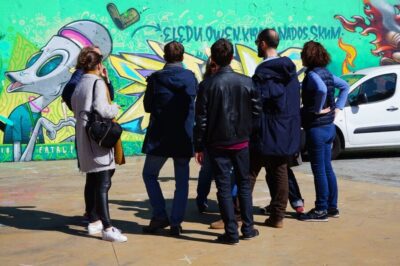
Private Barcelona Street Art Workshop with a Street Artist
Read our review →
Barcelona Art & Wine: Galleries, Studios & Street Art
Read our review →
Insider Street Art Tour with Private Studio Visit
Read our review →
Browse the lists this tour appears in