
Reviewed · HISTORICAL TOURS
Barcelona in 2 Hours: Guided Walk Through History and Sights
Barcelona’s old center is best understood on foot, and this tour quickly moves from Els 4 Gats, the café linked with Picasso and Gaudí, through the Gothic Quarter and into El Born. Along the way, you get more than pretty façades: Catalan defeat, Jewish heritage, royal power, religious legends, and Barcelona’s modern political identity all enter the story.
I like the wide mix of subjects packed into two hours, and I like the route’s finish at Santa Maria del Mar, one of the city’s great Gothic churches. The main drawback is the pace. Eleven listed stops leave little room for long visits, and the cathedral and basilica admission fees are not included.
In This Review
- Key points to know before you book
- Why this two-hour walk works as a first look at Barcelona
- Starting at Els 4 Gats with Barcelona’s artistic crowd
- El Mon Neix En Cada Besada and the meaning behind a photo spot
- Barcelona Cathedral and the story of Saint Eulalia
- Roman Barcelona at Casa de l’Ardiaca
- Pont del Bisbe and Plaça Sant Felip Neri
- El Call and Barcelona’s former Jewish quarter
- Plaça de Sant Jaume, where Barcelona’s public life gathers
- Plaça del Rei and the darker side of royal Barcelona
- Plaça de l’Àngel and the legend of Saint Eulalia
- Santa Maria del Mar and the finish in El Born
- What the $22.99 price really buys you
- Pace, group size, and practical comfort
- Who will get the most from this Barcelona walk
- Should you book Barcelona in 2 Hours?
- FAQ
- How long does the Barcelona walking tour last?
- What language is the tour offered in?
- Where does the tour start?
- Where does the tour end?
- How many people can join the regular tour?
- Are admission fees for Barcelona Cathedral included?
- Is admission to Santa Maria del Mar included?
- Can I cancel for a full refund?
Key points to know before you book
- Picasso and Gaudí’s café: Els 4 Gats gives the walk an artistic opening, with Art Nouveau design and a strong link to Barcelona’s creative past.
- Eleven old-city stops: The route covers the Gothic Quarter, the former Jewish district, Plaça Sant Jaume, Plaça del Rei, and El Born.
- History beyond the postcard: Expect stories about the 1714 Catalan defeat, Saint Eulalia, the Spanish Inquisition, Roman Barcino, and Catalan independence.
- English-speaking guides: Guides have included Darren, Petra, Jorge, Sonia, Lydia, Sarah, Vanessa, Rolene, and Mariah.
- Two hours, maximum 20 people: This is a compact orientation walk, not a slow architectural tour.
- Church entry costs extra: Admission to Barcelona Cathedral and Santa Maria del Mar is not included.
Why this two-hour walk works as a first look at Barcelona
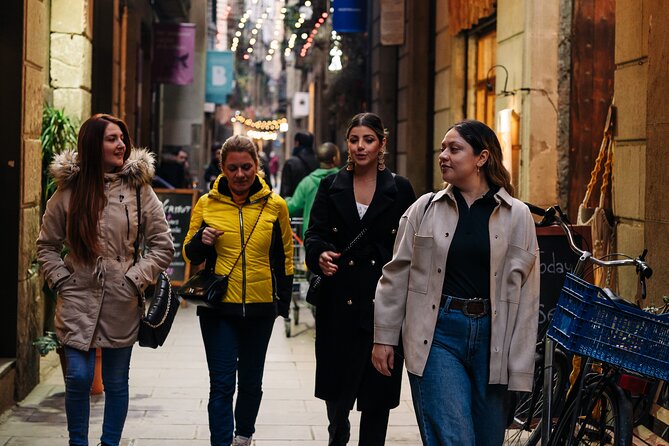
The best feature here is the route. You are not sent from one isolated sight to another by bus or subway. Instead, the walk threads through the old center, where a Roman wall may appear beside a Gothic doorway, and a political square may be only a few minutes from a quiet lane.
That makes the tour useful on your first day. You get a working map of Ciutat Vella, the historic core, while also learning why Barcelona feels culturally distinct from other Spanish cities. The guide’s stories connect the sights instead of treating them as separate photo stops.
Guides such as Darren, Petra, Jorge, Sonia, Lydia, Sarah, Vanessa, Rolene, and Mariah have led this experience. Their styles vary, but the strongest feedback points to clear English, lively storytelling, local suggestions, and a willingness to answer questions.
The two-hour limit is both a strength and a weakness. You can fit it into a morning or afternoon without giving up half a day. But each listed stop is allocated about ten minutes, and that includes walking between places. You will hear a lot, yet you should not expect a detailed interior visit at every church or museum.
A few more Barcelona options worth an hour of your trip
- Barcelona: Tapas Walking Tour with Food, Wine, and History
★ 4.8 · 4,261 reviews - Barcelona Tapas Walking Tour: Food, Wine & History
★ 4.5 · 1,928 reviews - Barcelona: 2.5-Hour Bike or E-Bike Historical Tour
★ 4.5 · 1,262 reviews
Starting at Els 4 Gats with Barcelona’s artistic crowd
The walk begins at Plaça del Vuit de Març and soon reaches Els 4 Gats. This café and restaurant was a meeting place for artists and thinkers, including Pablo Picasso and Antoni Gaudí.
The building’s Art Nouveau character sets the tone. Barcelona’s architecture is not only about famous Modernisme landmarks such as the Sagrada Família. Small façades, cafés, courtyards, and doorways also reflect the city’s artistic energy.
Your guide explains why Els 4 Gats mattered, rather than simply pointing out its exterior. You will not pay an admission fee for this stop, and the visit is short. Think of it as a cultural introduction, not a meal or a café experience.
That distinction matters. If you want to sit down for lunch or study the restaurant at length, you will need to return on your own. On the tour, the value comes from the setting and the story.
El Mon Neix En Cada Besada and the meaning behind a photo spot
The next stop, El Mon Neix En Cada Besada, is a large photomosaic that many people recognize as a popular picture stop. Its meaning reaches back to September 11, 1714, when Catalan forces were defeated.
That date remains central to Catalan public memory and helped shape La Diada, Catalonia Day. Your guide uses the artwork to explain how memory, identity, and public space meet in Barcelona.
This is one of the better examples of the tour’s approach. You see something easy to photograph, but you also learn why it matters. The stop takes about ten minutes and costs nothing, making it an efficient way to connect a modern artwork with an older political story.
If you prefer architecture alone, this may feel like a detour. If you want context for Catalan culture, it is a useful stop early in the walk.
Barcelona Cathedral and the story of Saint Eulalia
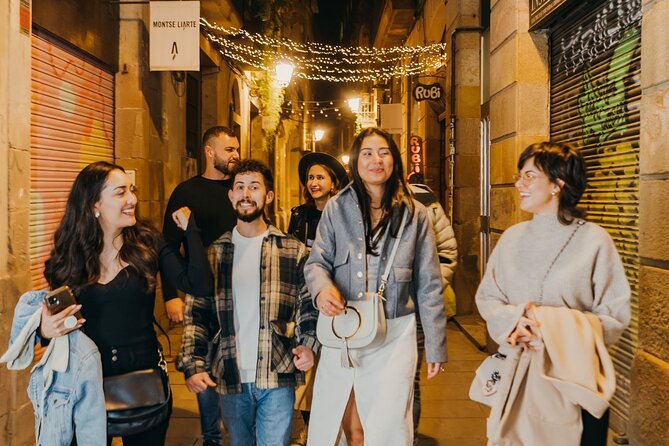
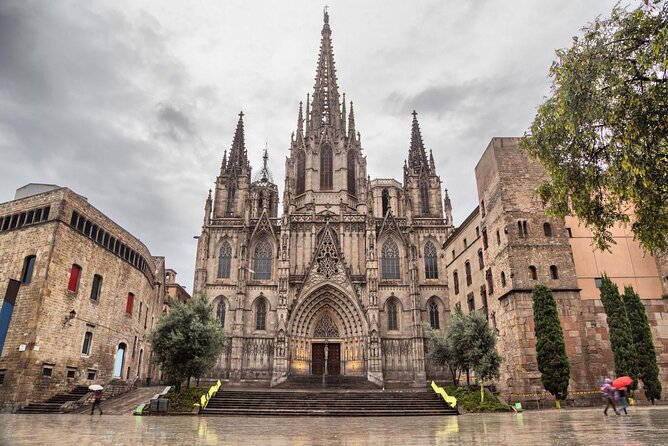
Barcelona Cathedral introduces the city’s Gothic religious tradition. Built over several centuries, it sits at the heart of the old city and is linked to Saint Eulalia, Barcelona’s patron saint.
The guide explains the story of Eulalia’s martyrdom and how her life and death became part of the cathedral’s identity. The tale is grim, as medieval saint stories often are, but it helps explain why religious buildings in Barcelona carry so much civic meaning.
Admission to the cathedral is not included. That is important when comparing the $22.99 tour price with other paid walking tours. You are paying for the guided route and interpretation, not an all-inclusive entry ticket.
The ten-minute stop also means you may only see the exterior or receive a brief introduction unless the group enters and moves efficiently. If the cathedral is high on your list, leave time to return for a fuller visit.
More walking tours in Barcelona:
- Barcelona Tapas and Wine Experience Small-Group Walking Tour
★ 5.0 · 5,804 reviews - Barcelona: Tapas Food Crawl Walking Tour with Tastings
★ 4.9 · 1,798 reviews - Barcelona: Gothic Quarter Ghosts and Legends Walking Tour
★ 4.7 · 1,443 reviews - Barcelona Helicopter, Sailboat & Old Town Private Walking Tour
★ 5.0 · 1,395 reviews
Roman Barcelona at Casa de l’Ardiaca
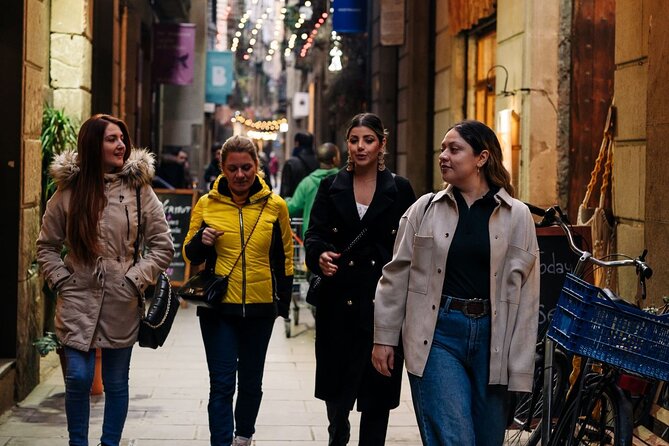
Casa de l’Ardiaca is a small but layered building in the Gothic Quarter. Its design combines Gothic and Renaissance elements, while nearby remains point back to Roman Barcino.
You can see remnants of the old Roman wall and sections of the aqueduct that once brought water into the settlement. This is the sort of detail that is easy to miss when walking alone. Barcelona often hides its oldest evidence in plain sight, folded into later buildings.
The stop is free and brief. You are unlikely to receive a full archaeological lecture in ten minutes, but the guide gives you a useful sense of how the city grew over time: Roman foundations, medieval walls, later civic buildings, and modern life all occupy the same small area.
For me, this is one of the most valuable stops for understanding Barcelona as a layered city rather than a collection of famous façades.
Pont del Bisbe and Plaça Sant Felip Neri
Pont del Bisbe is one of Barcelona’s most photographed architectural details. The bridge links buildings across a narrow Gothic Quarter street, and its pointed design feels older than it really is.
A local legend gives the bridge an eerie edge. The story concerns a skull and a curse, and it is the kind of tale that can make even a practical visitor glance upward before walking underneath.
The nearby Plaça Sant Felip Neri changes the mood. This quiet square carries scars from a tragic past and is tied to the wider struggle over Catalan identity and independence. The damaged walls are not merely atmospheric decoration. They point toward violence and loss.
These two stops work well together. Pont del Bisbe offers legend and visual drama. Plaça Sant Felip Neri asks you to slow down and consider the human cost behind political conflict. Both are free, but the square deserves respectful attention rather than a quick photo.
El Call and Barcelona’s former Jewish quarter

MUHBA El Call takes you into the old Jewish district. Narrow streets and medieval buildings mark an area shaped by Barcelona’s former Jewish population.
The stop helps correct a common problem with old-city walks: the Christian and royal story can dominate, while other communities fade into the background. Here, your guide gives the district a place in the city’s story and points out how its street pattern preserves traces of the past.
The route does not promise a full museum visit, and no admission fee is included or required for this brief stop. You should see it as an orientation to the district. If you want deeper information, the name MUHBA points you toward Barcelona’s municipal history museums for a separate visit.
Plaça de Sant Jaume, where Barcelona’s public life gathers
Plaça de Sant Jaume is the city’s main civic square. It holds the seat of the Catalan government and City Hall, making it a natural place to discuss public power, political gatherings, celebrations, and protest.
The square also connects to the story of an important figure honored during one of Catalonia’s best-loved holidays. Your guide uses the setting to explain how Barcelona’s political identity remains visible in everyday public space.
This stop is especially helpful if Catalan politics feels confusing. The tour cannot cover every modern dispute in ten minutes, but it gives you the vocabulary and landmarks needed to understand what you see elsewhere in the city.
The square is also an easy place to appreciate the tour’s practical value. Afterward, you will recognize it as more than a large open plaza. It is a working center of civic life.
Plaça del Rei and the darker side of royal Barcelona
Plaça del Rei has a more imposing mood. The Royal Palace gives the square a strong medieval presence, while the guide connects the area to Barcelona’s experience during the Spanish Inquisition.
This stop moves the story from public government to royal authority and religious control. It adds balance to the tour, since Barcelona’s past was not only artistic or picturesque.
The square is free to visit, but the short stop may leave you wanting more. Its buildings and surrounding museum spaces can reward a longer return visit. On the walking tour, you get the setting and the main historical thread without spending time inside.
Plaça de l’Àngel and the legend of Saint Eulalia
Plaça de l’Àngel was once known as Wheat Square, a name tied to grain trading. It later became Angel’s Square after a heavenly apparition appeared during a procession carrying the body of Saint Eulalia.
The story links commerce, religion, and the city’s patron saint in one compact stop. It also shows how place names preserve old events long after the original activity has disappeared.
You will not spend long here, but the stop helps tie the route together. Saint Eulalia appeared earlier at the cathedral, and now her story returns in a public square. This sort of repetition is useful because it gives the tour a narrative thread.
Santa Maria del Mar and the finish in El Born
The walk ends at the Basilica de Santa Maria del Mar in El Born. This Gothic church is closely linked to Barcelona’s maritime past and gives the tour a fitting finish near the old waterfront district.
The basilica’s setting makes the final transition clear. The route has moved from artists and Roman remains through churches, political squares, royal power, and Jewish heritage, then into a neighborhood shaped by trade and the sea.
Admission is not included, so check the cost and opening arrangements if you want to go inside. The tour’s endpoint is still useful even if you do not enter. You finish in El Born, an area with plenty more to explore on foot.
I like ending here rather than at a generic city square. The basilica gives the final stop a clear visual focus, and El Born is a practical base for continuing your afternoon.
What the $22.99 price really buys you
At $22.99 per person, this is priced as an accessible group introduction rather than a full private sightseeing service. The value depends on how much context you want.
If you walked the route alone, you could see many of the same exteriors for free. You would not automatically get the stories connecting Picasso, Roman waterworks, Catalan defeat, Saint Eulalia, the Inquisition, and maritime Barcelona. For a first visit, that added explanation can make the old city far easier to read.
The price also looks better if you use the tour to plan the rest of your stay. Guides have offered local suggestions, including restaurant advice. One recommendation for Tapas 2254 was specifically praised, though you should treat any dining tip as a starting point rather than a guarantee.
A private upgrade is available if you want more personal attention. That makes sense for families, couples, or small groups with a strong interest in history. The regular tour has a maximum of 20 people, so it is still limited in size, but it may feel less personal than the private option.
Pace, group size, and practical comfort
The tour is offered in English and uses a mobile ticket. Confirmation arrives at booking, and the start is near public transportation at Plaça del Vuit de Març in Ciutat Vella.
The finish is at Basílica de Santa Maria del Mar, Plaça de Santa Maria, 1. Since the walk ends in a different neighborhood from where it starts, plan your next stop from El Born rather than assuming you will return to the starting point.
Wear good walking shoes and bring sun protection. The route uses historic streets and open squares, and one guide’s feedback specifically stressed both shoes and sunblock.
Most people can participate, but the supplied details do not describe a specific accessibility route or step-free access at every stop. If that matters to you, ask the provider before booking.
The group limit is 20. That is small enough for a useful group walk, though sound can still be a problem in busy streets. One participant had trouble hearing because of background noise and the lack of a speaker or audio guide. If you have difficulty hearing, try to stay close to the guide and ask about audio support in advance.
Who will get the most from this Barcelona walk
I would choose this tour for a first or second day in Barcelona, especially if you want a quick orientation before exploring alone. It suits curious visitors who want politics, religion, architecture, art, and local legends in one route.
It is also a good match if you prefer stories to formal museum lectures. Guides such as Vanessa have been praised for mixing archaeological details, government buildings, artistic sites, churches, and the old Jewish quarter while answering questions along the way.
Families may appreciate the changing subjects. A café tied to artists, a cursed bridge, a skull legend, a royal square, and a heavenly apparition give the guide plenty of memorable material. Still, the tone includes martyrdom, political defeat, religious persecution, and tragedy, so it is not a purely light sightseeing stroll.
You may want something else if you need long interior visits, extensive architectural analysis, or a slow photographic walk. The content is broad by design. One piece of feedback found a first-time guide pleasant but felt the content could have been stronger, which is a reminder that the assigned guide can shape the experience.
Free cancellation is available until 24 hours before the start time. Changes or cancellations inside that window are not accepted for a refund.
Should you book Barcelona in 2 Hours?
Book it if you want a fast, meaningful introduction to the Gothic Quarter and El Born, with an English-speaking guide to connect the sights. The route covers far more than the standard postcard view, and the $22.99 price is fair for two hours of focused interpretation.
I would schedule it early in your stay, then return to the cathedral, Santa Maria del Mar, Plaça del Rei, or El Call if one subject catches your interest. Choose the private upgrade if personal questions and a slower pace matter most.
Skip it if you already know Barcelona’s old center well or want admission to major interiors included. For most first-time visitors, though, this is a sensible way to get your bearings, learn the city’s Catalan context, and finish near one of Barcelona’s most memorable churches.
FAQ
How long does the Barcelona walking tour last?
The experience lasts approximately two hours.
What language is the tour offered in?
The tour is offered in English.
Where does the tour start?
It starts at Plaça del Vuit de Març in Ciutat Vella, Barcelona.
Where does the tour end?
It ends at Basílica de Santa Maria del Mar, Plaça de Santa Maria, 1, in Ciutat Vella.
How many people can join the regular tour?
The group can include a maximum of 20 people.
Are admission fees for Barcelona Cathedral included?
No. Admission to Barcelona Cathedral is not included in the tour price.
Is admission to Santa Maria del Mar included?
No. Admission to the Basilica de Santa Maria del Mar is not included.
Can I cancel for a full refund?
Yes. You can cancel at least 24 hours before the experience start time for a full refund. Cancellations and changes made less than 24 hours before the start time are not accepted for a refund.
More 2-Hour Experiences in Barcelona
- Barcelona: Two-Hour Midday or Sunset Sailing Cruise
★ 4.8 · 1,732 reviews - Barcelona: 2-Hour City Sights Guided Segway Tour
★ 4.9 · 453 reviews - Barcelona: 2-Hour Sailboat Tour with Snacks and Drinks
★ 4.8 · 357 reviews - Barcelona: Jewish Quarter 2-Hour Walking Tour
★ 4.8 · 333 reviews
Just added around Barcelona
- GoCar Full Day Tour★ 4.0 · 6 reviews
- Sagrada Familia and Barcelona Highlights: Private Guided 4-Hour Driving Tour★ 5.0 · 6 reviews
- Barcelona: Highlights & Gems Private Tour with Tapa & Drink★ 3.9 · 6 reviews
- Gothic Quarter and Born District: Photographic Workshop★ 5.0 · 6 reviews
- Gobbi Yacht Rental in Barcelona 9 Pax 2/4/8hs★ 5.0 · 6 reviews
- Barcelona: Gothic Quarter & La Sagrada Familia Private Tour★ 4.9 · 6 reviews
- Private Sailboat Ride at Sunset from Sitges★ 5.0 · 6 reviews
- Barcelona: Private Tour of Casa Batllo with Reserved Access★ 3.5 · 6 reviews
Historical Tours, compared.
Tapas Walking Tour with Food, Wine, and History
Read our review →
Barcelona Tapas Walking Tour: Food, Wine & History
Read our review →
Barcelona Erotic Museum – Explore Art, History & Fun
Read our review →
Andorra Original History and Sightseeing Tour (Private, Pickup)
Read our review →
Tarragona and Sitges Small Group Tour – Roman History & Culture
Read our review →
Girona History and Legends Tour Small Group from Girona
Read our review →Browse the lists this tour appears in