
Reviewed · GOTHIC QUARTER WALKING TOURS
Discover Barcelona’s Gothic Quarter | Private & Semi-Private
Barcelona’s Gothic Quarter packs Roman columns, medieval churches, government buildings, and narrow old streets into a compact part of Ciutat Vella. This two-hour walk gives you a quick route through that layered past, with cathedral admission and rooftop access included rather than left for you to arrange later.
I like the small size, capped at six people, and I like the choice between a shared tour and a private outing. Guide Pabelo is specifically praised for making the area’s changes over time easy to understand. The main consideration is the price: at $130.97 per person, this is best value for visitors who want focused guiding, not simply a stroll through streets you could explore alone.
In This Review
- Key points at a glance
- Why this short Gothic Quarter walk works
- Starting at Plaça Nova beside Barcelona Cathedral
- Inside the Cathedral of Barcelona
- Plaça Sant Felip Neri and the marks of war
- Roman Barcelona at Plaça de Sant Jaume
- The Temple of Augustus and the surviving Roman columns
- Plaza del Dei and the final Columbus connection
- What the six-person format changes
- Is $130.97 per person fair value?
- Who should book this Barcelona walk?
- Should you book it?
- FAQ
- How long does the Gothic Quarter tour last?
- Where does the tour begin?
- Where does the activity end?
- How large is the shared tour group?
- Is a private tour available?
- Is admission to Barcelona Cathedral included?
- What language is the tour offered in?
- What should I wear for the cathedral visit?
Key points at a glance
- The Cathedral of Barcelona anchors the tour: You visit the interior, cloisters, Well of Geese, and the top of the cathedral.
- The group stays very small: Shared tours allow a maximum of six people, which makes questions and conversation easier.
- The route covers several eras: Roman Barcino, medieval Barcelona, Catalan government, and Civil War damage all appear within two hours.
- Sant Felip Neri adds a more somber stop: You learn how the church survived the Spanish Civil War and was restored.
- The tour suits a tight schedule: It begins and ends at Plaça Nova and takes about two hours.
- Dress matters inside places of worship: Shoulders and knees must be covered, so plan your clothing before arriving.
Why this short Gothic Quarter walk works
I see this tour as an orientation walk with a strong centerpiece. Rather than spending two hours on one broad overview, you move between a major cathedral, a quiet square, Roman remains, civic buildings, and a final plaza linked to Christopher Columbus.
That variety helps you understand Barcelona as a city built in layers. The Gothic Quarter is not only medieval, despite its name. Roman foundations remain under the modern city, Catalan institutions occupy a historic square, and later events left their mark on old churches and public spaces.
The route is also manageable for a first visit. You do not need to plan a complicated route through the Old Town, find the cathedral entrance, or work out how the separate sights fit together. Your guide provides the thread connecting them.
The tradeoff is time. Two hours passes quickly, and the walk cannot give every stop the treatment of a full museum visit. If you want long periods inside the cathedral or detailed architectural study, you may still want to return on your own.
More Gothic Quarter walks:
- Barcelona in 1 Day: Sagrada Familia, Park Guell,Old Town & Pickup
★ 5.0 · 13,541 reviews - Barcelona all included: Sagrada, Park Güell, Montjuic & Gothic
★ 5.0 · 2,169 reviews - Barcelona: Sagrada Familia, Modernism, and Old Town Tour
★ 4.7 · 1,621 reviews
Starting at Plaça Nova beside Barcelona Cathedral
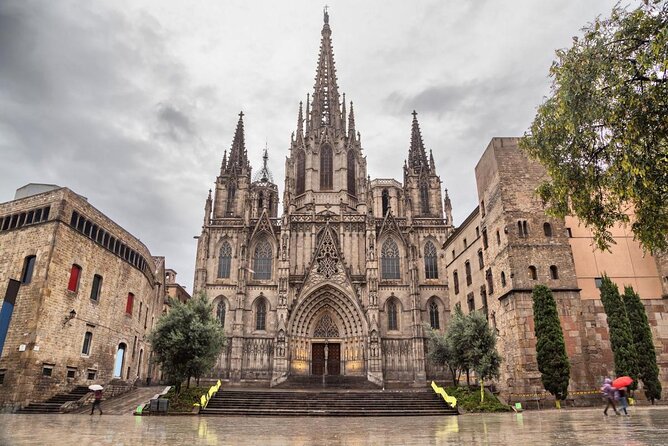
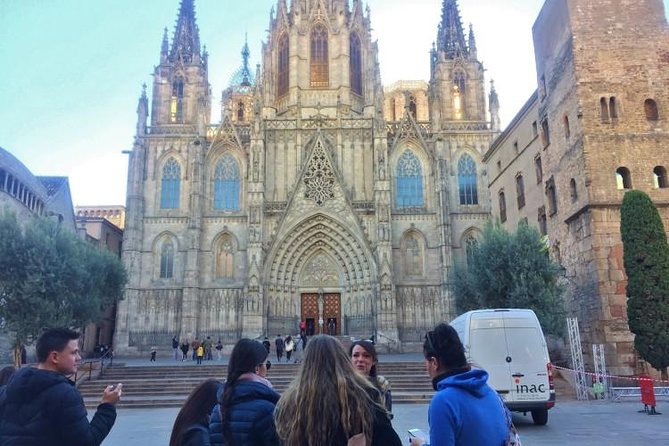
The meeting point is Plaça Nova, 5, in the vestibule at Plaça Nova, Ciutat Vella. This puts you right beside the Cathedral of Barcelona, also called the Cathedral of St. Eulalia, so the tour begins in one of the quarter’s most useful landmarks.
The activity ends back at the meeting point. That makes the walk easy to fit before lunch, after another Old Town visit, or between planned activities. Since the area is near public transportation, you can reach the start without making the Gothic Quarter your entire day.
I would arrive ready to walk, with comfortable shoes and clothing that meets the cathedral’s rules. You need to keep your shoulders and knees covered to enter places of worship. This is not a detail to ignore: a tank top or short dress could prevent entry, which would remove the most substantial included visit.
Inside the Cathedral of Barcelona
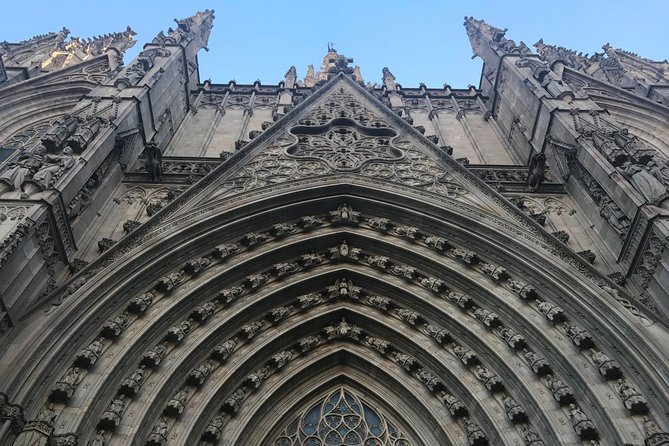
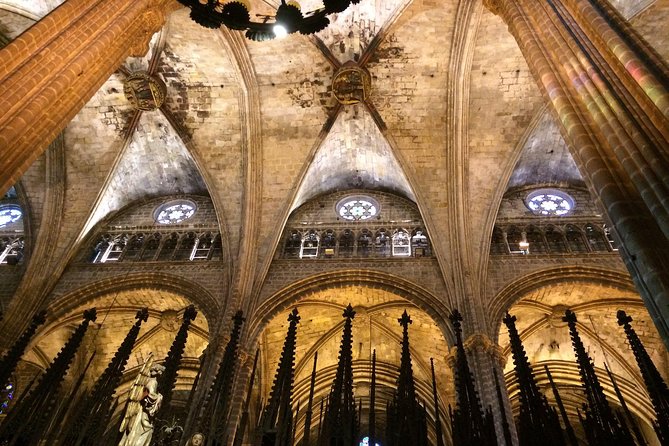
The cathedral receives about 45 minutes of the tour and includes admission. That is a meaningful part of the price because you are not only looking at the exterior while your guide talks from the square. You go inside, see the Gothic design, visit the cloisters, and have access to the top.
The cloister courtyard is home to 13 white geese, known as the Well of Geese. They symbolize the 13 years of St. Eulalia’s life before her death at the hands of the Romans. It is an unusual detail and the sort of small feature that can be easy to miss without someone pointing it out.
The cathedral also gives the walk a clear historical starting point. You begin with medieval religious architecture, then move outward into streets and squares shaped by Roman, civic, and modern history. That order makes the rest of the route easier to place.
Access to the top is one of the strongest practical features. You get views over Barcelona and a chance for photographs without having to arrange a separate visit. The supplied information does not specify how long you remain at the top, so expect it to be one part of the cathedral segment rather than a long rooftop session.
If you have mobility concerns, note that the tour includes a walking route and a visit to the cathedral’s upper level. The information provided says most people can participate, but it does not give detailed access notes for the climb or all parts of the route. You may want to check directly before booking if stairs or uneven Old Town streets are a concern.
Plaça Sant Felip Neri and the marks of war
From the cathedral, the walk continues to Plaça Sant Felip Neri. This square is quieter than the main routes and is home to the Church of Sant Felip Neri.
The stop adds a harder edge to the tour. You learn how the church survived the Spanish Civil War and how it was restored. The square is not presented as a decorative photo stop only. Its importance comes from the damage, memory, and rebuilding tied to the place.
This is where a local guide can add real value. A quick look at an old church tells you very little by itself. A clear explanation of what happened and how the site changed gives the square a human scale.
The stop also helps break up the architectural focus. After Gothic stonework and religious symbolism at the cathedral, you encounter a place shaped by conflict and repair. That shift keeps the walk from becoming a string of dates and building names.
A few more Barcelona options worth an hour of your trip
- Barcelona: Park Güell Admission Ticket
★ 4.4 · 76,534 reviews - Barcelona: Casa Batlló Entry with Self-Audioguide Tour
★ 4.7 · 25,359 reviews - Barcelona: 24 or 48-Hour Hop-On Hop-Off Bus Tour
★ 4.4 · 20,872 reviews - Barcelona: Park Guell Guided Tour with Skip The Line Entry
★ 4.7 · 17,563 reviews
Roman Barcelona at Plaça de Sant Jaume
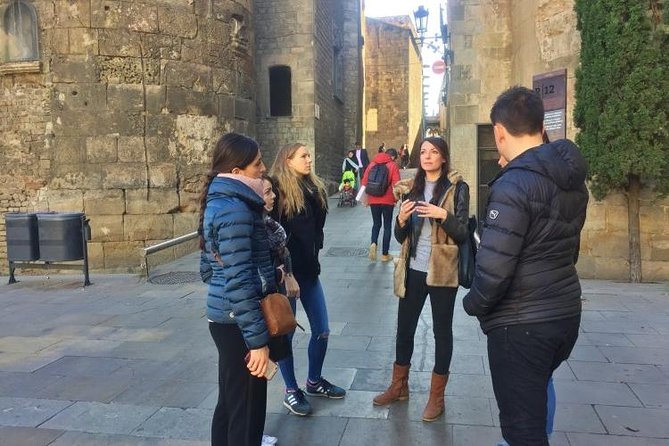
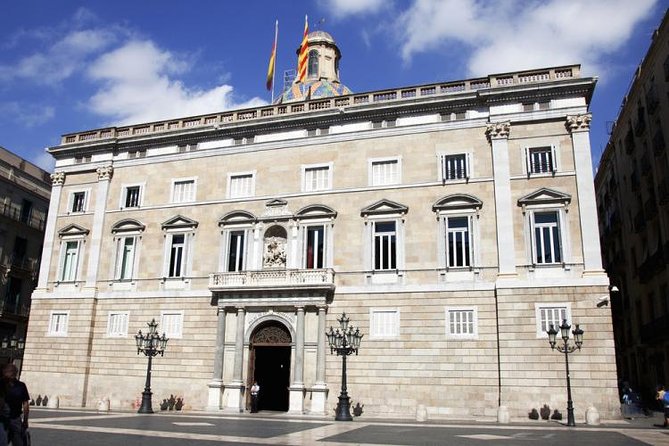
Next comes Plaça de Sant Jaume, a square that reaches back to the Roman city of Barcino. Today, it is the administrative center of Barcelona and Catalonia, with Barcelona City Hall and the Generalitat de Catalunya facing the square.
I like this stop because it shows how old civic spaces remain politically useful. You are not looking at an abandoned archaeological site separated from modern life. The Roman past, present-day city government, and Catalan regional government all meet in one place.
The square also gives you a helpful sense of Barcelona’s political identity. The tour information does not promise a political discussion, so do not book it expecting a long treatment of current affairs. Still, the setting offers context that you would miss if you treated the Gothic Quarter as only a collection of old buildings.
With a group of no more than six, you should have a better chance of hearing the explanation clearly than in a large walking group. That matters in a public square, where street noise and passing foot traffic can make a guide’s details easy to lose.
The Temple of Augustus and the surviving Roman columns
The route then reaches the Temple of Augustus. Its columns were dedicated to the Roman emperor Augustus and rise about 30 feet high. They are described as among the finest examples of Roman architecture and as old as the city itself.
This is a powerful stop because the remains appear within the living Old Town rather than in a separate ancient site. You can connect the Roman name Barcino from Plaça de Sant Jaume with physical evidence of that earlier city.
The Temple of Augustus is also a good example of why a guided walk helps in this quarter. Without context, the columns can look like an isolated fragment tucked into the medieval streets. With an explanation of their purpose and age, they become evidence of how Barcelona grew around its Roman core.
Do not expect a full archaeological visit here. The listed experience describes walking by the temple, not a long indoor tour or a separate museum admission. I would treat it as a focused viewing stop within a broader route.
Plaza del Dei and the final Columbus connection
The final listed stop is Plaza del Dei, a picturesque square with cafés, cocktail bars, and restaurants. It is linked to the meeting between Christopher Columbus and King Ferdinand and Queen Isabella after Columbus returned from his first journey to the New World.
That story gives the walk a clear closing point. You begin with Roman and medieval Barcelona, pass through government and war history, and finish with a later moment tied to Spain’s global expansion.
The square’s present-day character is more relaxed, with places to sit and eat. Since the tour ends back at Plaça Nova, this stop is not necessarily the endpoint for your afternoon, but it can help you decide where to continue afterward.
The information does not include a food or drink stop, so plan to pay separately if you want to use one of the cafés or restaurants. I would see the square as a useful place to continue exploring, not as an included refreshment break.
What the six-person format changes
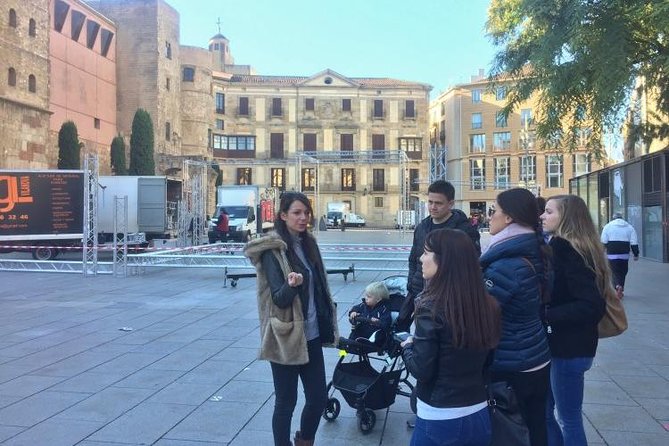
The shared tour has a maximum of six people. That is small enough to keep the guide close and make questions practical. If you want to ask about architecture, Barcelona’s changing neighborhoods, or the places you pass afterward, you are less likely to feel lost in a crowd.
A small group also suits the narrow streets of the Gothic Quarter. Large parties can bunch up at doorways and corners, while six people are easier to keep together. The benefit is not luxury for its own sake. It is a more direct connection with the guide during a short route.
You can also upgrade to a private tour. That makes sense for families, couples, or friends who want the guide’s attention to themselves. The available information does not give the private-tour price or explain how much the route changes, so compare the final cost before choosing it.
The tour is offered in English and includes a mobile ticket. Confirmation arrives at booking, which is useful if you are organizing a Barcelona schedule well ahead of time. This experience is booked an average of 53 days in advance, so I would not treat it as something guaranteed to remain available for a last-minute trip.
Is $130.97 per person fair value?
At $130.97 per person, this costs more than a casual self-guided walk. You are paying for a professional local guide, a very small shared group, and cathedral admission with access to the top.
The value is strongest if you are visiting Barcelona for the first time, have only a few hours, or prefer historical context to reading signs on your phone. It is also attractive if you want a route that combines major landmarks with less obvious corners, without spending half a day planning it.
The value is weaker if you already know the Gothic Quarter well or mainly want free time for photography. You could walk through several of these public squares independently, though you would not get the same structured explanation or included cathedral entry.
Group discounts may be available, but the supplied details do not state the discount amount. The private option will also change the total price. Check the booking screen carefully so you know which version you are buying and what the final per-person amount includes.
Who should book this Barcelona walk?
I would recommend it to first-time visitors who want a fast, well-shaped introduction to the Old Town. It works especially well early in a Barcelona stay, when you still need to learn how the Gothic Quarter fits together.
It also suits people who enjoy history in small portions. The route moves from Roman columns to medieval architecture, Civil War memory, Catalan government, and the Columbus story without demanding a full day.
Families and small friend groups may appreciate the private upgrade. The shared version is a good fit if you want personal attention but do not need the guide exclusively.
I would be more cautious if you dislike walking, cannot meet the dress rules, or want a slow visit with lots of time at each sight. The tour lasts about two hours and covers several locations, so its strength is range and explanation rather than an unhurried examination of every room.
Should you book it?
Book this tour if you want the Cathedral of Barcelona, rooftop views, Roman remains, and Old Town stories tied together by an English-speaking guide in a group of six or fewer. The praise for Pabelo points to the kind of clear, engaging explanation that can turn a short walk into useful orientation.
Skip it if the price feels high for a public walking route or if you would rather explore at your own pace. For a first visit with limited time, though, the included cathedral access and small-group format make the cost easier to justify. Free cancellation up to 24 hours before the start also gives you some protection if your plans change.
FAQ
How long does the Gothic Quarter tour last?
The tour lasts approximately two hours.
Where does the tour begin?
It begins at Plaça Nova, 5, Vestibul, Ciutat Vella, 08002 Barcelona, Spain.
Where does the activity end?
The activity ends back at the meeting point.
How large is the shared tour group?
The shared tour has a maximum of six participants.
Is a private tour available?
Yes. You can upgrade to a private tour.
Is admission to Barcelona Cathedral included?
Yes. The tour includes entrance to the Cathedral of Barcelona, including a visit to the top.
What language is the tour offered in?
The tour is offered in English.
What should I wear for the cathedral visit?
You must have your shoulders and knees covered to enter places of worship. Comfortable walking shoes are also recommended.
Just added around Barcelona
- GoCar Full Day Tour★ 4.0 · 6 reviews
- Sagrada Familia and Barcelona Highlights: Private Guided 4-Hour Driving Tour★ 5.0 · 6 reviews
- Barcelona: Highlights & Gems Private Tour with Tapa & Drink★ 3.9 · 6 reviews
- Gothic Quarter and Born District: Photographic Workshop★ 5.0 · 6 reviews
- Gobbi Yacht Rental in Barcelona 9 Pax 2/4/8hs★ 5.0 · 6 reviews
- Barcelona: Gothic Quarter & La Sagrada Familia Private Tour★ 4.9 · 6 reviews
- Private Sailboat Ride at Sunset from Sitges★ 5.0 · 6 reviews
- Barcelona: Private Tour of Casa Batllo with Reserved Access★ 3.5 · 6 reviews
Gothic Quarter Walking Tours, compared.
Barcelona in 1 Day: Sagrada Familia, Park Guell,Old Town & Pickup
Read our review →
Barcelona all included: Sagrada, Park Güell, Montjuic & Gothic
Read our review →
Sagrada Familia, Modernism, and Old Town Tour
Read our review →
Barcelona Gothic Quarter Tapas & Taverns Food & Wine Tour
Read our review →
Gothic Quarter Ghosts and Legends Walking Tour
Read our review →
Barcelona Helicopter, Sailboat & Old Town Private Walking Tour
Read our review →
Barcelona Old Town & Gothic Quarter Small Group Tour
Read our review →Browse the lists this tour appears in