
Reviewed · GOTHIC QUARTER WALKING TOURS
Gothic Quarter – Private Tour
Barcelona’s oldest center is best understood on foot, one tight lane and weathered stone wall at a time. This private Gothic Quarter tour connects the city’s Roman beginnings with medieval power, Jewish Barcelona, Catalan Gothic art, and the political life of modern Catalonia.
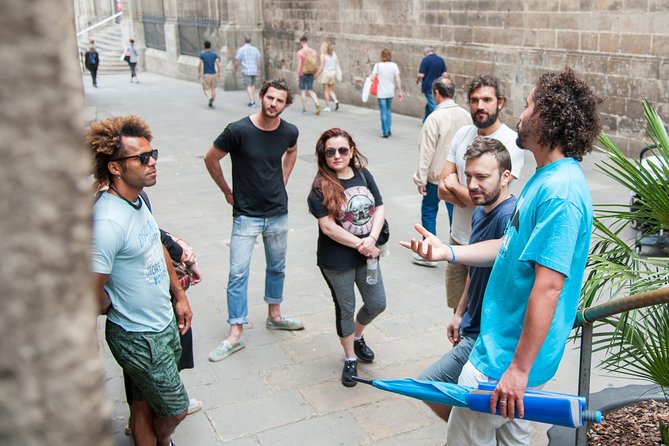
I like two things right away: you get a guide devoted only to your group, and the route goes beyond the postcard sights. Guides Patrick and Carlos are praised for clear storytelling, humor, local knowledge, and patience with different walking speeds. The main drawback is simple: it is a long walking tour through old streets, with no transport and no scheduled interior visits listed.
In This Review
- Key things to know before booking
- From La Rambla to the Roman city of Barcino
- Medieval lanes, churros, and Barcelona’s old Jewish quarter
- Catalan Gothic architecture at Santa Maria del Pi
- The bridge with unsettling symbols
- Royal power in Plaça del Rei
- A private pace through a crowded old town
- What the guides add to the experience
- Who should book this Gothic Quarter walk?
- Should you book it?
- FAQ
- How long does the Gothic Quarter private tour last?
- How much does the tour cost?
- Is the tour private?
- Is the tour offered in English?
- Where does the tour start?
- Is hotel pickup available?
- Where does the tour end?
- Is transportation included?
- What happens if the weather is poor?
Key things to know before booking
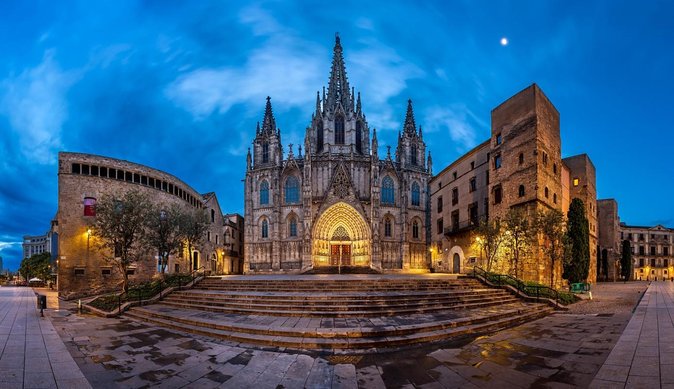
- A private walk with Patrick or Carlos: Your group gets the guide’s full attention, and you can ask questions without keeping up with a large crowd.
- Nearly 2,000 years in 150 minutes: The route moves from Roman Barcino to medieval churches, royal palaces, and present-day Catalan identity.
- More than the main cathedral: Expect Roman tombs, the old Jewish quarter, a bomb-scarred church, and the much-photographed neo-Gothic bridge.
- Pickup near Plaça de Catalunya: Hotel pickup is offered within 0.5 kilometers of Catalunya Square, though the exact meeting point deserves close attention.
- Good for families and mixed ages: Patrick has been praised for using humor, including a memorable story about a medieval poop log, to keep younger people engaged.
- Strong value for a private experience: At $66.52 per person, the price makes more sense for a small group that wants flexibility and a focused guide.
From La Rambla to the Roman city of Barcino
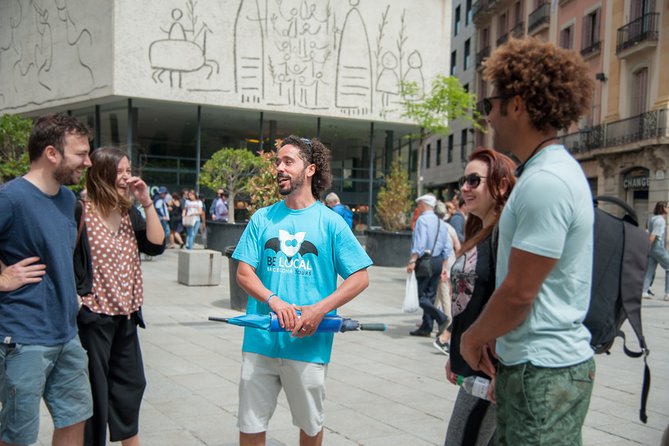
The walk begins at Plaça de Catalunya, Barcelona’s major meeting point at the edge of the Eixample and old city. Pickup is available if you choose a location within half a kilometer of the square. Your guide carries a company card, but the plaza is large, so confirm the exact spot and guide identification before you set out.
From there, the route reaches La Rambla, the famous avenue that leads toward the port. This is not just a place for a quick photo. It is the city’s symbolic spine, and the guide uses it to explain how Barcelona developed around its old center. The avenue can feel crowded and commercial, so the historical framing helps you see more than its present-day shops and foot traffic.
The tour then turns into the Gothic Quarter, where the scale changes at once. Narrow medieval lanes replace the broad avenue. Stone façades, small squares, old churches, and grand civic buildings appear around corners with little warning.
I like this early contrast. You begin with Barcelona’s best-known boulevard, then move into the less obvious streets where the city’s layers are easier to read. The Gothic Quarter is not one single period preserved intact. It combines ancient Roman traces, medieval structures, later restorations, and modern urban life. A good guide helps you tell those periods apart.
One of the first major historical stops is an old imperial burial site with Roman tombs displayed outdoors. These remains belong to the world of ancient Barcino, the Roman settlement beneath today’s city center. They are not grand ruins in the style of Rome’s Colosseum. Their value is more intimate: they show how close everyday Roman burial customs are to the modern streets.
The route also reaches remains of the Temple of Augustus, a surviving piece of Roman Barcelona tucked into a corner that is easy to miss on your own. This is exactly the kind of stop that rewards a walking guide. Without context, you might pass through the area and see only another old wall. With an explanation of Barcino, the Gothic Quarter becomes a layered archaeological site.
More Gothic Quarter walks:
- Barcelona in 1 Day: Sagrada Familia, Park Guell,Old Town & Pickup
★ 5.0 · 13,541 reviews - Barcelona all included: Sagrada, Park Güell, Montjuic & Gothic
★ 5.0 · 2,169 reviews - Barcelona: Sagrada Familia, Modernism, and Old Town Tour
★ 4.7 · 1,621 reviews
Medieval lanes, churros, and Barcelona’s old Jewish quarter
The walk includes one of the neighborhood’s most charming streets, lined with traditional churrerías and details from Barcelona’s past. This is a pleasant change of pace from formal churches and government buildings. You get a glimpse of the city as a place where food traditions and small businesses remain part of the old center.
The tour does not promise a food tasting, so consider the churrerías a visual and cultural stop rather than a guaranteed snack break. If you want to buy something, ask your guide about timing. The guide can also point out places for pastry or chocolate afterward, a useful bonus if you are building a food stop into your day.
Next comes the old Jewish quarter, a maze of medieval-flavored alleys where a large Jewish community once lived. This section adds an important social layer to the usual church-and-palace story. You learn that medieval Barcelona was shaped by several communities, faiths, and systems of power, not only by its kings and bishops.
The lanes are narrow, and the buildings can make orientation difficult. That is part of the appeal, but it also means you should wear comfortable shoes and stay aware of the group. The private format helps here. If you need a slower pace or want to stop for a question, the guide is not managing a large party.
A small square brings a darker chapter into view. Here, a baroque church still bears marks from bombings during the Spanish Civil War. It is a modest but powerful stop because the damage makes modern history visible in a district often presented only as medieval.
Patrick is particularly well suited to visitors who want political and cultural context. He has been praised for explaining Spanish and Catalan history, including local politics, in a way that connects past events to Barcelona today. Carlos also receives strong praise for his energy, clear explanations, and ability to answer questions.
Catalan Gothic architecture at Santa Maria del Pi
One of the architectural highlights is a beautiful 14th-century church, a strong example of Catalan Gothic design in the center of the old quarter. The church offers a chance to see how Catalan Gothic differs from the more ornate vertical styles many people associate with northern Europe.
The important point is not only the age of the building. It is the way the church fits into the surrounding neighborhood. Medieval religious buildings were part of civic life, trade, politics, and daily movement. The narrow streets around them help you picture how public and private life once overlapped.
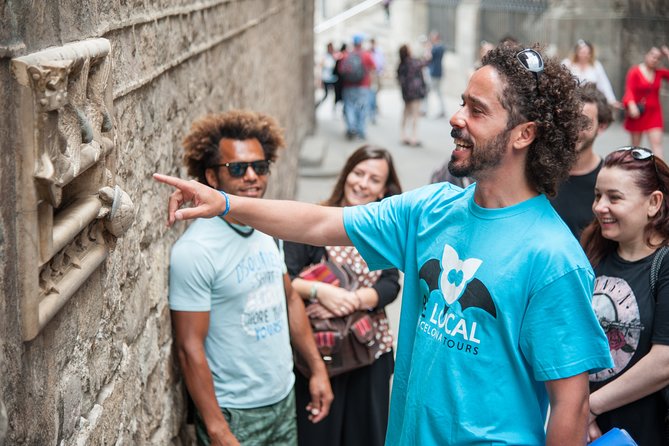
The route also includes the Cathedral of Santa Creu and Santa Eulalia. Its grand neo-Gothic façade can make it look newer than it is, but the building rests on a medieval structure with centuries of alterations and stories. The guide can help you separate the façade from the older fabric behind it.
This is one place where a short guided visit has real value. A cathedral can overwhelm you with chapels, stonework, symbols, and historical names. A guide gives you a framework, so you are not simply looking at an impressive church without understanding its role in Barcelona.
Keep in mind that the tour details do not list admission to interiors or a guaranteed cathedral entry. The experience is described as a walking route through these landmarks and districts. If seeing the inside is essential to you, ask the provider before booking.
The bridge with unsettling symbols
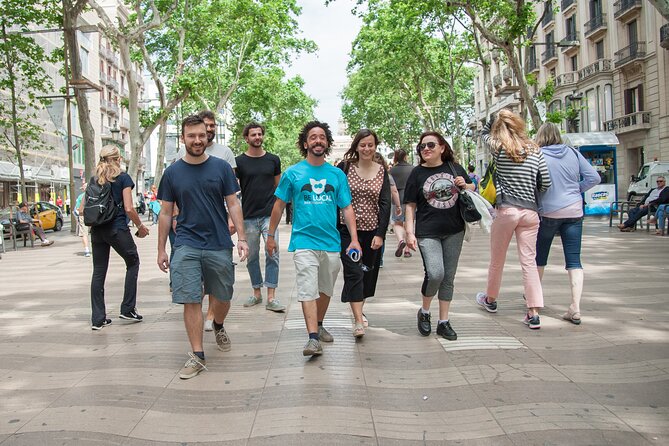
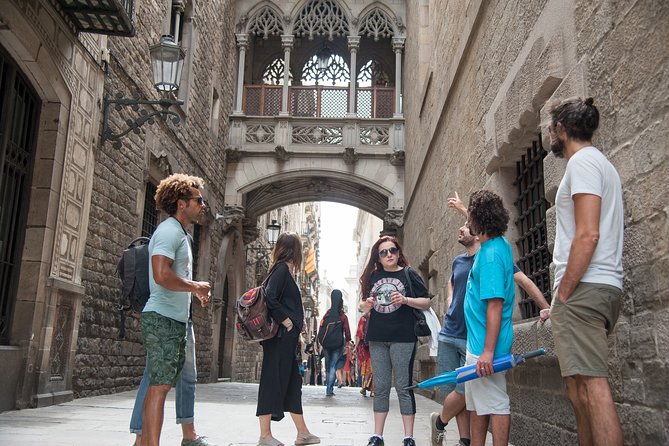
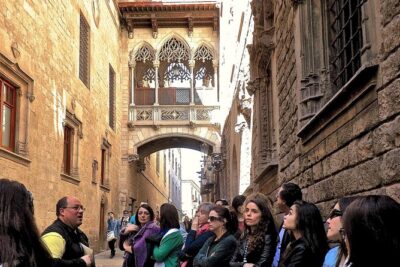
The itinerary includes one of Barcelona’s most recognizable neo-Gothic details: an elaborate bridge connecting historic buildings above a narrow street. Its dramatic design and curious symbols have made it a favorite photo stop.
The bridge is often associated with the older image of the Gothic Quarter, but its story is more complicated. Much of the quarter’s appearance comes from restorations and later neo-Gothic work, not only untouched medieval construction. That distinction matters. The guide can show you how Barcelona shaped its old center to reflect an image of the medieval city.
The bridge’s unsettling symbols add a little humor and mystery to the walk. This is where Patrick’s storytelling style seems especially useful. Several tour descriptions praise his comedic timing and ability to mix jokes with serious history. That balance can keep the tour from feeling like a school lecture.
For families, that matters. One parent specifically noted that the famous poop-log detail caught the children’s attention while the adults received more serious historical background. The private setting also lets the guide adjust the explanation to the group rather than delivering the same speech to everyone.
A few more Barcelona options worth an hour of your trip
- Barcelona: Park Güell Admission Ticket
★ 4.4 · 76,534 reviews - Barcelona: Casa Batlló Entry with Self-Audioguide Tour
★ 4.7 · 25,359 reviews - Barcelona: 24 or 48-Hour Hop-On Hop-Off Bus Tour
★ 4.4 · 20,872 reviews - Barcelona: Park Guell Guided Tour with Skip The Line Entry
★ 4.7 · 17,563 reviews
Royal power in Plaça del Rei
The walk continues to an old medieval palace that once represented Barcelona’s political power and now serves as the seat of the Government of Catalonia. This stop helps connect architecture with authority. The Gothic Quarter was not only a religious district or a maze of pretty lanes. It was also the center of government, royal ceremony, and civic decisions.
The route then reaches Plaça del Rei, one of the most atmospheric squares in the area. The old Royal Palace of the Kings of Aragon and the Chapel of Santa Ágata give the square a strong medieval character, while later neo-Gothic elements shape the way it looks today.
This is one of the best places to pause and let the setting work. The square is more spacious than the surrounding alleys, so you can take in the relationship between palace, chapel, and civic space. Your guide can explain how royal and religious power operated side by side.
You may find this section especially useful if you have already seen Barcelona’s modernist landmarks and want a better sense of the city before Gaudí. The tour focuses on the older political and religious center, giving you a foundation for understanding how Barcelona grew.
A private pace through a crowded old town
The tour lasts about two hours and 30 minutes. That is enough time to cover a broad sweep of the Gothic Quarter without turning the outing into a full-day commitment. It is a useful first-day activity because it gives you a map in your head before you return to explore independently.
The pace appears to be a steady, easy stroll rather than a race. Patrick has adjusted the walk for people with slowed mobility, and several accounts praise his patience. Still, the old quarter’s streets are not designed like a modern boulevard. Expect uneven surfaces, tight passages, and frequent standing while the guide explains a site.
The private format is the main practical advantage. Only your group participates, so you can ask about Catalan identity, Roman Barcelona, food, religion, or local politics. You can also spend more time at a favorite stop, provided the overall route remains workable.
The tradeoff is that private tours cost more per person than a large group walk. The listed price is $66.52 per person. For one person or a couple, that may feel high for a two-and-a-half-hour walking tour. For a family or small group, the cost becomes easier to justify because you are paying for a dedicated guide and a flexible experience. Group discounts are also offered, though the exact discount is not specified.
No transport is included. That is not a serious problem for this route, since the main experience is walking through the historic center, but it does mean you should plan how you will reach Plaça de Catalunya and how you will continue from the finish near Sant Jaume Square and Pl. de Correus.
What the guides add to the experience
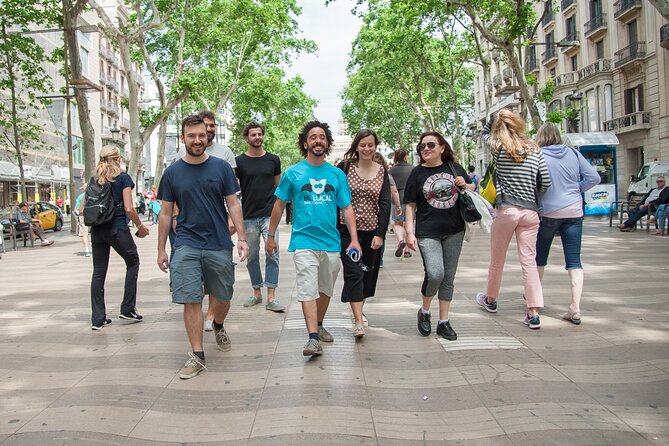
The strongest feature is the guide. Patrick is repeatedly described as an engaging storyteller who explains Barcelona from Roman times through modern Spain and Catalonia. He is also praised for being punctual, flexible, funny, and attentive to questions.
Carlos receives similar praise for energy, timing, historical explanation, and patience. His style seems to work well for first-time visitors who want the Gothic Quarter explained rather than simply pointed out. Both guides are presented as local English-speaking guides, and the activity is offered in English.
The humor is worth noting. This is not a silent architecture walk. You can expect anecdotes, quirky facts, and explanations designed to keep the group involved. That approach suits families, young adults, and anyone who loses interest during long strings of dates and names.
At the same time, the experience seems best for people who enjoy history and conversation. If you want a fast checklist of photo stops with little explanation, this may feel too detailed. If you want the district to make sense, the guide is the reason to book.
One practical warning: the meeting point at Plaça de Catalunya has caused confusion for at least one participant, who spent about 15 minutes looking for the guide in the large square. The provider sends meeting information before the tour, but you should read it in advance and confirm exactly where to stand. Do not rely only on spotting a person by clothing.
Who should book this Gothic Quarter walk?
I would choose this tour for a first visit to Barcelona, especially on the first or second day. You will gain a basic map of the old center and learn which streets, churches, squares, and Roman remains deserve a return visit.
It also suits families with older children and young adults. The private format lets the guide shift between Roman archaeology, royal power, religion, local food, and funny details. That range is more likely to hold everyone’s attention than a narrow architecture lecture.
People with reduced walking speed may appreciate the guide’s flexibility, but the tour still requires walking through an old neighborhood. Ask questions about the route if mobility is a concern. Service animals are allowed, the area is near public transportation, and most people can participate.
You should think twice if you need guaranteed entry into the cathedral or churches, a seated tour, or transport between sights. Those features are not included in the stated arrangement.
The experience has a 4.9 rating from 89 reviews, with 99 percent of customers recommending it. Those numbers support the tour’s strongest points: guide quality, clear storytelling, flexibility, and the value of seeing lesser-noticed corners with a private host. They do not remove the practical limits of weather, walking, or meeting-point confusion.
Should you book it?
Book this Gothic Quarter tour if you want Barcelona’s old center explained by a personable English-speaking guide, not just photographed. Patrick and Carlos appear to bring the right mix of historical detail, humor, and flexibility, and the route covers Roman Barcino, Jewish Barcelona, Catalan Gothic churches, royal power, Civil War damage, and modern Catalan identity.
At $66.52 per person, it is strongest value for a family or small group that will use the private format. For a couple on a tight budget, a shared walk may cost less. For everyone else, this is a smart way to get oriented early, ask plenty of questions, and find corners you might otherwise pass without noticing.
Free cancellation is available up to 24 hours before the start time. The tour requires good weather, and a cancellation for poor weather brings a choice of a new date or a full refund.
FAQ
How long does the Gothic Quarter private tour last?
The tour lasts approximately two hours and 30 minutes.
How much does the tour cost?
The listed price is $66.52 per person. Group discounts are offered, but the exact discount is not specified.
Is the tour private?
Yes. Only your group participates in the activity.
Is the tour offered in English?
Yes. The tour is offered in English.
Where does the tour start?
The stated starting point is Plaça de Catalunya in Barcelona.
Is hotel pickup available?
Yes. Pickup is offered from a location you choose if it is within 0.5 kilometers of Catalunya Square. Guides carry a company card.
Where does the tour end?
The end point is listed near Sant Jaume Square, at Pl. de Correus in Ciutat Vella.
Is transportation included?
No. Transport is not included. The experience is a walking tour.
What happens if the weather is poor?
The experience requires good weather. If it is canceled because of poor weather, you will be offered another date or a full refund.
Just added around Barcelona
- GoCar Full Day Tour★ 4.0 · 6 reviews
- Sagrada Familia and Barcelona Highlights: Private Guided 4-Hour Driving Tour★ 5.0 · 6 reviews
- Barcelona: Highlights & Gems Private Tour with Tapa & Drink★ 3.9 · 6 reviews
- Gothic Quarter and Born District: Photographic Workshop★ 5.0 · 6 reviews
- Gobbi Yacht Rental in Barcelona 9 Pax 2/4/8hs★ 5.0 · 6 reviews
- Barcelona: Gothic Quarter & La Sagrada Familia Private Tour★ 4.9 · 6 reviews
- Private Sailboat Ride at Sunset from Sitges★ 5.0 · 6 reviews
- Barcelona: Private Tour of Casa Batllo with Reserved Access★ 3.5 · 6 reviews
Gothic Quarter Walking Tours, compared.
Barcelona in 1 Day: Sagrada Familia, Park Guell,Old Town & Pickup
Read our review →
Barcelona all included: Sagrada, Park Güell, Montjuic & Gothic
Read our review →
Sagrada Familia, Modernism, and Old Town Tour
Read our review →
Barcelona Gothic Quarter Tapas & Taverns Food & Wine Tour
Read our review →
Gothic Quarter Ghosts and Legends Walking Tour
Read our review →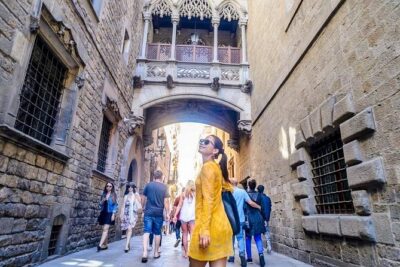
Barcelona Helicopter, Sailboat & Old Town Private Walking Tour
Read our review →
Barcelona Old Town & Gothic Quarter Small Group Tour
Read our review →Browse the lists this tour appears in