
Reviewed · GOTHIC QUARTER WALKING TOURS
Luca’s Hidden Old Barcelona: the Gothic and El Born Tour
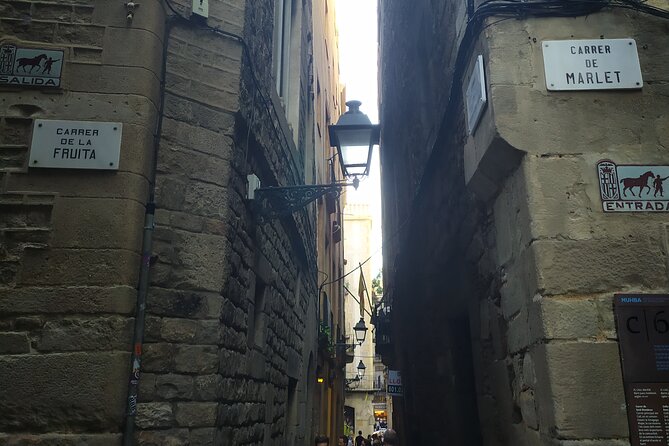
Barcelona’s old center makes the most sense when someone explains what you are looking at. Luca’s tour links Roman columns, medieval streets, Catalan identity, Jewish heritage, Civil War scars, and modern Barcelona in one walk. I especially like the route’s small maximum of 15 people and its focus on places you could easily pass without noticing.
I also like Luca’s lively style and practical local advice. He uses photos to explain the past, asks questions, and finishes with suggestions for food, cafés, shops, and sights. The main drawback is the amount of information. Luca talks fast and packs a lot into 2 hours and 15 minutes, and the walk can feel demanding in hot, humid weather.
In This Review
- Key points at a glance
- Why this old Barcelona walk is worth your time
- Placa de Sant Jaume and the civic heart of Barcelona
- Roman columns at MUHBA Temple d’August
- The cathedral exterior and the look of the Gothic Quarter
- El Call and the city’s Jewish past
- Sant Felip Neri and the scars of the Spanish Civil War
- Crossing into El Born and La Ribera
- Santa Maria del Mar, El Born’s beloved church
- Fossar de les Moreres and Catalan political memory
- Passeig del Born and the tour’s final turn
- Luca’s style: lively, personal, and very full
- Who should book this walk?
- Booking advice and final verdict
- FAQ
- How long does Luca’s Hidden Old Barcelona tour last?
- How much does the tour cost?
- What language is the tour offered in?
- Where does the tour start?
- Where does the tour finish?
- What places are included on the route?
- Is admission to Barcelona Cathedral included?
- How large is the group?
- Is the tour suitable for people with reduced mobility?
- Can I cancel for a full refund?
Key points at a glance
- Roman Barcelona in Placa de Sant Jaume: Begin at the city’s political center, where Barcelona’s civic life has gathered for roughly 2,000 years.
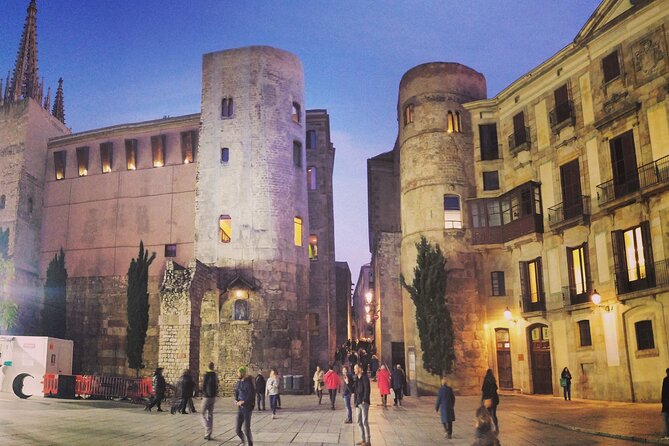
- Four original columns from the Temple of Augustus: See some of the oldest surviving objects in the city at MUHBA Temple d’August.
- A thoughtful look at Catalan and Spanish conflict: Fossar de les Moreres gives the political story behind Barcelona’s relationship with Madrid.
- Two old neighborhoods in one walk: Move from the Gothic Quarter into medieval El Born and La Ribera.
- Luca’s personal guidance: Expect historical context, humor, questions, photo references, and food recommendations.
- A compact but active route: The walk covers about three miles, with a maximum group size of 15.
Why this old Barcelona walk is worth your time
At $13.27 per person, this is an unusually modest price for a guided walk lasting about 2 hours and 15 minutes. You are paying for a professional guide rather than entry to monuments, and that distinction matters. The value comes from learning how the streets fit together and why certain corners carry political, religious, or social weight.
I would use this tour early in a Barcelona visit. It gives you a working map of the old city, then helps you recognize details when you return on your own. You also finish in El Born, a useful part of town for continuing your afternoon.
The tour is offered in English and is capped at 15 people. That is small enough for Luca to speak with people individually, answer questions, and keep the walk from becoming a flag-following exercise. Some departures may be even smaller, which can make the experience feel almost private.
Luca is the guide named for this experience, and his strongest quality is enthusiasm. He brings a binder filled with photos, uses humor, and takes a clear interest in the causes behind events, not only the dates. He also has a sharp eye for the difference between genuine Gothic features and later imitations.
That energy comes with a trade-off. You need to pay attention. One person found the pace of information heavy, and another noted that Luca speaks quickly. If English is not easy for you, or if you prefer a slow, quiet walk with only a few facts, this may not be your ideal tour.
More Gothic Quarter walks:
- Barcelona in 1 Day: Sagrada Familia, Park Guell,Old Town & Pickup
★ 5.0 · 13,541 reviews - Barcelona all included: Sagrada, Park Güell, Montjuic & Gothic
★ 5.0 · 2,169 reviews - Barcelona: Sagrada Familia, Modernism, and Old Town Tour
★ 4.7 · 1,621 reviews
Placa de Sant Jaume and the civic heart of Barcelona
The meeting point is Placa de Sant Jaume, at number 3. This square is a strong place to begin because it is not just a pretty opening scene. It has been Barcelona’s political and social center for about 2,000 years.
The City Hall and the regional government building face each other here. That setting gives Luca a natural way to introduce the long-running tension between local Catalan authority and power based in Madrid. You will not simply hear about a square. You will start to see Barcelona as a city shaped by civic pride, regional identity, and political arguments.
Allow about 15 minutes here. The square is open and easy to find, though it can be sunny. If you are joining in summer, bring water, wear a hat, and avoid assuming that an urban walking tour will provide much shade.
Roman columns at MUHBA Temple d’August
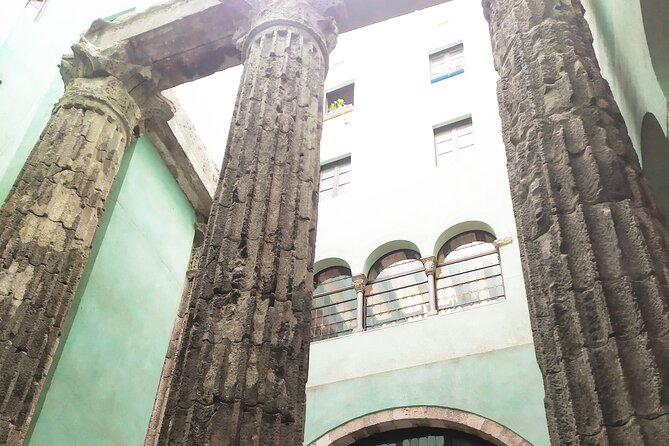
The next stop brings Barcelona’s Roman past into view. At MUHBA Temple d’August, you see four columns from the large Temple of Augustus that once occupied this site.
The stop lasts around 10 minutes and has no admission charge. It is short, but it gives you a useful contrast with the medieval streets around it. Barcelona’s oldest surviving objects are not isolated in a grand archaeological park. They appear within the dense old quarter, surrounded by later buildings and narrow lanes.
This is the sort of place I would probably miss without a guide. The columns do not announce themselves as loudly as the cathedral or a major museum. Luca’s explanation helps you read the city in layers: Roman foundations, medieval construction, and later changes all sharing the same few blocks.
The cathedral exterior and the look of the Gothic Quarter
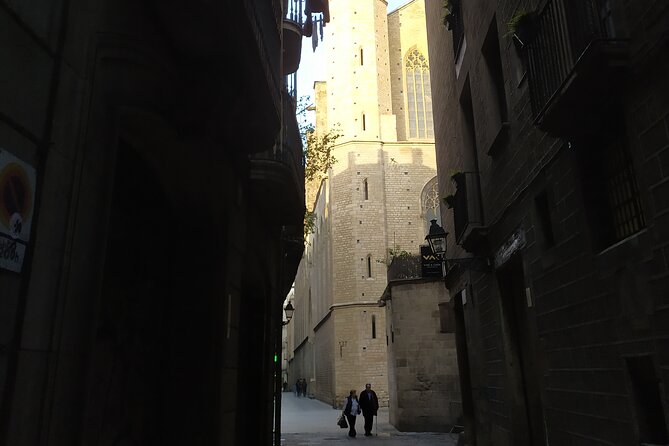
The tour then reaches Barcelona Cathedral. The scheduled focus is the outside of the Gothic cathedral, and the admission ticket is not included. That means you should not book this walk expecting a guided visit inside.
The exterior is still an important part of the route. Luca explains what you are seeing and uses it as part of the wider Gothic Quarter story. This is also where his comments about real Gothic features and later imitations become useful. Barcelona’s old center contains buildings and details from different periods, and a confident label is not always the same thing as an original medieval feature.
The cathedral stop takes about 15 minutes. You will be standing and listening in a busy old-city setting, so it helps to stay close enough to hear. The route includes a further Gothic Quarter feature before moving toward the former Jewish neighborhood.
More local corners of Barcelona:
- Barcelona 3-hour Bike or E-Bike Tour: Highlights and Hidden Gems
★ 5.0 · 1,429 reviews - Barcelona: El Born and Gothic Quarter Wine & Tapas Bar Tour
★ 4.8 · 674 reviews - Barcelona: El Born Food Walking Tour with Tapas and Drinks
★ 4.9 · 662 reviews - Barcelona Old Town Tapas Tour: Vermouth, Bites & Hidden Gems
★ 5.0 · 627 reviews
El Call and the city’s Jewish past
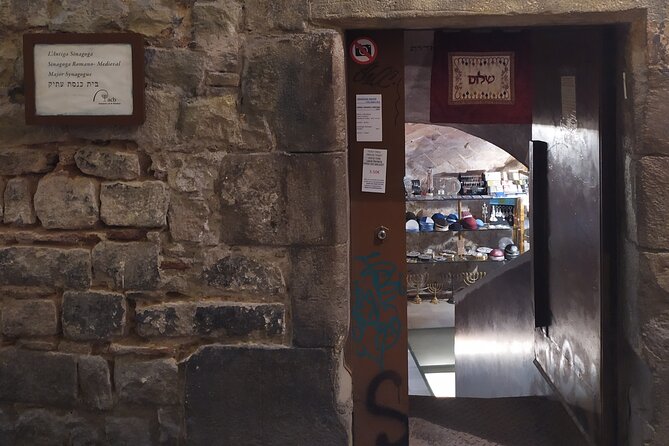
MUHBA El Call marks the medieval Jewish neighborhood, known as El Call. The stop lasts around 15 minutes and has no admission charge.
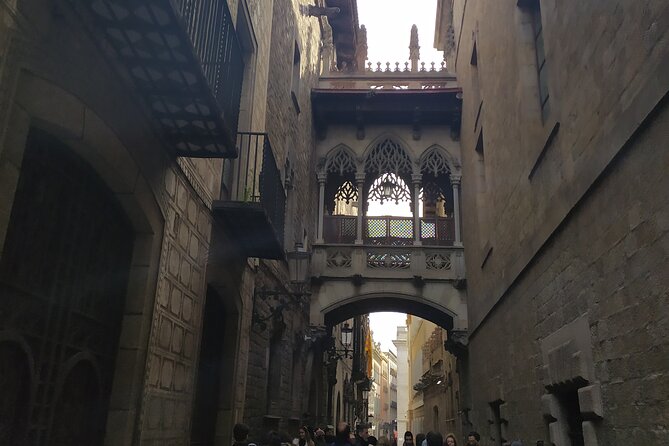
This part of the walk adds a needed layer to Barcelona’s story. The Gothic Quarter is easy to reduce to stone walls, pretty lanes, and cathedral views. El Call reminds you that the old city was also a place of distinct communities, faiths, trade, and conflict.
The value here is not in checking off a single monument. It is in understanding how a neighborhood functioned and how much history can be concealed by today’s ordinary-looking streets. The narrow layout can be confusing if you explore alone, which is one reason a guided walk works well in this part of Barcelona.
Sant Felip Neri and the scars of the Spanish Civil War
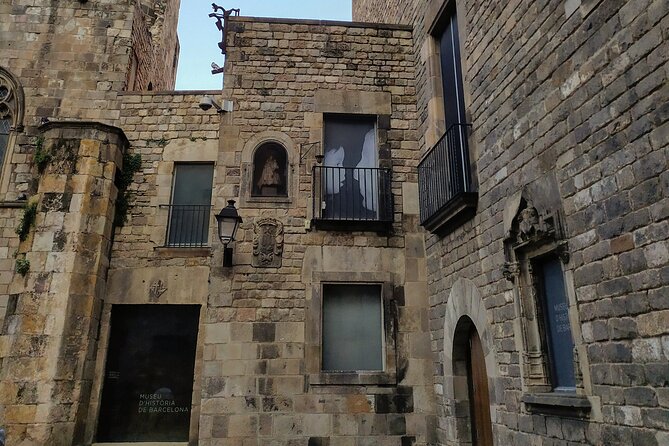
Esglesia de Sant Felip Neri is one of the tour’s more memorable stops. The church sits beside a small square often described as one of the prettiest in the old city. It was also associated with Gaudí, who favored the church during his lifetime.
The setting has a darker side. Luca uses Sant Felip Neri to discuss the Spanish Civil War, shifting the tone from medieval Barcelona to a much more recent past. This is an effective reminder that the old quarter is not frozen in the Middle Ages. Its walls and public spaces also carry the marks of 20th-century violence and political division.
The stop takes about 15 minutes and is free. You should expect a story-led visit rather than an extended interior tour. The point is the square, the church, and the historical meaning Luca draws from the place.
Crossing into El Born and La Ribera
After the Gothic Quarter, the walk turns toward El Born and La Ribera, with around 30 minutes devoted to this medieval neighborhood. This longer section gives the tour a change of mood and a broader view of old Barcelona.
El Born is not simply another set of narrow streets. It was an important medieval area, linked to commerce, public life, and entertainment. Luca’s route helps you compare it with the Gothic Quarter instead of treating both as one undifferentiated old town.
This is also a good point to use Luca’s local suggestions. He offers recommendations for places to eat, have coffee, shop, and see more of the city. Specific advice mentioned during the walk has included a fish place, a market, an ice-cream stop, and a pizza restaurant. You should treat these as suggestions, not promised inclusions, but they can be useful when you want to turn the tour into a full afternoon in El Born.
The walk covers about three miles in total. That is not an extreme distance, but the old streets, standing time, and warm weather can make it feel longer. Wear shoes you can comfortably walk in and keep your schedule clear enough that you do not need to rush away from the final stop.
Santa Maria del Mar, El Born’s beloved church
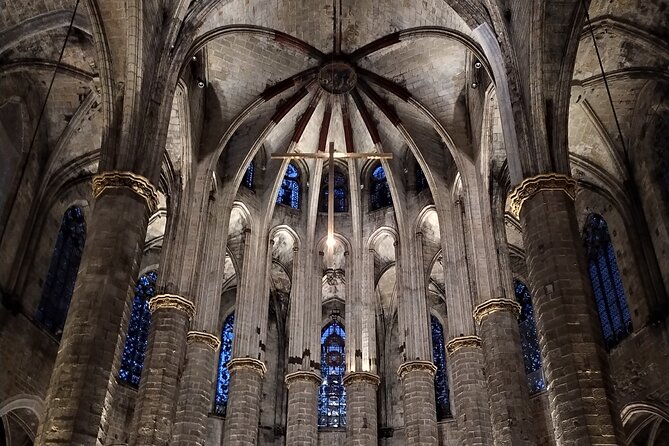
The Basilica of Santa Maria del Mar receives about 10 minutes. It is described as Barcelona’s most loved church, and its importance to El Born is easy to understand from its position in the neighborhood.
The tour’s listed stop is free, but the information provided does not promise an interior visit or a special admission arrangement. Plan on learning about the basilica as part of the walk rather than assuming you will have a long, quiet look inside.
This brief stop works best as a piece of the neighborhood story. After hearing about medieval El Born and La Ribera, you can place the church within the area rather than seeing it as a separate attraction. If you want more time inside, plan a return visit after the tour.
Fossar de les Moreres and Catalan political memory
Fossar de les Moreres is one of the most important stops for understanding the political conflict between Madrid and Barcelona. Luca uses it to explain a difficult part of Catalan history and the emotional weight it still carries.
The stop lasts around 15 minutes and is free. I consider this one of the tour’s strongest moments because it moves beyond architecture. You get a sense of how public places can preserve memory, identity, and political feeling.
This subject may not suit someone looking only for light sightseeing. For most people interested in Barcelona, though, it adds essential context. The city’s regional pride is not just a present-day slogan. It is tied to long conflicts, losses, and arguments over power.
Passeig del Born and the tour’s final turn
The final stop is Passeig del Born, a medieval entertainment square. It is a short five-minute stop, but it gives the tour a neat ending in the center of El Born.
The route ends at El Born Centre de Cultura i Memòria, inside the former Mercat del Born at Plaça Comercial, 12. This is a practical finish. You are left in an area where you can continue exploring, find a meal, or make your way toward other parts of the city.
The endpoint is not the same as the starting point, so do not plan to collect anything from the starting location afterward. The walk begins at Placa de Sant Jaume and ends in El Born, with public transport nearby.
Luca’s style: lively, personal, and very full
The strongest reason to choose this tour is Luca himself. He is energetic, friendly, funny, and deeply interested in Barcelona. He asks questions about where people come from and connects the city’s story to different experiences.
His use of a photo binder is a particularly helpful touch. Old Barcelona has changed so much that a visual comparison can make a historical explanation easier to follow. Luca also brings in Catalan and Spanish history, local culture, architecture, and present-day recommendations instead of sticking to a narrow list of dates.
He is willing to answer questions and often checks whether the group wants clarification. His English is described as clear, but he can speak quickly. If you need extra time to process information, tell him at the start and stay near him during the walk.
The food advice is a real bonus. Luca can point you toward places for fish, pizza, ice cream, tapas, coffee, and market food. I would keep your phone ready to note names and locations, since the recommendations may be as useful as the sightseeing for the rest of your stay.
Who should book this walk?
I would choose this tour if you:
- Want a strong first introduction to the Gothic Quarter and El Born
- Care about politics, religion, architecture, and local identity
- Prefer a small group to a large city tour
- Enjoy a guide who talks with energy and gives plenty of background
- Want restaurant and sightseeing suggestions from someone familiar with Barcelona
- Are comfortable walking about three miles and standing outdoors
I would think twice if you have reduced mobility, since the route is not designed for easy access. The tour can be adapted to your pace, and a private experience may be arranged, but that is something to discuss before booking.
I would also choose another style of tour if you want long visits inside churches, museums, or monuments. This is an outdoor walking experience, and the cathedral entry is not included. Its strength is the connection between places, not extended time at one attraction.
At $13.27, the cost is easy to justify if you use the tour as your orientation to the old city. You get a professional English-speaking guide, a compact group, about two hours and 15 minutes of context, and practical ideas for the days ahead. The main price you pay is attention: Luca covers a lot.
Booking advice and final verdict
This is a good first-day or first-morning choice, especially if Barcelona is new to you. Start with an open schedule afterward so you can follow up on a square, church, market, or restaurant that catches your interest.
The tour has a 4.9 rating from 66 reviews, with 98 percent of customers recommending it. Those figures support the practical impression here: Luca’s passion and command of the subject are the main draw, while heat, walking distance, and a fast flow of information are the real cautions.
I would book it if you want Barcelona explained rather than merely photographed. You will see famous sights, but the better reward is learning why the old streets matter. If you prefer a slow architectural tour or a museum-heavy visit, choose something else. For a lively, personal introduction to Gothic Barcelona and El Born at a low price, this is an easy pick.
FAQ
How long does Luca’s Hidden Old Barcelona tour last?
The tour lasts approximately 2 hours and 15 minutes.
How much does the tour cost?
The listed price is $13.27 per person.
What language is the tour offered in?
The tour is offered in English.
Where does the tour start?
It starts at Pl. de Sant Jaume, 3, Ciutat Vella, 08002 Barcelona, Spain.
Where does the tour finish?
The tour ends at El Born Centre de Cultura i Memòria, Mercat del Born, Plaça Comercial, 12, Ciutat Vella, 08003 Barcelona, Spain.
What places are included on the route?
The route includes Placa de Sant Jaume, MUHBA Temple d’August, the exterior of Barcelona Cathedral, MUHBA El Call, Esglesia de Sant Felip Neri, El Born and La Ribera, Basilica de Santa Maria del Mar, El Fossar de les Moreres, and Passeig del Born.
Is admission to Barcelona Cathedral included?
No. The tour explores the outside of the cathedral, and the admission ticket is not included.
How large is the group?
The tour has a maximum of 15 participants.
Is the tour suitable for people with reduced mobility?
The tour is not specifically suitable for people with reduced mobility. The route can be adapted to an individual pace, and a private experience may be arranged. Service animals are allowed, and the tour is near public transportation.
Can I cancel for a full refund?
Yes. You can cancel at least 24 hours before the experience’s start time for a full refund. Cancellations or changes made less than 24 hours before the start time are not accepted for a refund.
Just added around Barcelona
- GoCar Full Day Tour★ 4.0 · 6 reviews
- Sagrada Familia and Barcelona Highlights: Private Guided 4-Hour Driving Tour★ 5.0 · 6 reviews
- Barcelona: Highlights & Gems Private Tour with Tapa & Drink★ 3.9 · 6 reviews
- Gothic Quarter and Born District: Photographic Workshop★ 5.0 · 6 reviews
- Gobbi Yacht Rental in Barcelona 9 Pax 2/4/8hs★ 5.0 · 6 reviews
- Barcelona: Gothic Quarter & La Sagrada Familia Private Tour★ 4.9 · 6 reviews
- Private Sailboat Ride at Sunset from Sitges★ 5.0 · 6 reviews
- Barcelona: Private Tour of Casa Batllo with Reserved Access★ 3.5 · 6 reviews
Gothic Quarter Walking Tours, compared.
Barcelona in 1 Day: Sagrada Familia, Park Guell,Old Town & Pickup
Read our review →
Barcelona all included: Sagrada, Park Güell, Montjuic & Gothic
Read our review →
Sagrada Familia, Modernism, and Old Town Tour
Read our review →
Barcelona Gothic Quarter Tapas & Taverns Food & Wine Tour
Read our review →
Gothic Quarter Ghosts and Legends Walking Tour
Read our review →
Barcelona Helicopter, Sailboat & Old Town Private Walking Tour
Read our review →
Barcelona Old Town & Gothic Quarter Small Group Tour
Read our review →Browse the lists this tour appears in