
Reviewed · GOTHIC QUARTER WALKING TOURS
The Timeless Beauty of Barcelona’s Gothic and Born Quarters
Barcelona’s oldest streets tell their stories in layers: Roman columns sit beside medieval churches, wartime scars remain on quiet squares, and narrow lanes open into El Born’s cafés and artisan shops. This two-hour walking tour links those pieces with stories about Santa Eulalia, Sant Jordi, Wilfred the Hairy, and the famously odd el Caganer.
I especially like the route’s mix of major sights and less obvious corners, and I like that the guide connects monuments to Catalan culture and politics, rather than treating the Gothic Quarter as a museum set. The main drawback is the brisk pace. The route covers a lot, and one past booking was reportedly cut to 90 minutes, so you should confirm the start time and speak up if the group is moving too fast.
In This Review
- Key points to know
- A Roman beginning at Plaça de Sant Jaume
- Narrow lanes and the ancient synagogue
- Plaça de Sant Felip Neri and the scars of war
- The Bishop’s Bridge and the Temple of Augustus
- Barcelona Cathedral and the old royal center
- From the Gothic Quarter into El Born
- Santa Maria del Mar, the people’s church
- What the guide brings to the walk
- Pace, comfort, and practical planning
- Is $14 a fair price?
- Who should choose this Barcelona walk?
- Should you book it?
- FAQ
- How long does the walking tour last?
- What language is the tour in?
- Where does the tour begin?
- Where does the tour finish?
- Which main areas does the route cover?
- Which historic sights are included?
- Is the tour suitable for wheelchair users?
- What should I bring?
- Are food and drinks included?
Key points to know
- Roman Barcelona appears beneath the medieval streets: See the Temple of Augustus and learn about ancient Barcino.
- The old Jewish Quarter adds a quieter layer: Visit the ancient synagogue and hear about one of Europe’s oldest Jewish places of worship.
- Plaça de Sant Felip Neri carries painful civil-war history: The square offers a sober pause amid the Gothic lanes.
- Santa Maria del Mar is the grand finish: The church, also called the Cathedral of the Sea, is the tour’s final stop.
- The guide is a one-person operation: Luca BCN says the same experienced guide leads every walk, in English.
- The route suits curious walkers: Expect narrow streets, uneven historic paving, and no wheelchair access.
A Roman beginning at Plaça de Sant Jaume
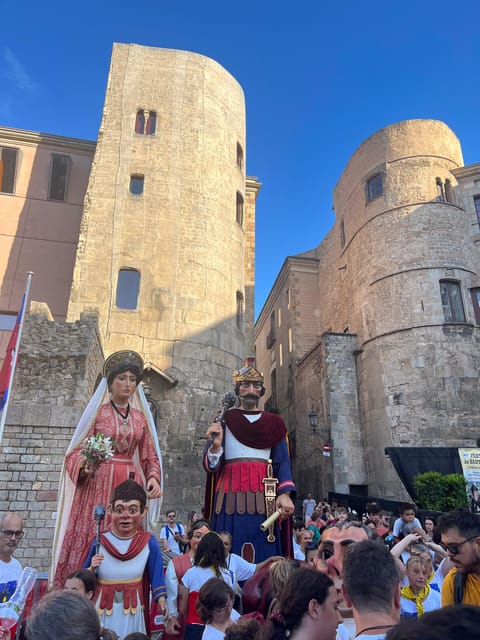
You meet in front of Starbucks at Plaça de Sant Jaume, a central square in the Gothic Quarter. This is a practical starting point because the tour begins among Barcelona’s civic and historic landmarks, not at a remote meeting point that costs you extra time to reach.
From here, your guide leads you through the old center toward the remains of Barcino, the Roman settlement that became Barcelona. The city does not present its ancient past in one tidy archaeological park. Instead, pieces appear between later buildings, which makes the walk useful for understanding how Barcelona grew layer by layer.
I would arrive a few minutes early. Plaça de Sant Jaume is a natural place to meet, but busy city streets can make it harder to spot a guide at the last moment. Keep your phone, wallet, and bag close from the start. Pickpocketing is a known concern in crowded parts of Barcelona.
More Gothic Quarter walks:
- Barcelona in 1 Day: Sagrada Familia, Park Guell,Old Town & Pickup
★ 5.0 · 13,541 reviews - Barcelona all included: Sagrada, Park Güell, Montjuic & Gothic
★ 5.0 · 2,169 reviews - Barcelona: Sagrada Familia, Modernism, and Old Town Tour
★ 4.7 · 1,621 reviews
Narrow lanes and the ancient synagogue
The first section moves through the Gothic Quarter, where medieval-looking lanes twist between old buildings. Locals still live here, and you pass tapas bars, small shops, stone doorways, and gargoyles rather than walking through a preserved set built only for sightseeing.
That everyday setting is part of the appeal. You get a sense of Barcelona as a working neighborhood, though the narrow streets can be crowded and dark in places. They are also not easy for wheelchairs or anyone with serious mobility limits. The historic paving and tight passages are a real part of the route, not a minor footnote.
The ancient synagogue brings the city’s Jewish past into view. This stop helps widen the story beyond Roman and Christian Barcelona, pointing to the former medieval Jewish Quarter and one of Europe’s oldest synagogues. The visit is guided rather than presented as a long museum stop, so expect context and explanation instead of extensive time indoors.
If religious history interests you, listen closely here. The stop is short, listed at about ten minutes, but it gives the Gothic Quarter a more layered character. Barcelona’s past was shaped by several communities, and this is one of the few points on the walk that focuses directly on Jewish life.
Plaça de Sant Felip Neri and the scars of war
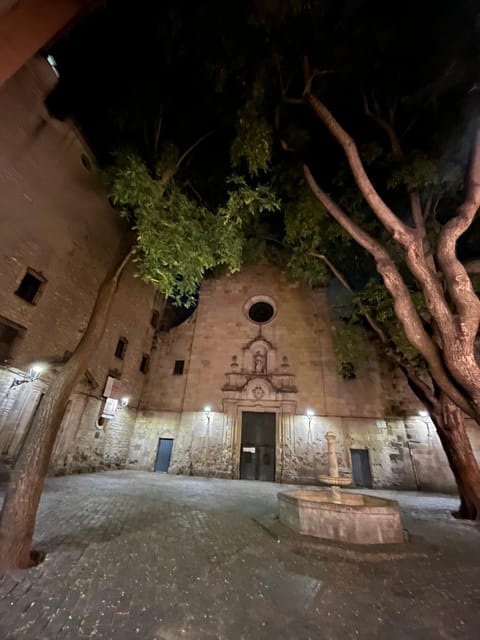
Plaça de Sant Felip Neri is one of the most affecting stops. It is a small square with a quieter mood than the surrounding lanes, and the guide explains Barcelona’s resistance during Franco’s uprising in the Spanish Civil War.
This is where the tour shifts from medieval legend to modern political memory. You are not simply hearing about kings, saints, and Roman foundations. You are also asked to consider how Barcelona experienced violence, resistance, and the long shadow of dictatorship.
The square rewards a slower look, but the scheduled visit is brief. You may want to take photographs, yet this is also a place where a respectful pause matters more than snapping quickly and moving on. The guide’s storytelling is important here, since the physical setting alone will not explain why the square matters.
The Bishop’s Bridge and the Temple of Augustus
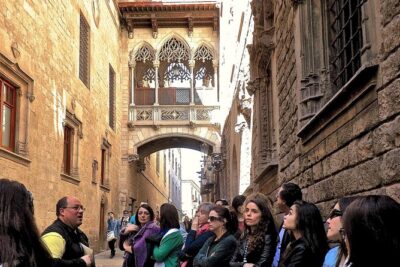
The route then passes beneath or near the Bishop’s Bridge, one of the Gothic Quarter’s most recognizable architectural details. Its ornate design makes it an obvious photography stop, especially when framed against the narrow street and old façades.
You will not get a long architectural lecture at every point. The bridge is allocated only a few minutes, so this part works best as a visual marker within the larger route. Your guide uses it to keep the walk moving while showing how the quarter mixes genuine medieval fabric with later additions.
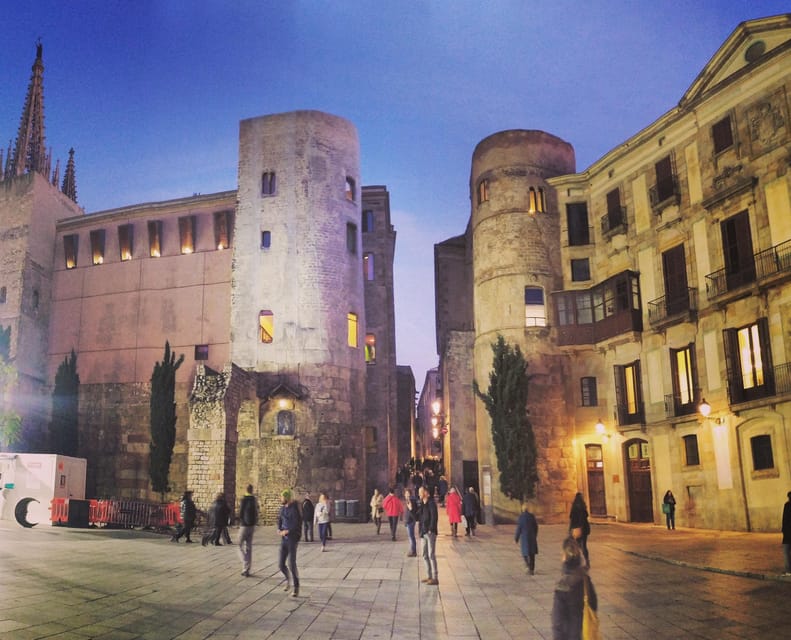
The Temple of Augustus offers a sharper connection to Roman Barcelona. Its surviving columns are easy to miss if you do not know where to look, which is exactly why a guided walk helps. The short stop places modern Barcelona over the footprint of Barcino and gives you a physical reference for the city’s ancient beginning.
I like this contrast: one moment you are looking at a medieval bridge, and minutes later you are standing beside Roman remains tucked into the old quarter. At $14 per person, those small discoveries form much of the tour’s value. You are paying for orientation and interpretation, not admission to a long list of separate attractions.
A few more Barcelona options worth an hour of your trip
- Barcelona: Park Güell Admission Ticket
★ 4.4 · 76,534 reviews - Barcelona: Casa Batlló Entry with Self-Audioguide Tour
★ 4.7 · 25,359 reviews - Barcelona: 24 or 48-Hour Hop-On Hop-Off Bus Tour
★ 4.4 · 20,872 reviews - Barcelona: Park Guell Guided Tour with Skip The Line Entry
★ 4.7 · 17,563 reviews
Barcelona Cathedral and the old royal center
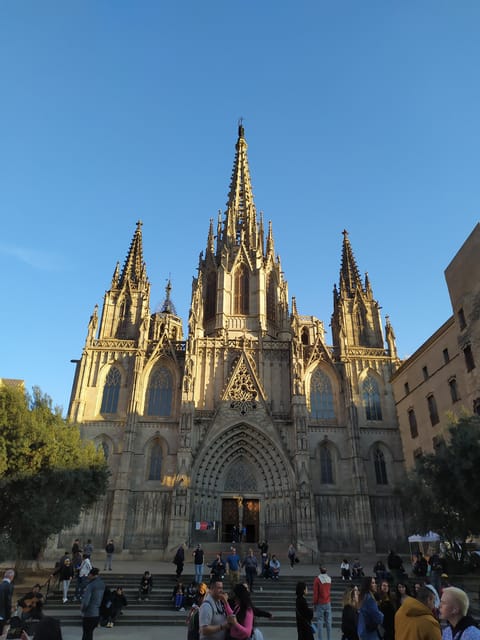
Barcelona Cathedral is the next major landmark. Its scale and detail provide a change from the close, winding streets, and the guide explains its role in the city’s religious and civic life.
The stop is planned for about ten minutes, so do not expect a full interior tour or a quiet architectural study. The route is designed to give you a strong introduction, then carry you onward. If the cathedral is high on your personal list, plan a separate visit when you can set your own pace.
The walk continues toward Palau Reial Major, the former royal center. This part of the route helps explain how Barcelona’s religious buildings, public squares, and royal power fit together. You hear stories about the city’s heroes and legends, including Santa Eulalia, Sant Jordi, and Wilfred the Hairy.
The inclusion of el Caganer adds a very different note. This traditional Catalan figure, often found in nativity scenes, reflects the local taste for humor and irreverence. It is a small cultural detail, but it helps you see that Catalan identity is not presented only through solemn monuments. The guide also discusses passions and peculiarities that distinguish Catalonia from the rest of Spain.
From the Gothic Quarter into El Born
The route gradually leaves the Gothic Quarter and enters Barri de la Ribera, the area associated with El Born. This change is easy to feel. The streets open into a district known for small artisan shops, bars, and restaurants, giving the second half of the walk a more relaxed, neighborhood feel.
I like the route’s structure because it does not stop with medieval architecture. El Born lets you see how an old quarter functions today. You get a chance to note places you might return to later for food or a drink, although meals and drinks are not included in the tour.
The guide continues to connect the streets with Barcelona’s past rather than turning the final section into a shopping walk. The emphasis remains on local customs, historic meeting places, and the way the old city has changed. Since the entire experience lasts only two hours, you should think of El Born as an introduction, not a full district tour.
This is also a good point to manage your expectations. The route includes many stops, but several are short, usually five or ten minutes. You will see more places than you could study in depth. That suits you if you want a broad first look at the old center. It may feel rushed if you prefer long explanations or extended time inside churches.
Santa Maria del Mar, the people’s church
The final stop is the Basilica of Santa Maria del Mar, known as the Cathedral of the Sea. It is one of the most memorable buildings in El Born and gives the walk a fitting finish.
The church is associated with Barcelona’s medieval working population, and the guide presents it as a spiritual temple of the people dating from the fourteenth century. Its modern fame has also grown through books and Netflix, which may be familiar to anyone who has encountered stories set in medieval Barcelona.
The tour ends here, rather than returning you to Plaça de Sant Jaume. That matters for planning. You can continue exploring El Born, stop for food, or make your way elsewhere from the eastern side of the old center. Hotel pickup and drop-off are not provided, so you handle your own transport before and after the walk.
Since the church is the finish, you may want to decide in advance if you hope to go inside at greater length. The guided stop is listed at about five minutes. That is enough to understand why the basilica matters, but not enough for an unhurried visit.
What the guide brings to the walk
This experience is run as a one-person operation by Luca BCN. The guide describes more than 20 years of leading tours in Italy, London, Berlin, and Barcelona, with past subjects ranging from the Berlin Wall and the wives of Henry VIII to Michelangelo and Gaudí.
That background suggests a guide who enjoys connecting places across Europe, although the Barcelona route itself remains the focus. The guide also places strong emphasis on books and storytelling. In practical terms, you should expect a talk-led walk, with history, legends, and cultural explanation filling the spaces between sights.
The strongest part of the feedback available for this experience concerns the amount and clarity of information. Several recent five-star comments, translated from Spanish and French, praised the breadth and usefulness of the explanations and the guide’s effort to make sure everyone understood.
There is also a clear caution. One German-language assessment described the presentation as loud, focused on too few highlights, and missing important details. It also reported a tour lasting 90 minutes instead of the advertised two hours. That is not a reason to reject the experience outright, but it is a reason to keep an eye on the clock and politely ask questions if the route feels shortened.
Pace, comfort, and practical planning
Two hours sounds modest, but this is a busy walking route. You move through the Gothic Quarter, the old Jewish area, Plaça de Sant Felip Neri, the Bishop’s Bridge, Roman remains, the cathedral area, Palau Reial Major, Ribera, El Born, and Santa Maria del Mar.
Wear comfortable shoes. Historic streets can be uneven, and the route includes a moderate amount of walking. The tour is not suitable for wheelchair users or people with mobility impairments because of the narrow streets and old surfaces.
Barcelona can be hot, so carry water and sunscreen. For cooler or rainy weather, bring a jacket or umbrella. Photography is encouraged, and the route offers plenty of striking details, from Roman columns to medieval stonework and small squares.
The tour is in English. If English is not your first language, the guide’s effort to check that everyone understands is useful, but the amount of history packed into two hours can still be demanding. Stand where you can hear clearly, especially in narrow streets where outside noise may bounce between the buildings.
Is $14 a fair price?
At $14, this is an inexpensive way to get a first orientation to Barcelona’s oldest center. The price includes the local guide and the walking tour, but not food, drinks, hotel transport, or separate admission costs.
The value comes from the route’s range. In one short outing, you connect Roman Barcino, medieval religious life, the Jewish Quarter, civil-war memory, Catalan legends, royal history, and the modern El Born district. Paying separately for a guide with this route would usually cost more, though the short format means you should not expect a private, slow-paced lesson at every monument.
I would book it early in a Barcelona visit, not at the end. The walk gives you useful bearings and may point you toward places you want to revisit, especially Santa Maria del Mar, the cathedral, or El Born’s restaurants. If you already know the Gothic Quarter well, the brief stops may feel less rewarding unless the guide’s historical storytelling is your main reason for going.
Free cancellation up to 24 hours before the start and the option to reserve now and pay later make the booking less rigid. Those policies are useful if your schedule is still shifting, but they do not change the need to arrive ready for a continuous walk.
Who should choose this Barcelona walk?
I would choose this tour if you want a compact introduction to old Barcelona and prefer stories to a list of isolated monuments. It is a good match for first-time visitors, history fans, photographers, and anyone curious about Catalan identity.
It also suits you if you enjoy seeing a city through several eras in one outing. The route does not treat Barcelona as only Roman, only medieval, or only Gaudí-inspired. It gives each period a place, even when the time at each stop is short.
I would look elsewhere if you need step-free access, dislike walking on old streets, or want extended time inside churches and historic buildings. I would also choose a slower format if you prefer a small, quiet tour with long pauses for questions.
Should you book it?
Book this $14 walk if you want a lively, information-heavy introduction to the Gothic Quarter and El Born, especially if Catalan legends, Roman remains, Jewish history, and civil-war memory all interest you. The guide’s clear explanations and effort to make the history understandable are the main reasons to consider it.
Go in with realistic expectations. This is a brisk overview, not a two-hour visit inside every landmark, and the reported shortened tour makes it wise to confirm that the full time is being delivered. Wear good shoes, guard your belongings, and save Santa Maria del Mar and any cathedral interiors for a longer independent visit if you want more than a quick look.
FAQ
How long does the walking tour last?
The advertised duration is two hours. One past booking reported a 90-minute tour, so you should confirm the timing and ask the guide if the walk appears to be ending early.
What language is the tour in?
The live tour is conducted in English.
Where does the tour begin?
The meeting point is in front of Starbucks at Plaça de Sant Jaume, 3, in Barcelona.
Where does the tour finish?
The tour ends at the Basilica of Santa Maria del Mar in El Born.
Which main areas does the route cover?
It covers Barcelona’s Gothic Quarter, the former Jewish Quarter, Barri de la Ribera, and El Born.
Which historic sights are included?
The route includes the ancient synagogue, Plaça de Sant Felip Neri, the Bishop’s Bridge, the Temple of Augustus, Barcelona Cathedral, Palau Reial Major, and Santa Maria del Mar.
Is the tour suitable for wheelchair users?
No. The tour is not suitable for wheelchair users or people with mobility impairments because the Gothic Quarter has narrow historic streets.
What should I bring?
Bring comfortable walking shoes, water, sunscreen, and a camera. A jacket or umbrella is useful in cooler or rainy weather.
Are food and drinks included?
No. Food and drinks are not included, and the tour does not include hotel pickup or drop-off.
Just added around Barcelona
- GoCar Full Day Tour★ 4.0 · 6 reviews
- Sagrada Familia and Barcelona Highlights: Private Guided 4-Hour Driving Tour★ 5.0 · 6 reviews
- Barcelona: Highlights & Gems Private Tour with Tapa & Drink★ 3.9 · 6 reviews
- Gothic Quarter and Born District: Photographic Workshop★ 5.0 · 6 reviews
- Gobbi Yacht Rental in Barcelona 9 Pax 2/4/8hs★ 5.0 · 6 reviews
- Barcelona: Gothic Quarter & La Sagrada Familia Private Tour★ 4.9 · 6 reviews
- Private Sailboat Ride at Sunset from Sitges★ 5.0 · 6 reviews
- Barcelona: Private Tour of Casa Batllo with Reserved Access★ 3.5 · 6 reviews
Gothic Quarter Walking Tours, compared.
Barcelona in 1 Day: Sagrada Familia, Park Guell,Old Town & Pickup
Read our review →
Barcelona all included: Sagrada, Park Güell, Montjuic & Gothic
Read our review →
Sagrada Familia, Modernism, and Old Town Tour
Read our review →
Barcelona Gothic Quarter Tapas & Taverns Food & Wine Tour
Read our review →
Gothic Quarter Ghosts and Legends Walking Tour
Read our review →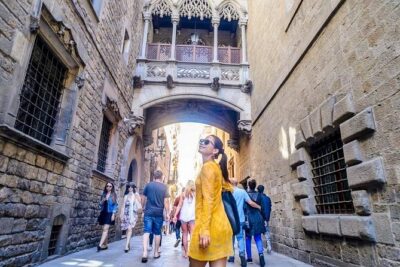
Barcelona Helicopter, Sailboat & Old Town Private Walking Tour
Read our review →
Barcelona Old Town & Gothic Quarter Small Group Tour
Read our review →Browse the lists this tour appears in